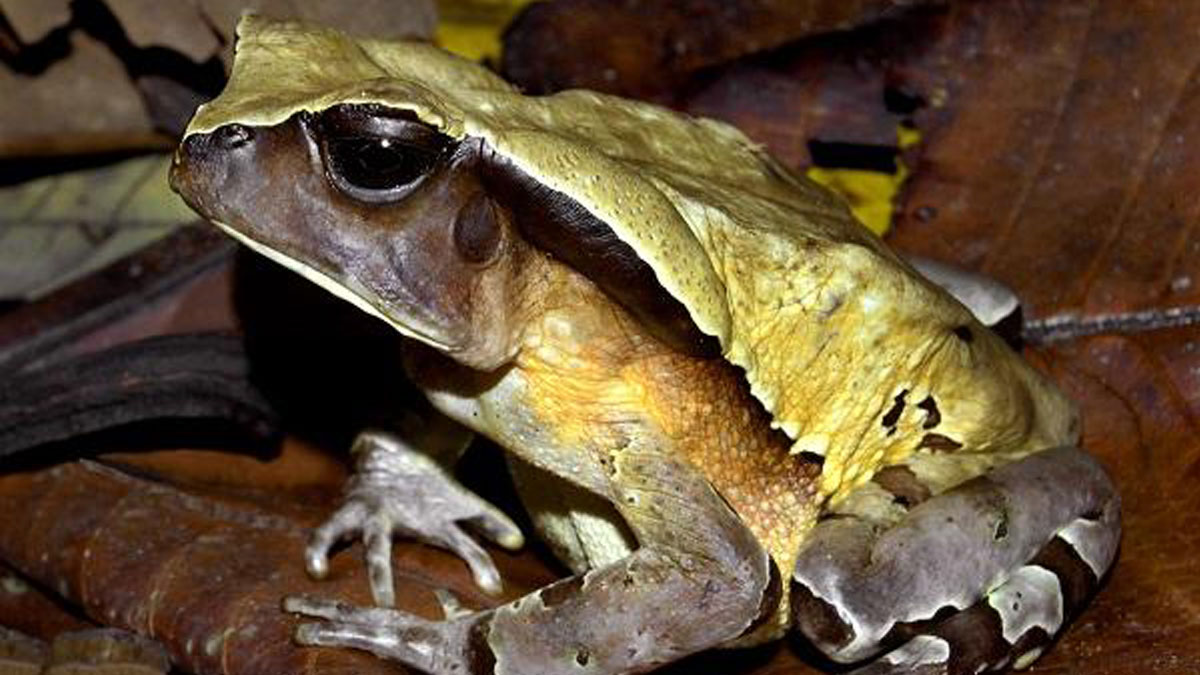
Sharing its tropical habitat with one of Africa’s most formidable snakes, the Congolese giant toad has learned to mimic the venomous reptile in order to deter its predators. A tactic that has clearly paid off.
The first Batesian mimicry case in an amphibian
Mimicry is observed in many animals. For instance, there is a mantis species that disguises itself as an orchid to avoid predators and lure prey, while the burrowing owl has learned to imitate the rattlesnake’s threatening hiss to scare away invading squirrels from its habitat. In studies published in the Journal of Natural History, researchers observed for the first time its Batesian form, when a harmless species imitates the appearance and behavior of a dangerous creature to foil its predators, in an amphibian.
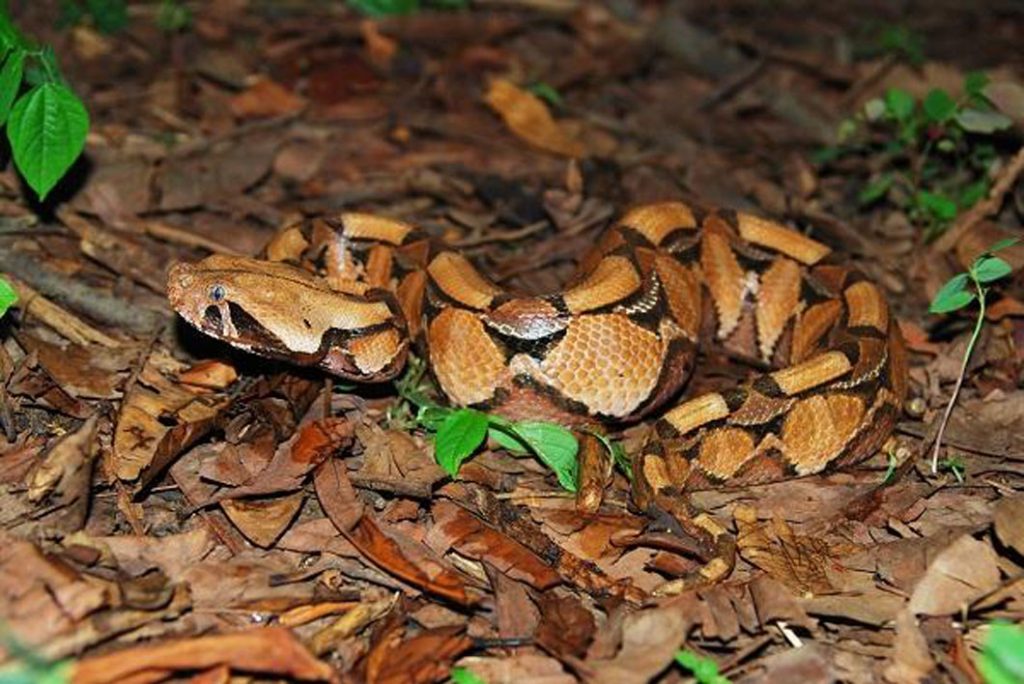
Measuring more than 1.8 meters and weighing up to 20 kilograms, the Gaboon viper is the largest member of its species on the African continent. This highly venomous reptile shares a habitat with the Congolese giant toad in the humid tropical forests of the Democratic Republic of the Congo, and it turns out that the close resemblance the amphibian cultivates with the reptile is the key to its survival. The researchers indeed found that predators tended to avoid it more than other species, despite its size and fleshy appearance, which would ordinarily make it an easy prey.
In tawny color, the toad bears two distinctive spots as well as a brown stripe running along its back. Its flanks display a dark brown tint from the snout to the hind limbs, imitating the snake’s gaping mouth, while the presence of slightly raised eyebrows and horn-like features echoes the reptile’s protrusions. But the imitation doesn’t stop there: the toad also reproduces the viper’s hiss (resembling the sound of a deflating balloon), and it intensifies when threatened to appear even more formidable.
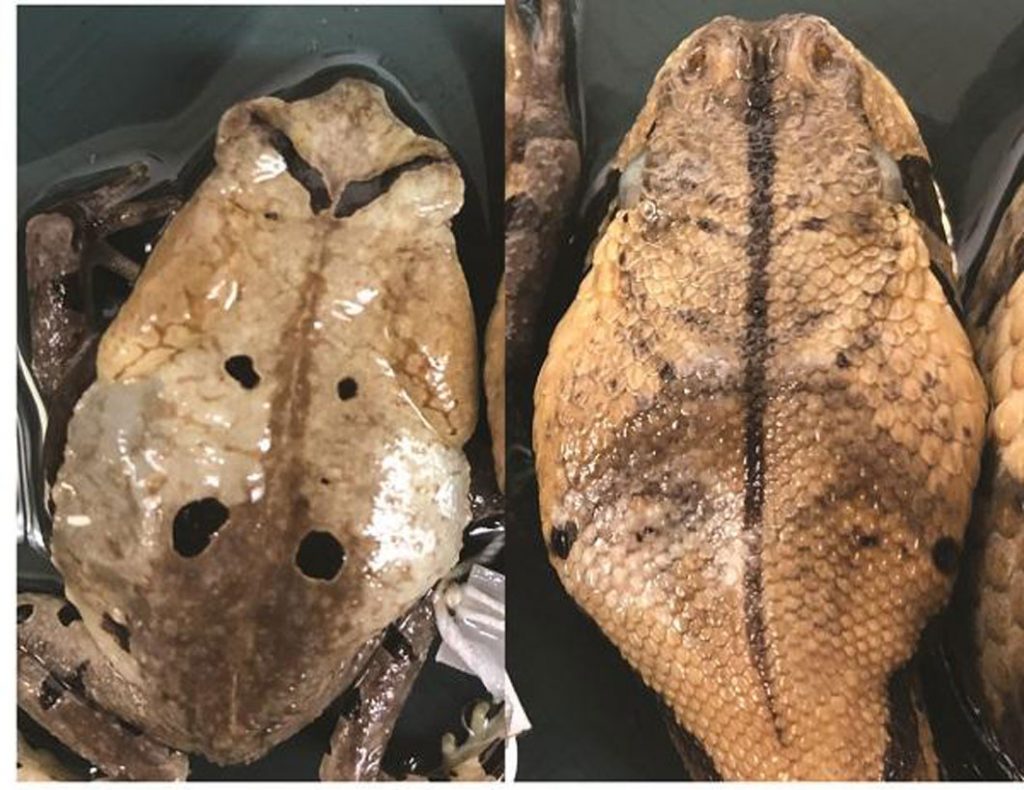
A fairly convincing camouflage
“From above, the toad makes a convincing viper,” notes Eli Greenbaum, a researcher at the University of Texas in El Paso and the study’s lead author. “It isn’t a perfect imitation, but when the model proves as venomous and feared as Gaboon vipers can be, predators are generally unable to tell them apart.”
The authors of the study note that numerous species, especially primates that share the habitat of this formidable African serpent, have an innate fear of it. Consequently, they argue that they might instinctively avoid the amphibian, although the work completed so far has not definitively confirmed this.
Another fascinating mimicry case: an Indonesian octopus capable of imitating as many as 15 different species.

Contact details
Address:
Farmers Forum,
36, Dominick Street,
Mullingar,
Co. Westmeath,
Ireland
Phone:
+353 (0)44 9310206
Or email us:
For technical issues please check out our FAQ's page or email - [email protected]
For general Queries email - [email protected]
Request to add event to our Calendar - [email protected]
Send us your mart reports - [email protected]
Suggestions and feedbacks - [email protected]
News Items / Press Release - [email protected]
To Advertise on Farmers Forum - [email protected]