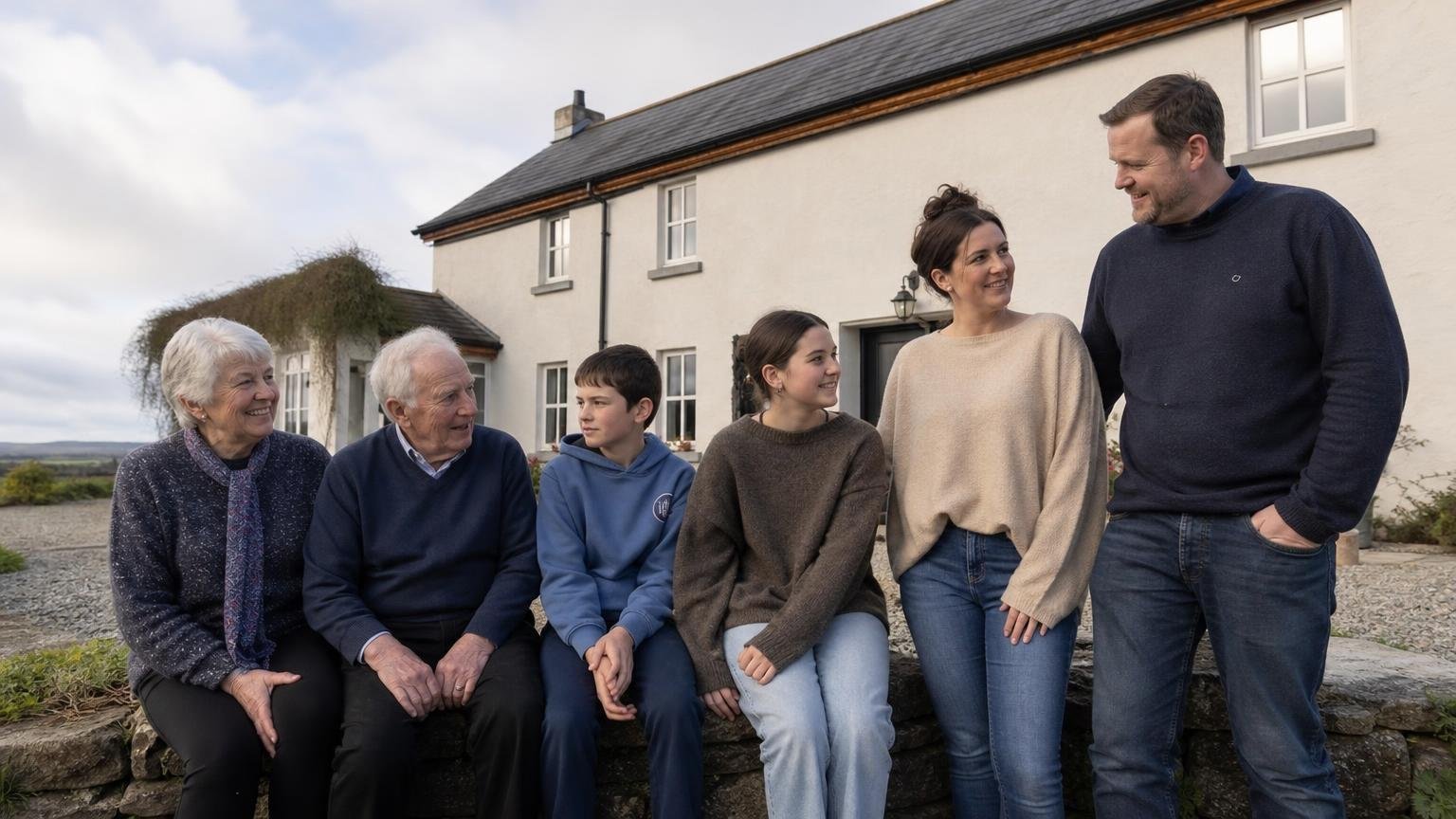
On a wind-bright afternoon in Sligo, a slate-roofed farmhouse hums with layered life. Three generations share walls, but also a rhythm that feels surprisingly light. The kettle hisses, dogs thud past boots, and someone laughs about mud, again.
They didn’t plan a grand experiment, they simply refused a quiet goodbye to distance. “We thought we were mad,” says Siobhán, the middle generation, “but the sums and the heart both agreed.”
A house remade for many lives
The old farmhouse had bones, but the family gave it breath. They stitched on a timber link, opened walls for salted light, and carved privacy where it mattered most. “You need a door you can close, and a view you can share,” the architect warned.
Grandmother Eileen took the sunniest annex, facing hens and hydrangeas. The parents claimed the original core, creaking floors and a stout stove. The twenty-somethings slid into a loft, tucked above the workshop, with a ladder that squeaks on rainy nights.
No maze of corridors, no tyranny of open-plan echoes. Just a series of thresholds that say “come in” or “not now” with equal ease.
Why they said yes
Rents were rising, petrol swallowed weekly wages, and childcare kept devouring sleep. At the same time, the old place leaned, its roof pleading for new hands. So the family pooled savings, signed on for late nights, and learned to live with plaster in their tea.
“Home isn’t a postcard, it’s a practice,” says Tom, the practical uncle, knotting twine with precise fingers. “We traded distance for meaning, and the numbers took care of themselves.”
Boundaries that breathe
Coexistence needs edges, and edges need humor. Early on they sketched three calm rules on a blackboard that still wobbles by the back door:
- Knock with your knuckles, speak with your inside voice, share with your calendar.
They added nothing grand, just a promise to reset and forgive after sleep and tea.
“Silence is a gift, not a punishment,” Aoife says, waving her headphones like a small flag. Eileen counters with her own treaty: “No politics when the scones are hot.”
Designing for peace of mind
Noise travels through old timber, so they stacked quiet over quiet. Bedrooms don’t sit above TVs; doors have soft seals; the laundry wall eats vibration. A small library soaks up sound, paper acting like gentle moss between rooms.
They set work outside the kitchen, because simmering pots and simmering emails make terrible neighbors. Desks look to green fields; the sink frames a cold sky; everyone shares the same horizon.
Work, weather, and small repairs
Sligo’s weather writes the schedule, and everyone reads along. When the rain hammers, they tackle indoor repairs. When sunlight blinks awake, they run for ladders and hedge trimmers.
“Conflict loves idle hands,” Declan jokes, hoisting a guilty bucket. “Give people a task, and grievances dribble away.”
Not every day is a postcard. Someone forgets the henhouse latch, foxes leave clues, tempers drum like a wet roof. Then the kettle sings, and the storm loses interest.
Food as negotiation
Dinners turned into diplomacy, and diplomacy turned into ritual. On Fridays, Eileen makes coddle that tastes like a patient story. On Tuesdays, the young ones experiment, serving noodles with scandalous courage.
“Every plate is an apology or an invitation,” Siobhán laughs, thumbing a smear of chilli from her lip. The table holds grievances, then clears them with hot water and a striped cloth.
Space for solitude
They learned to protect solitude the way farmers protect fences. A bench hides under the ash, sized for one thoughtful body. The loft has a dawn-only window, and the annex keeps an afternoon nap’s good secrets.
Phones go in a wooden bowl at shared meals, less out of virtue than out of mercy. “We’re interesting enough,” Eileen shrugs, buttering bread with crisp efficiency.
The ledger that actually matters
Yes, the bills are lighter, and maintenance spreads like warm butter across many hands. Yes, school pick-ups became possible, and no one panics at a flat tyre.
But the real arithmetic is quieter. A bulb gets changed before it fails. A cough gets noticed before it lingers. A small victory gets witnessed before it can doubt itself.
What the place has taught them
“Love needs corridors, not cages,” Tom says, pointing at the timber link that ties old to new. The house listens softly, boards expanding and settling, as if it, too, learned to share.
They don’t pretend to be saints. Someone will slam a door, someone will cry into a hot tea, someone will laugh at the wrong moment. But the roof holds, and the washing line holds, and the feeling of being held outlasts the day’s dramas.
On clear evenings, Benbulben cuts its shape from a rinsed sky, and the cows write patient sentences across the field. Lights move room to room, like lanterns in an honest story. Nobody has fallen out, because they keep falling back in.

What a lovely well written piece of prose! Interesting and inspiring, it is full of practical suggestions to maintain independent living and respect in a multigenerational home.It is time for our family to revisit the now derelict homestead where we spent many happy childhood holidays just outside Tubbercurry.
What a great thing thing to do.
No one in nursing homes back to the old way of living.
Never being alone in country side.
I have always thought of that idea living with other people in a big old house.
And sow our own vegetables.
What a whole sum wsy of life .