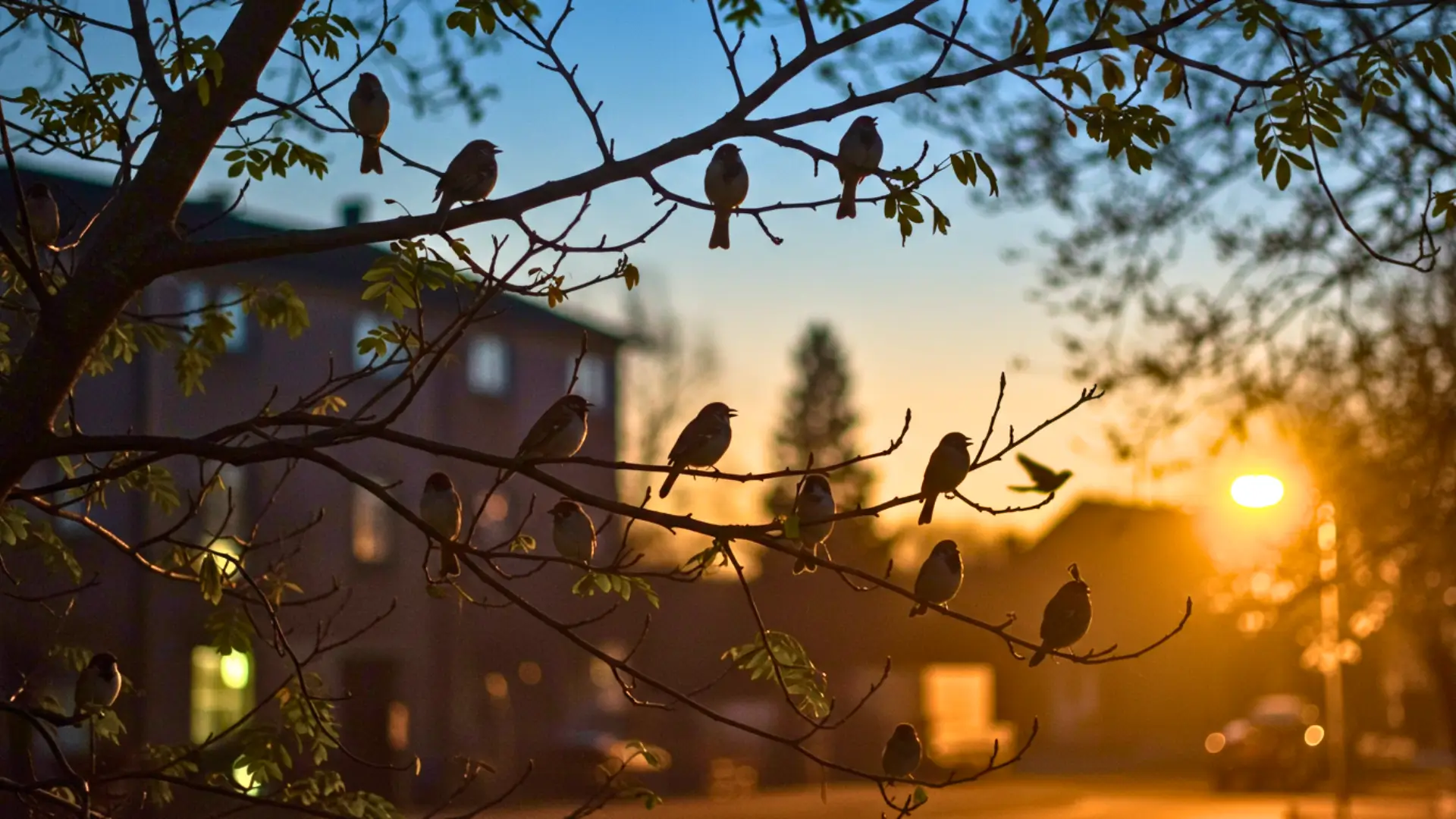
In the fragile hush of dawn, a subtle phenomenon takes hold. Birds sing earlier, longer, as if the night were fading before its time. Behind this shift lies an unexpected yet real factor that is profoundly reshaping their natural rhythms.
Massive recordings reveal an unprecedented extension of daily singing periods
Around the world, acoustic devices continuously record the soundscapes. These tools enable precise detection of when birds begin and stop singing, revealing variations that were previously invisible. Analysis of these data highlights a gradual yet pronounced transformation of the vocal behavior.
In heavily lit areas, birds push forward their first song well before sunrise. This shift is not trivial, as it alters the organization of their entire day. This phenomenon reflects an adaptation to a ubiquitous artificial light, even at the heart of the night.
A ubiquitous light disrupts natural cycles and alters essential biological cues
The night is no longer entirely dark for a large portion of the planet. This permanent light veil acts as a false signal for many species. In birds, it muddles the cues tied to day-night alternation, profoundly affecting their biological clock.
This disruption influences essential functions such as rest, vigilance, and reproduction. By artificially prolonging the active period, nocturnal light imposes an unusual rhythm. Birds must then adjust their behaviors, often at the expense of their physiological balance.
Contrasting effects on energy, reproduction, and interactions among individuals
Extending the duration of singing comes with energy costs. Producing prolonged vocalizations demands substantial resources, especially during sensitive periods such as reproduction. This surplus of activity can lead to increased fatigue and leave some individuals more vulnerable to environmental pressures.
However, this extra time can also offer opportunities. Some birds take advantage of these extended hours to strengthen their territory or improve their chances of attracting a mate. The song becomes a strategic tool in an environment altered by light pollution.
Effects vary by species and lifestyle. Birds in open habitats or with broad ranges appear particularly affected. Their greater exposure to light amplifies the changes observed, revealing a differentiated adaptation in response to this global phenomenon of light pollution.
Reducing nocturnal lighting could limit disturbances and preserve ecological balances
In light of these findings, several avenues are emerging to limit the impact of artificial lighting. Adjusting the intensity and direction of lights could reduce unnecessary glow in the sky. These simple adjustments could lessen the effects of skyglow on wildlife.
The creation of preserved zones where darkness is maintained also appears as a promising solution. These spaces would provide essential refuges for sensitive species. They would help restore conditions close to the natural night, crucial for many biological cycles.
Finally, a collective awareness seems necessary to rethink our use of light. Night-time illumination, often perceived as harmless, is increasingly seen as a major ecological challenge. Reducing its impact could help preserve the richness and diversity of the nocturnal life.

Contact details
Address:
Farmers Forum,
36, Dominick Street,
Mullingar,
Co. Westmeath,
Ireland
Phone:
+353 (0)44 9310206
Or email us:
For technical issues please check out our FAQ's page or email - [email protected]
For general Queries email - [email protected]
Request to add event to our Calendar - [email protected]
Send us your mart reports - [email protected]
Suggestions and feedbacks - [email protected]
News Items / Press Release - [email protected]
To Advertise on Farmers Forum - [email protected]