
Animals can be warm-blooded or cold-blooded. While reptiles bask in the sun to warm up, mammals must feed regularly to maintain their body temperature. But this has not always been the case: thousands of years ago, a small goat stranded on a Mediterranean island with scarce resources became their first (and only) known cold-blooded representative.
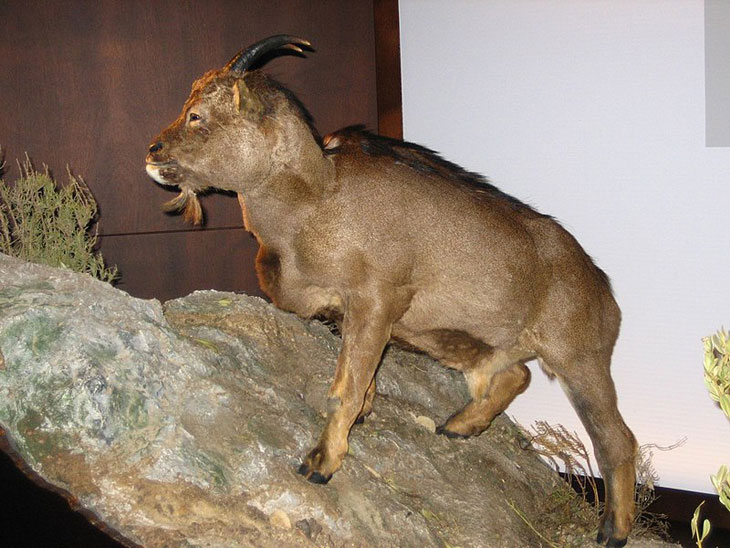
Myotragus balearicus
Originally roaming the territory that connected what are today the Balearic Islands to continental Europe, Myotragus balearicus found itself stranded on the island of Majorca when the island was encircled by the sea. A restricted habitat led to a series of morphological adaptations (shorter limbs, smaller brains and sensory organs) in these creatures.
This prehistoric mammal species, whose individuals did not exceed 45 centimeters in height, was also the first to display bone features typical of reptiles. By examining the remains of the ancient caprin, researchers identified lamellar tissues analogous to those of crocodiles, signaling their capacity to regulate, or even halt completely, their growth depending on available resources.
Further analyses showed that the sexual maturity of M. balearicus occurred around the age of 12 years, compared with less than 12 months for a modern caprid, and suggested that the species also led a much slower and less acrobatic lifestyle than its present-day relatives.
“Myotragus not only reduced its aerobic capacity and behavioral traits, but also flexibly adjusted its growth rates and metabolic needs,” summarized researchers Meike Köhler and Salvador Moyà-Solà in a study published in the journal PNAS in 2009.
An excellent model for study
Among ectothermic species, bones are generally composed of lamellar structures with slow growth. However, fibrolamellar bones with rapid growth, typical of warm-blooded creatures, have also been found in some dinosaurs and birds, hinting at a potential intermediate state.
M. balearicus provides an excellent model for study because it had no natural predators on the island of Majorca. This implies that it developed reptile-like features to cope with resource scarcity, allowing it to endure for about 5.2 million years, roughly half as long as continental species.
Despite these adaptations, the arrival of humans on the island led to the decline of the plant species consumed by these tiny prehistoric herbivores, and they went extinct about a millennium later.

Contact details
Address:
Farmers Forum,
36, Dominick Street,
Mullingar,
Co. Westmeath,
Ireland
Phone:
+353 (0)44 9310206
Or email us:
For technical issues please check out our FAQ's page or email - [email protected]
For general Queries email - [email protected]
Request to add event to our Calendar - [email protected]
Send us your mart reports - [email protected]
Suggestions and feedbacks - [email protected]
News Items / Press Release - [email protected]
To Advertise on Farmers Forum - [email protected]