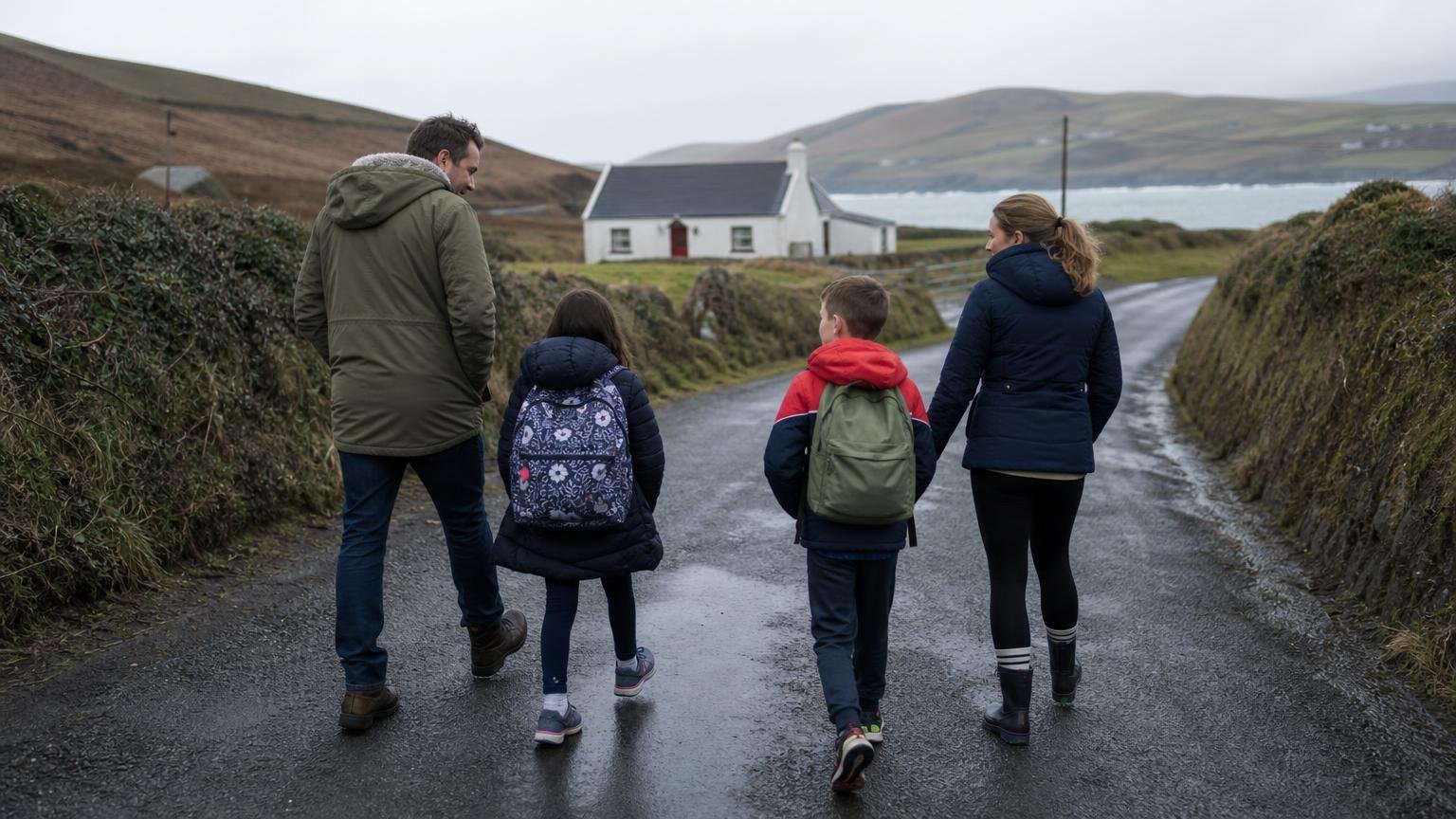
They packed the car with raincoats, lunchboxes, and a stack of readers, and pointed it west. By the time the motorway gave way to bogland and wind-bent hawthorn, the decision felt both reckless and inevitable. A winter by the Atlantic, the kids enrolled for a term in a local Irish-medium school, and the city shed like an old skin.
On the first night, they listened to the gale lean into the gable and the far-off boom of waves, while the woodstove stitched heat into their bones. “It’s not a holiday,” one of them said, “but it might be a different kind of home.”
Why winter, why here
They wanted the quiet, the space, and a bracing reset that only a storm coast can offer. “We kept saying we’d come down in summer, but so does everyone else,” the father said, half laughing, half stubborn. Winter felt truer, all the scaffolding of the place revealed: fishermen mending nets, kids in fluorescent jackets, tractors shouldering by the pier.
They had visited before, but visits skim. To live meant learning where the wind breaks on a lane, and how the light opens suddenly after a week of rain.
School through Irish, life through listening
The kids stepped into classrooms where Irish was not a subject, but the floor beneath every sentence. “At break I asked for a pencil and got three new words,” said their eldest, cheeks flushed. Teachers greeted them with “Fáilte romhaibh,” and the school bell cut through the salt air at nine sharp.
Homework shifted from tidy comprehensions to tense charts, playground games from “Tag!” to “Poc Poc!” Irish lifted out of the copybook and into the kitchen, a short, nightly chorus: “Cén t-am é?” “An féidir liom tae fáil?” Not perfect, but alive.
“It’s not about fluency in twelve weeks,” their mother said. “It’s about giving the kids a muscle for other voices.”
Making a working week on the edge
They both carried laptops, the portable tether to Dublin deadlines. Broadband wobbled when the wind screamed, but most days the calls went through. They learned to stack work between squalls and school runs, to mark the afternoon with a quick walk to the strand and a thermos of strong tea.
“You start to trust the gaps,” he said. “Ten minutes of clear sky is a gift. You move, you breathe, you remember the body is part of the brain.”
The temptation to measure everything against Dublin faded by the third week. A smaller radius, but a wider field of attention.
Weather as a teacher
Storms arrived like arguments, loud and sudden, then softened into days of low silver and rain so fine it felt like a temperature. They learned the names for clouds they used to ignore, and the hiss of blown sand across tarmac. On clear nights, Orion stood over Mount Brandon like a patient chaperone.
Winter’s palette turned the kids into noticers. “The sea looks angry, then it goes kind of sleepy,” the younger one said, cracking seaweed with boots and pronouncing the wrack “green spaghetti.”
The local map is made of people
In the shop they were told the milk would be in “anois go luath,” and they waited, and it was. A neighbour with a collie gave them turf the colour of old tea. Someone else advised the best corner for a stormwatch, another marked the safe cut through a flooded field.
“It’s different being the blow-ins when there are so few blow-ins,” their mother said. “Every hello is a decision, and most are generous.”
One night they found themselves in a session, not tourist-tight but a Thursday in February, the room full of steam and fiddle. A set danced itself into being, clapping was the only currency, and Irish threshed the air like a banner.
Small routines, big dividends
Their days began to rhyme. They left space for weather, for school, for work, for the ordinary care of meals and wet gear. They wrote it down so they wouldn’t overfill it:
- Quick sea look, school drop, emails and tea, shop for bread, a hill in the calm, collect and chat, homework-as-Gaelge, fire lit, the night long and kind.
None of it was exotic, which turned out to be the point. The kids tucked new sounds into their pockets, and the adults learned how to stay still without feeling stuck.
What the kids said out loud
“I like when people start in Irish and don’t switch to English for me,” said the eldest. “It feels like a game I can actually play.”
“I made a friend who says I talk fast, and now I don’t,” said the youngest, “because I have to find the word before I lose the thought.”
Their parents heard the same music, softer and more stubborn each day. Language as a threshold, not a test.
Going back, carrying forward
They know they will return east in the spring, back to commutes and midweek deliveries, back to pedestrian crossings that answer when you press. But the edge of the county did its work.
They will bring a handful of words, a pace, the memory of a coastline that keeps talking whether you answer or not. “We came for the kids’ Irish,” the father said, “but we stayed for the winter’s honesty.” And the mother added, “Sometimes you must shrink your world to hear it better.”

Contact details
Address:
Farmers Forum,
36, Dominick Street,
Mullingar,
Co. Westmeath,
Ireland
Phone:
+353 (0)44 9310206
Or email us:
For technical issues please check out our FAQ's page or email - [email protected]
For general Queries email - [email protected]
Request to add event to our Calendar - [email protected]
Send us your mart reports - [email protected]
Suggestions and feedbacks - [email protected]
News Items / Press Release - [email protected]
To Advertise on Farmers Forum - [email protected]