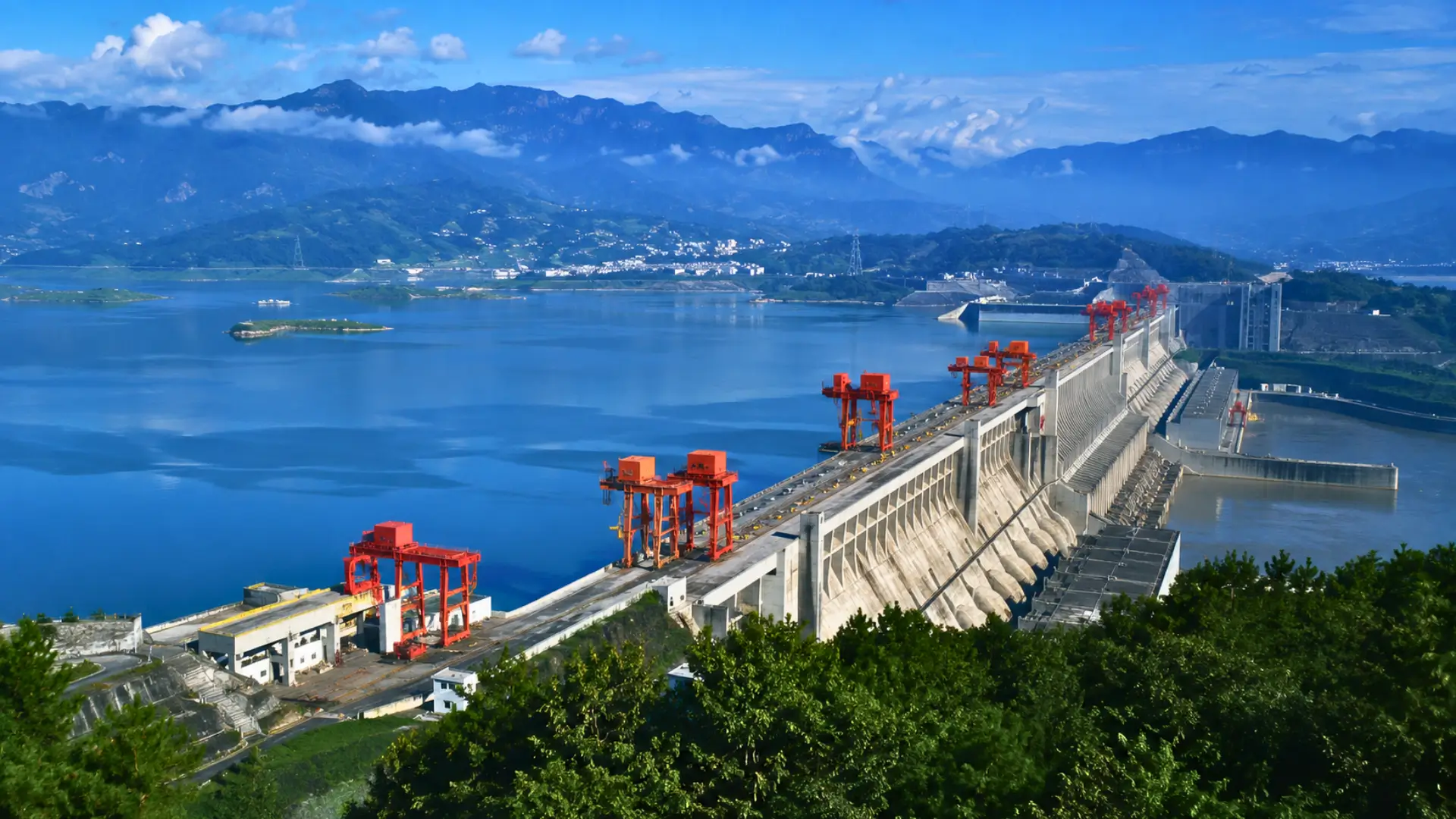
Forty billion tonnes of water held back behind a concrete wall—could they really alter the rotation of a planet? The Three Gorges Dam in China offers a staggering answer: yes, a little. And this almost nothing actually tells a great deal about the place humanity occupies on Earth.
The Three Gorges Dam has left a measurable trace on the Earth’s rotation
On the surface, the Three Gorges Dam belongs to the well-known realm of megaconstructions. 2,335 meters long, a gigantic reservoir, an electricity output beyond the ordinary. Yet, behind this image of titanic engineering lies a detail that immediately unsettles: its filling was enough to alter, very slightly, the rotation of the Earth itself.
This result is neither myth nor fevered media hype. In 2005, geophysicists Benjamin Fong Chao and Richard Gross, affiliated with NASA, estimated that the 40 cubic kilometers of water stored in the reservoir could lengthen the length of a day by 0.06 microseconds. A tiny duration, of course, but calculated, measurable, and above all profoundly symbolic.
Behind this minute figure lies a very simple idea. When a mass is moved farther from the axis of rotation, it slows the overall spin a little. It is the classic image of the schoolbook illustration of a figure skater opening their arms. With the Three Gorges, this textbook image suddenly becomes a story of concrete, water, and planet.
Shifting a mass of water is enough to slightly slow the Earth
The dam did not create new water. It chiefly relocated a colossal mass to a higher altitude, around 175 meters above its initial level. In physics, this simple redistribution is enough to increase the Earth’s moment of inertia. The planet then rotates a hair more slowly, like an object whose weight is distributed outward.
The effect does not stop there. The calculations tied to filling the reservoir also suggest a shift of the rotation axis by about 2 centimeters. On human scales, it is almost nothing. On the scale of a planet measuring 12,700 kilometers in diameter, it is a striking reminder: even the most terrestrial, technical gestures can leave a geophysical signature.
This is what is unsettling: not the raw magnitude of the phenomenon, but its meaning. 0.06 microseconds will never alter an alarm clock, a calendar, or an orbit. Yet this figure acts as a reveal. It shows that human activity no longer merely reshapes landscapes: it now influences the globe’s most fundamental physical parameters.
Dams and groundwater also shift the globe’s physical balance
The Chinese dam remains the most dramatic example for illustrating this mechanism, but it is no longer an isolated case. A study published in 2025 in Geophysical Research Letters shows that the cumulative effect of reservoirs created by dams around the world has contributed to moving the distribution of land masses on a planetary scale. The signal from a single site is subtle; the sum becomes captivating.
Another perhaps even more striking shock: groundwater pumped by agriculture and urban use. A study published in 2023 in Geophysical Research Letters linked the extraction of about 2,150 gigatons of groundwater between 1993 and 2010 to a shift of the Earth’s pole by roughly 80 centimeters toward the east. In other words, drawing water from beneath the fields ends up touching the planet’s geometry as well.
These works redraw the mental map. The Three Gorges Dam no longer appears as a mere curiosity. It is the legible symptom of a broader tipping point. Dams, pumping, water redistribution, land appropriation: all of this forms a diffuse force, less spectacular than an earthquake, but enduring and global.
Melting ice and dams tell the same geophysical tilt
Recently, researchers have begun looking beyond dams and aquifers to also consider the impact of ice melt on the Earth’s rotation. A study published in 2024 in PNAS shows that the transfer of water from polar regions toward the oceans, especially toward lower latitudes, also lengthens the day. The parallel with the Three Gorges becomes striking.
In one scenario, a dam concentrates water behind a wall. In the other, climate warming redistributes it on the scale of the planet. Nature retains the upper hand, of course: the 2004 Sumatra earthquake had a stronger effect. But now, human activities enter the same frame as tides, ice, and earthquakes.

Challenging Mother Nature’s perfection is going to alter how things are meant to be on our beautiful planet, which is a blight on Mankind’s ability to live harmoniously with her.
World wide soil erosion must have an opposite effect. Has this been estimated?