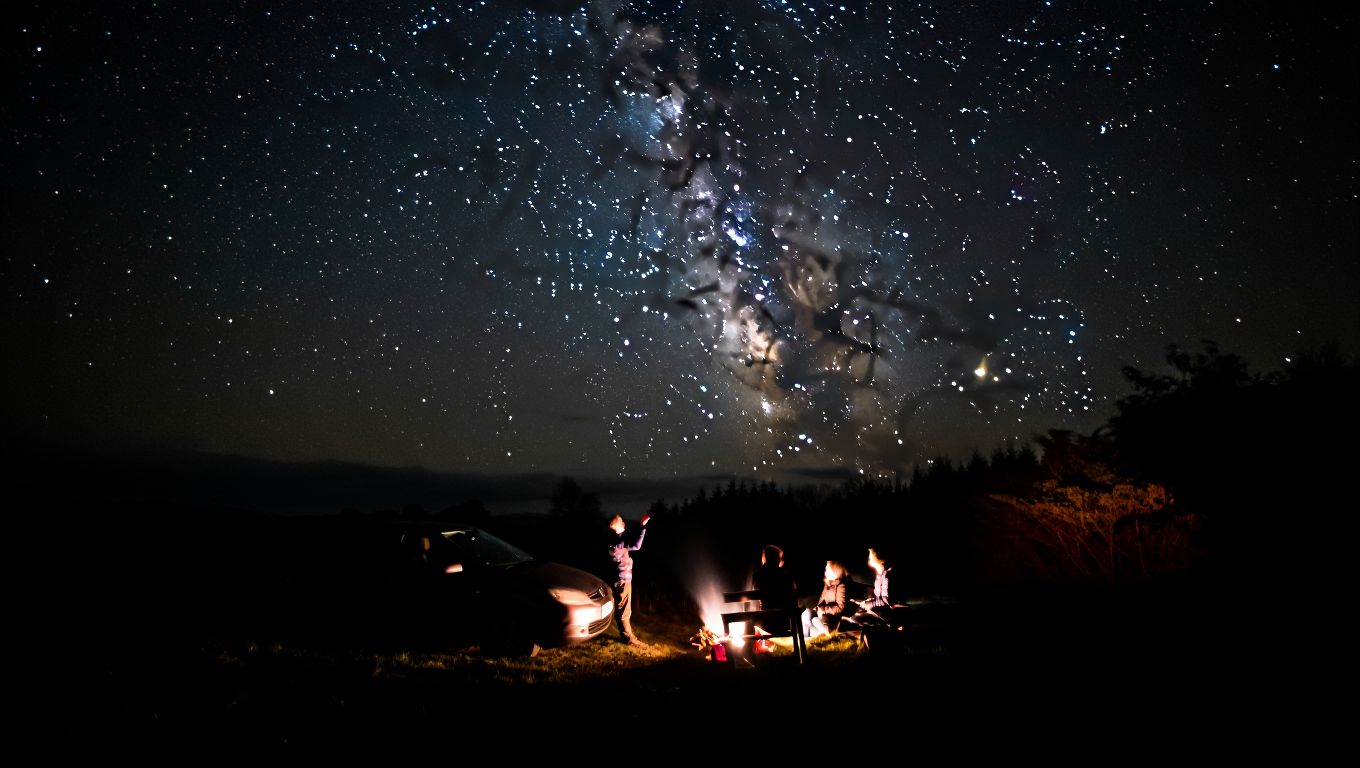
The first time you step into Davagh after dusk, the sky does a double‑take on your brain. Stars are so dense you struggle to find the familiar outlines, and the Milky Way looks airbrushed into existence. People gasp, phones go quiet, and a cool Tyrone breeze sharpens every sense. “It looks painted on,” someone whispers, and for a beat you almost agree.
You notice how blackness becomes a kind of texture, how silence makes bright things feel near. Your eyes keep widening, then widening more, as if they’ve been under a lid your entire life. It’s not a trick of photography, not a filter, just night done properly.
Where darkness is the attraction
Davagh is one of those rare places officially recognized for darkness, not for what’s built there but for what’s missing. With minimal light pollution, it offers a ceiling of stars that feels truly prehistoric. The absence of glare becomes a presence you can almost touch.
You stand in a forest clearing and the galaxy splits the sky like a bright, brushed river. Dust lanes show texture, not theory, and the word “remote” finally earns its meaning. “This is how our ancestors saw the world,” says a guide, “and how we still can, if we let the lights drop.”
OM Observatory: science with a heartbeat
At the OM Dark Sky Park and Observatory, the experience is equal parts story and science. Exhibits connect star maps with local myths, archaeology with cosmic time. The architecture glows in soft red hues that protect your night vision and heighten the sense of ritual.
Inside, you can trace constellations, listen to folklore, and meet the instruments that make starlight speak. Outside, trails lead you into the dark like pages turning slowly. Staff keep the tone warm and human, the way good astronomy always should.
What you can actually see up there
On a clear night, the sky at Davagh becomes a checklist you will actually want to finish. You can pick out the Milky Way’s core in summer, the Pleiades in winter, and planets that punch holes in the dark. With patience, your eyes pull more and more stars from the ink.
- Expect naked‑eye views of the Milky Way’s dust lanes, the Andromeda Galaxy as a soft smudge, bright planets when in season, fast meteors, and satellite passes drifting like slow punctuation.
Why stargazing nights are booking fast
Word spreads quickly when an experience feels both fragile and real. The stargazing sessions here sell out because the promise is simple: if the sky cooperates, you’ll see what cities stole. People drive for hours to reclaim a piece of the night.
“Every time, I hear the same soft wow,” a staff member smiles. It’s the kind of reaction venues dream about, and the calendar fills with people willing to chase that sound. Book early, and keep an eye on the forecast.
Ancient stones under a modern cosmos
Just beyond the observatory sit the Beaghmore stone circles, a constellation pressed into the earth. Standing among them, you feel the braid between ritual and sky, the old intuition that stars are both map and mirror. The past doesn’t feel distant; it feels dimmed, waiting for someone to lift the switch.
OM leans into that blend: ogham script, local story, science that doesn’t dismiss wonder. It’s a place where data and myth hold hands, and no one pulls away first.
How to make the most of your visit
Pack for cold, even in months you’d usually call mild. Bring binoculars if you have them, and keep phone screens dim or turned off. A red headlamp beats any burst of white light, which shatters night vision like dropped glass.
Give your eyes 20–30 minutes to fully adapt, and you’ll feel the sky grow busier. If you already know a few constellations, you’ll find the rest much more quickly. If you don’t, the guides make first contact feel easy.
The art of timing
Shoulder seasons can be absolute magic, with crisp air and earlier twilight. New Moon weeks are prime time, but even a slim moon can be part of the show. Weeknights tend to be quieter, which makes the silence feel even more deep.
Weather is the wildcard, as any astronomer will tell you. Cloud cover cancels photons, but it doesn’t cancel the place. Keep your booking flexible, and watch the observatory’s updates for real‑time calls.
When clouds turn up anyway
If the stars don’t show, the staff pivot to stories, demos, and hands‑on learning. You get the geology, the archaeology, the tech that turns photons into knowledge. Sometimes the clouds part late, and the field erupts in soft, grateful noise.
Astrophotography sessions also help you tame the dark, teaching techniques that reward patience and practice. Long exposures turn faint things bold, and the process changes how you see the sky.
Why it lingers after you leave
Driving away, you notice how streetlamps look suddenly loud, how shopfronts feel strangely crude. Davagh rewires a small part of your attention, reminding you that darkness is not an absence but a resource. The memory is bright, but the secret is black.
You’ll book again because you want that first gasp to return, and because each night writes a different script. The stars don’t repeat themselves, and neither should we. In Tyrone, the universe feels close enough to claim, and you don’t even need a filter.

It’s well worth a visit. But allow at least 20 minutes for your eyes to adapt fully to the darkness.
And obviously avoid nights when there is bright summer twilight, and bright moonlight (say from 5 days after New Moon until 17 days after New Moon.)