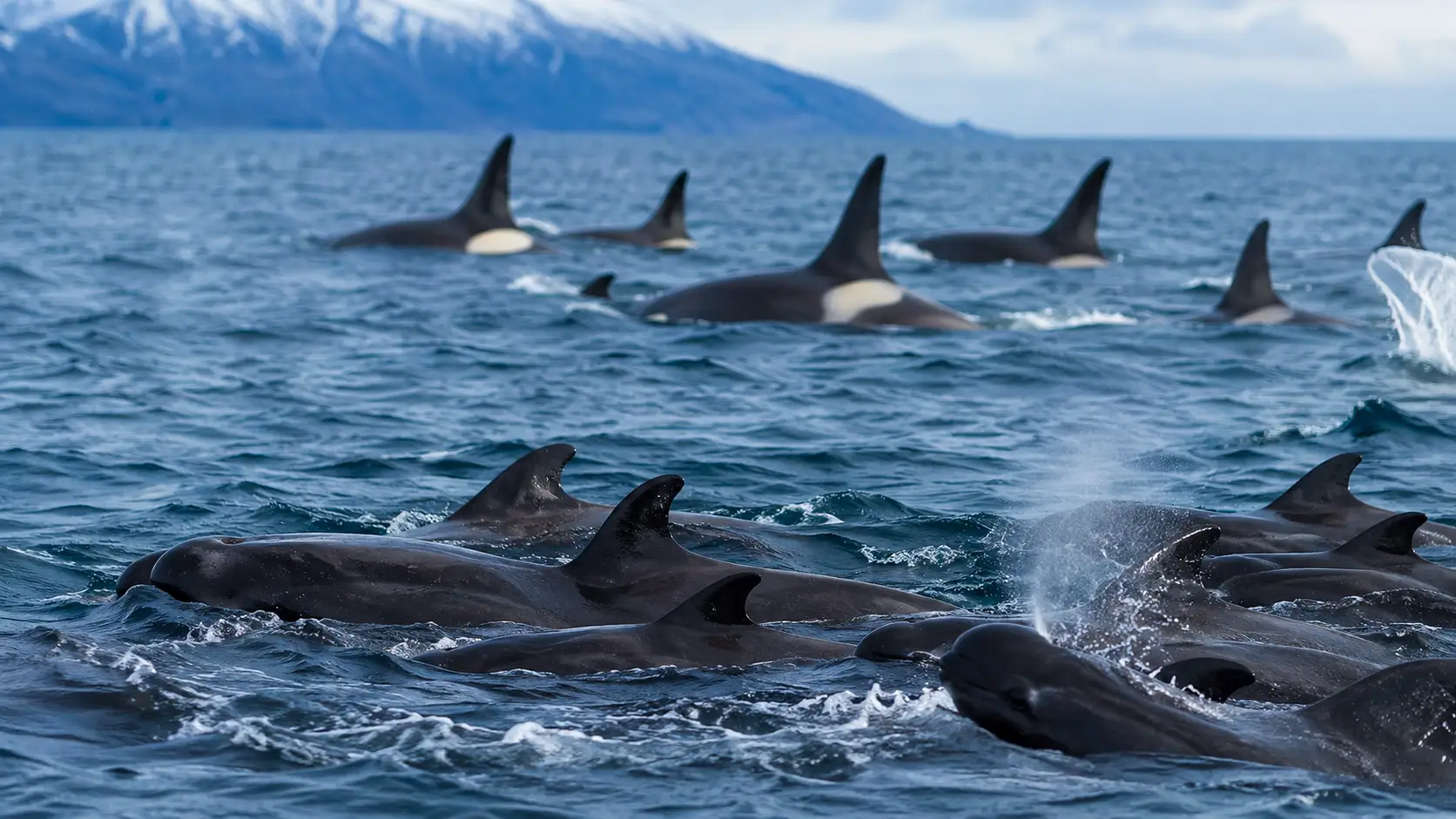
At the top of the marine food chain, the orca appears invincible. Yet recent studies reveal that it systematically flees from the black globicephale. Sometimes, a simple sound signal emitted by this smaller cetacean is enough to drive the sea’s giant away.
Marine biologists observe repeated retreats by orcas in the face of smaller cetaceans
In theory, the size and power of the orca should guarantee total dominance in the water. But field reality challenges this classic pattern. In the face of the black globicephale, the orca often chooses to retreat rather than confront its neighbor.
Scientists began documenting this odd behavior in the early 2000s. In the Strait of Gibraltar, as early as 2004, researchers led by Renaud de Stephanis noticed a consistent pattern: each arrival of globicephales prompted the immediate departure of groups of orcas.
In 2012, the work of marine biologist Charlotte Curé added a further detail. When the globicephales perceive the voice of the orcas, they steer directly toward the sound source. These mammals actively seek contact, triggering an immediate avoidance reaction in the large predator.
Isolated data from Iceland confirm the orcas’ flight during sea encounters
A large study published in 2022 consolidated these findings with data collected between 2007 and 2020. By analyzing 24 interactions recorded in six coastal zones of Iceland, specialists found that orcas retreated before any direct interaction in 68 % of cases.
In 28 % of the analyzed situations, the two species engaged in a high-speed chase. These underwater sprints reached a speed of 13.5 knots, roughly 25 km/h. The orcas preferred to maintain a constant safe distance rather than risk a close confrontation.
The mere diffusion of their vocalizations triggers panic in the top predator
To isolate the effect of these encounters, the team led by Anna Selbmann tested a direct experimental approach. In Iceland, scientists from the Sudurnes Science and Learning Center broadcast recordings of globicephale vocalizations to orcas that had been pre-fitted with tracking tags.
The reaction of the targeted animals was immediate and unequivocal when the sounds were played. The groups of orcas tightened their ranks, altered their own vocalizations, veered sharply, and accelerated their swimming. These results were published in Scientific Reports in January 2026.
The study’s authors explain that the top predator interprets these acoustic signals as a direct risk. Although it dominates the marine ecosystem, the animal associates its neighbor’s sonic signature with a potential threat, triggering an instant defensive retreat.
Scientific hypotheses attempt to explain this collective harassment behavior
To explain this behavior, the mobbing hypothesis remains favored by many specialists. This tactic involves gathering to harass a dominant predator until it is driven away. The globicephales’ social cohesion would thus turn the group into a formidable adversary.
Other avenues mention competition for food or the protection of young cetaceans. No direct physical attack has been recorded to date between the two species. Yet it only takes the globicephale to vocalize to push the carnivore toward preventive retreat.

Contact details
Address:
Farmers Forum,
36, Dominick Street,
Mullingar,
Co. Westmeath,
Ireland
Phone:
+353 (0)44 9310206
Or email us:
For technical issues please check out our FAQ's page or email - [email protected]
For general Queries email - [email protected]
Request to add event to our Calendar - [email protected]
Send us your mart reports - [email protected]
Suggestions and feedbacks - [email protected]
News Items / Press Release - [email protected]
To Advertise on Farmers Forum - [email protected]