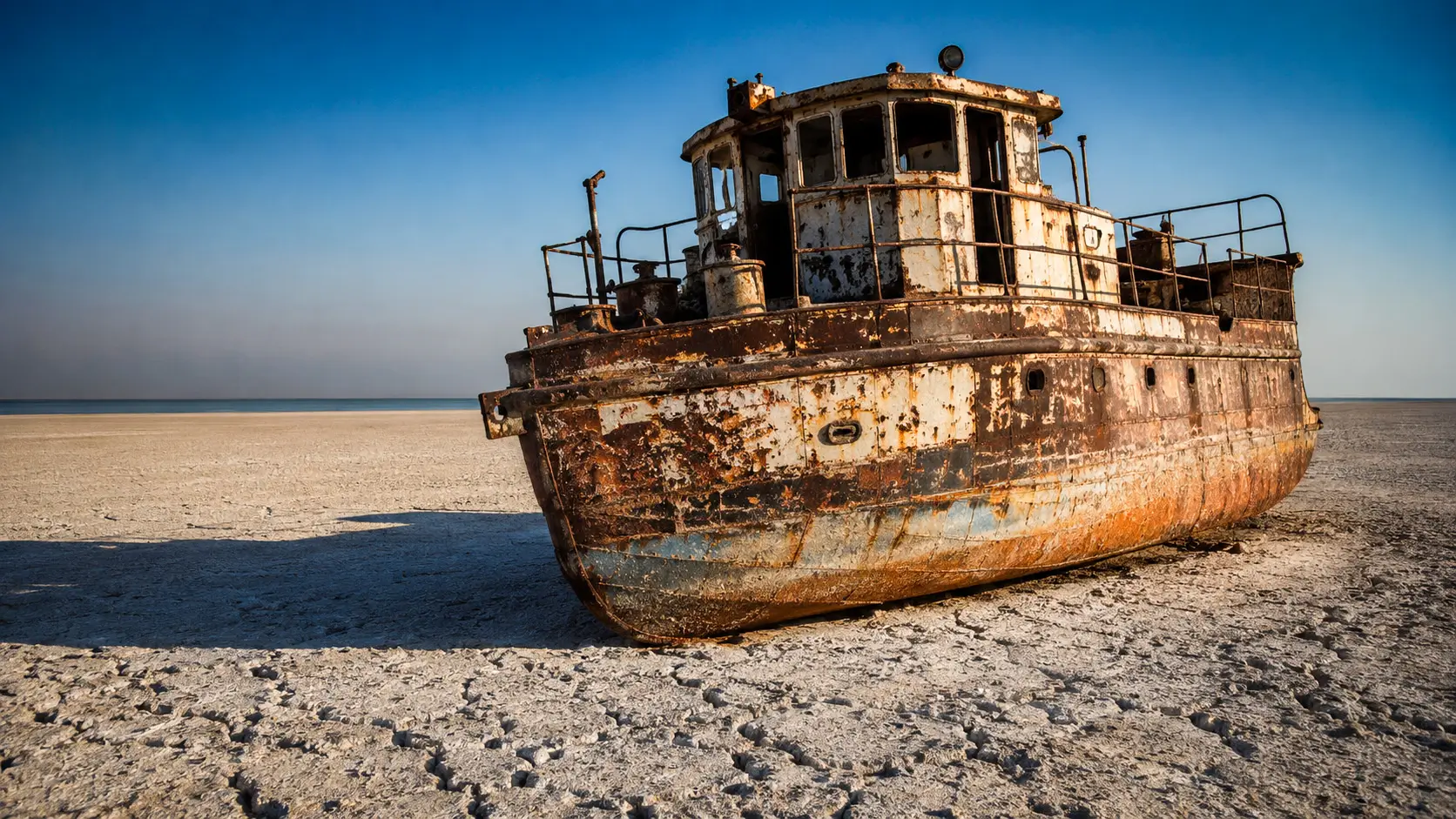
Desiccated since the 1960s, the Aral Sea is no longer merely a symbol of an ecological catastrophe. Its bare sediments have been releasing carbon into the atmosphere for six decades. A study published in Science shows that partially rehydrating the sea could reverse this trend and generate meaningful carbon revenues.
How the Aral Sea’s now-dry bed, once the world’s fourth-largest lake, began emitting carbon
In the 1960s, the Soviet Union redirected portions of the Amu Darya and Syr Darya rivers to irrigate cotton and wheat fields in Central Asia. The consequence was stark: the Aral Sea, then the fourth-largest lake on the planet, lost about 90 percent of its volume within a couple of decades.
Today, the site is bisected. A northern section, safeguarded by a dam, still endures. The southern portion, which accounted for roughly 90% of the original surface, has morphed into an endless salt desert with no water in sight.
But this desert is not inert. The sediments uncovered since 1960 have already released 748 megatons of CO2 into the atmosphere, according to a study published in Science. That figure places the drying of the Aral Sea among the planet’s major environmental catastrophes.
Reintroducing water to the Aral Sea could avert an additional 605 megatons of CO2 emissions
Interior bodies like lakes and seas naturally store carbon. Their sediments accumulate, over long timescales, organic matter captured from the atmosphere by vegetation and algae. Once dried out, these sediments oxidize and release this carbon as CO2.
But the reverse is also true. A substantial portion of carbon remains buried beneath the Aral Sea’s old bed. By reflooding the area, this reservoir would stay trapped: restoring water would prevent the emission of 605 megatons of CO2—the equivalent of three years of Spanish emissions.
A carbon treasure beneath the Aral Sea sediments with financial implications
For researcher Núria Catalán, coauthor of the study, the drying of a lake transcends hydrological or ecological concerns. The carbon cycle itself is disrupted—a broader impact that has largely been overlooked in climate accounting to date.
Rafael Marcé, lead author of the study, frames the issue differently: there would be a carbon treasure hidden under the Aral Sea. Exposed to air, the sediments release CO2. Re-submerging them could, conversely, become part of the climate solution.
And this treasure comes with a numerical value. Based on 2024 voluntary carbon market prices, the researchers estimate that preserving these 605 megatons could yield between 3.6 and 18 billion dollars in tradable carbon credits.
Why researchers deem the restoration of the Aral Sea feasible
Is this scenario credible? Yes, according to Georgiy Kirillin, a co-author of the study focused on safeguarding the northern part of the Aral Sea. There, oxygen levels have remained well maintained since the dam’s construction—a promising sign for the rest of the basin.
The researchers identify several concrete levers: improving irrigation efficiency, optimizing water transport infrastructure, and strengthening coordination among the basin’s countries. All of these avenues could make a partial refilling of the Aral Sea genuinely attainable.

Contact details
Address:
Farmers Forum,
36, Dominick Street,
Mullingar,
Co. Westmeath,
Ireland
Phone:
+353 (0)44 9310206
Or email us:
For technical issues please check out our FAQ's page or email - [email protected]
For general Queries email - [email protected]
Request to add event to our Calendar - [email protected]
Send us your mart reports - [email protected]
Suggestions and feedbacks - [email protected]
News Items / Press Release - [email protected]
To Advertise on Farmers Forum - [email protected]