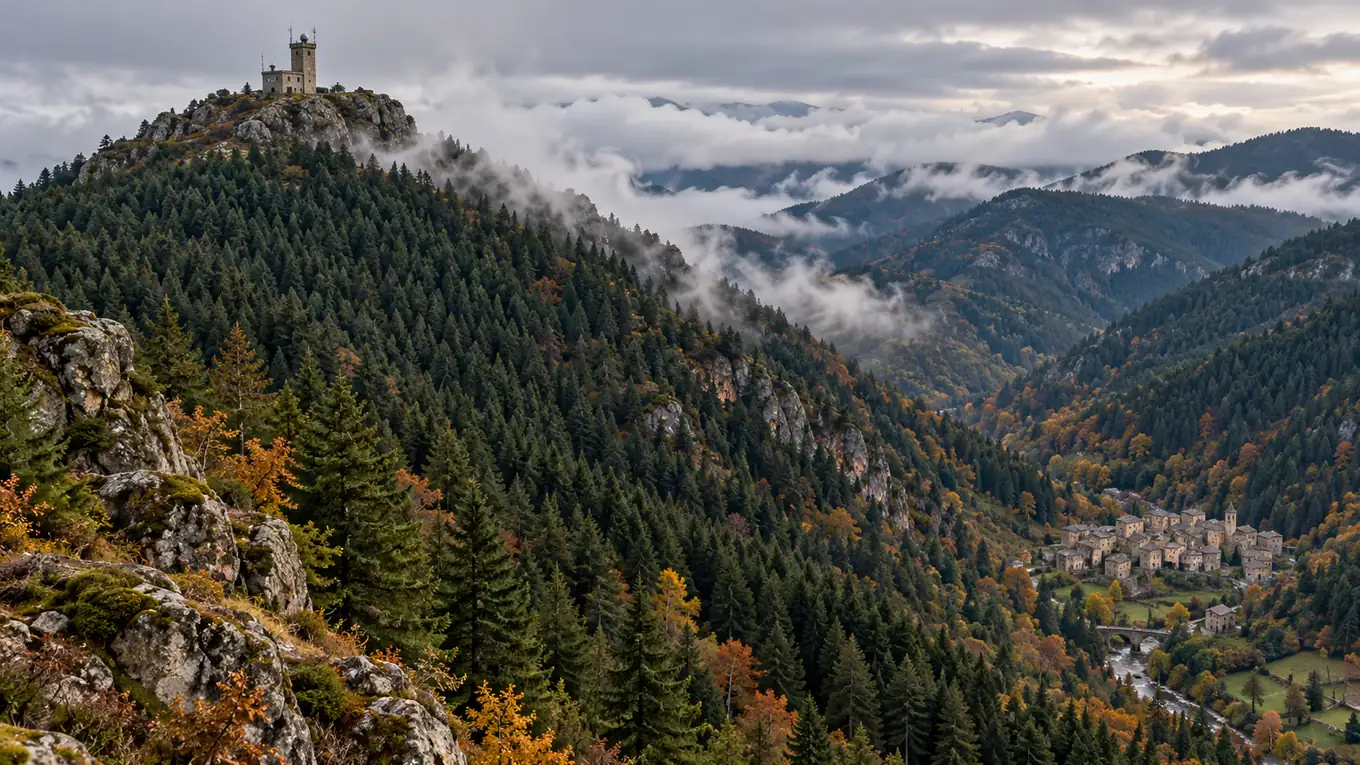
In the mid-19th century, the Aigoual massif possessed only about 2,200 hectares of forest. Floods regularly devastated the Cévennes valleys. Thanks to a reforestation program carried out from 1860 to 1914, the state forest now covers more than 16,000 hectares.
In the 19th century, forges, glassworks and 500,000 transhumant sheep stripped the slopes of the Aigoual
For more than a century, the massif’s timber fed the entire local economy. Thus, the forges, glassworks, charcoal kilns and silk mills consumed enormous volumes of trunks. In parallel, the transhumance brought every summer flocks from the plains of the Languedoc.
According to the National Forests Office, nearly 500,000 sheep were then ascending to the Cévennes, compared with about 20,000 today. The animals browsed the young shoots and blocked any natural regeneration. Consequently, the bare soils remained exposed to the violent Cévenol episodes, as in other parts of France before the major massifs were planted in the 19th century.
Soil eroded by these rains swelled torrents of mud and rocks. Therefore, the floods of 1844, 1856, 1861 and 1868 struck the valleys hard, notably the Hérault valley around Valleraugue. These repeated disasters convinced the State to intervene.
The mountain land restoration laws of 1860 and 1882 launched a project contested by shepherds
The response began with legislation, with the laws of 1860, 1864 and then 1882 on the restoration of mountainous terrain. Subsequently, the forestry administration entrusted the works to field engineers. Georges Fabre took charge of the Gard region beginning in 1875, while Émile Deuxdeniers handled the Lozère side.
However, the project clashed with shepherds, who saw their pastures shrink. Some herders even went as far as burning the plantations to reclaim their grazing grounds. Faced with this resistance, the foresters chose to preserve the best lands for grazing in order to maintain a mountain population.
Moreover, the reforesters did not rely solely on trees. Dry stone walls and fascines of branches stabilized the ravines while the roots settled in.
Between 1860 and 1914, 38 tonnes of seeds and more than 50 million plants covered the Cévennes massif
According to the ONF, teams sowed 38 tonnes of seeds and planted more than 50 million trees, mainly conifers such as the hook pine. The office’s documents, however, vary on the exact total, ranging between 58 and 68 million plants depending on the page.
Moreover, the reforestation was accompanied by a genuine scientific effort. Seven arboretums were created to test the acclimatization of foreign species, including the Hort-de-Dieu arboretum, still open to visitors. Most notably, Georges Fabre oversaw the construction of the meteorological observatory on the summit between 1887 and 1894.
Distinguished by the Forêt d’Exception label in 2019, the forest of the Aigoual must now face warming
Today, the state forest spans approximately 16,000 hectares, with about 70% in the Gard and 30% in Lozère. It continues to protect soils, but also provides high-quality timber and welcomes hikers year-round. Largely included within the Cévennes National Park, it also serves as a refuge for a diverse fauna and flora.
In 2019, it earned the Forêt d’Exception label, which requires revising the action program every five years. Climate change now sits at the forefront of managers’ concerns, with more frequent droughts. Consequently, the forest planted to protect the valleys must itself be safeguarded.

Contact details
Address:
Farmers Forum,
36, Dominick Street,
Mullingar,
Co. Westmeath,
Ireland
Phone:
+353 (0)44 9310206
Or email us:
For technical issues please check out our FAQ's page or email - [email protected]
For general Queries email - [email protected]
Request to add event to our Calendar - [email protected]
Send us your mart reports - [email protected]
Suggestions and feedbacks - [email protected]
News Items / Press Release - [email protected]
To Advertise on Farmers Forum - [email protected]