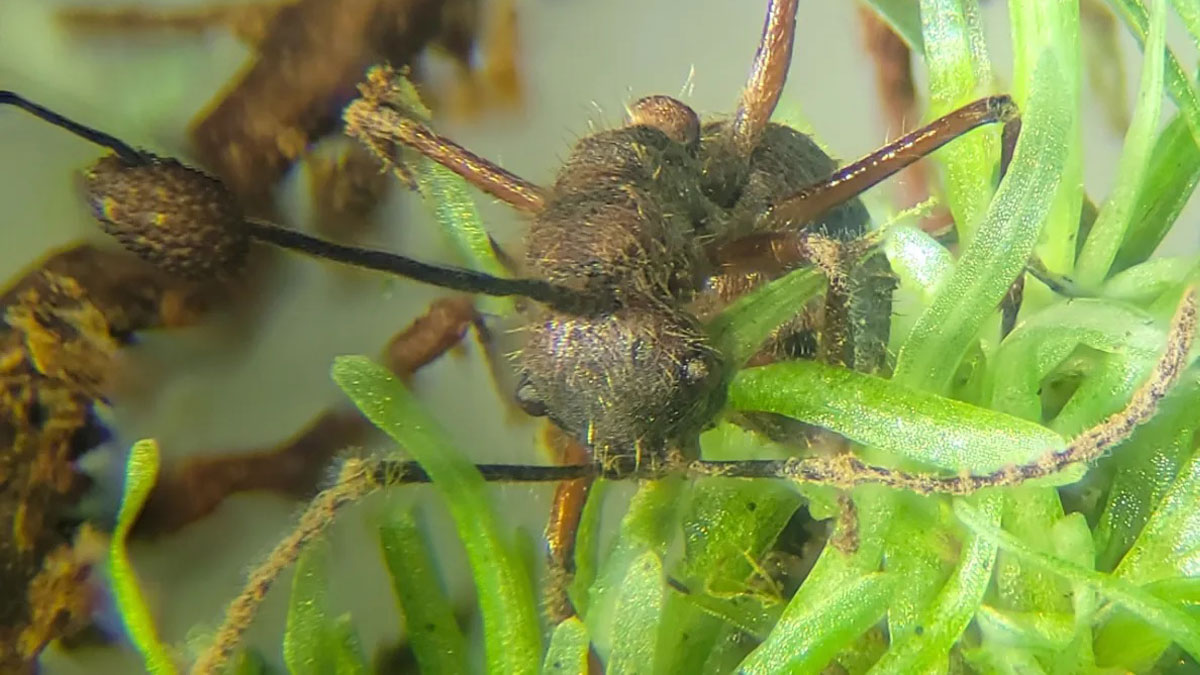
While it was once thought to infect only ants, new research conducted in Brazil reveals that the Amazonian zombie fungus has a very different host: mosses.
Endophyte Phase
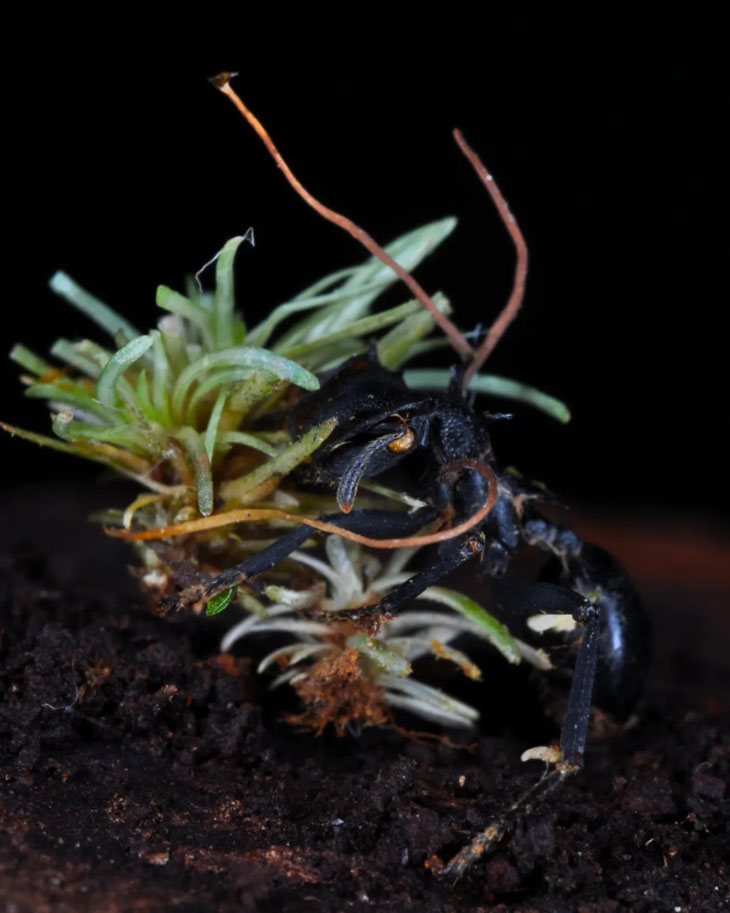
Through its spores, the Ophiocordyceps fungus infiltrates the bodies of ants and gradually alters their behavior, pushing them to climb onto vegetation that towers above the colony and to grip it tightly. When the insects die, the parasite continues to develop. Stems eventually protrude from the corpse of its host and release spores that will contaminate its nestmates, thereby marking the start of a new cycle of “zombification.”
Recently, genetic sequencing of mosses collected in the Adolpho Ducke Forest Reserve, near Manaus, yielded surprises for researchers. In particular, the systematic presence of the fungus in mosses sourced from areas far from the “infected ant cemeteries,” and thus without direct contact with the ants, has been observed.
Such a discovery points to a phase known as the “endophyte” phase of the fungus, during which Ophiocordyceps lives inside the plant without causing visible symptoms.
This unanticipated facet of the zombie fungus’s life cycle would reflect a broader trend, according to João Paulo Machado de Araújo, co-author of the new study, published in the journal IMA Fungus. “We are finding more and more distinct lineages of entomopathogenic fungi associated with plants, but this is the first time such a dual life has been documented in Amazonia and more broadly in the tropics,” he explains.
Descriptive similarities
In a further twist, in 2018, Machado de Araújo and colleagues described several new species of this genus of parasitic fungi also emerging from the Manaus region. Named O. monacidis, one of these species developed a structure very similar to the sporophyte of the moss Octoblepharum, to which the “zombie ants” attach and where Ophiocordyceps has also been found.
“This suggests that behavioral manipulation could depend not only on the fungal fruiting stage (EPF) and the host insect, but also on other factors related to the plant on which it attaches, as well as its microbiome,” says Machado de Araújo.
“It is possible that plants hosting the endophytic form of the fungus attract the corresponding EPF form in the insect. Demonstrating this could have potential implications for biological control of crop pests,” he concludes.
In case you didn’t know, there exists a parasite that makes snails dance.

Contact details
Address:
Farmers Forum,
36, Dominick Street,
Mullingar,
Co. Westmeath,
Ireland
Phone:
+353 (0)44 9310206
Or email us:
For technical issues please check out our FAQ's page or email - [email protected]
For general Queries email - [email protected]
Request to add event to our Calendar - [email protected]
Send us your mart reports - [email protected]
Suggestions and feedbacks - [email protected]
News Items / Press Release - [email protected]
To Advertise on Farmers Forum - [email protected]