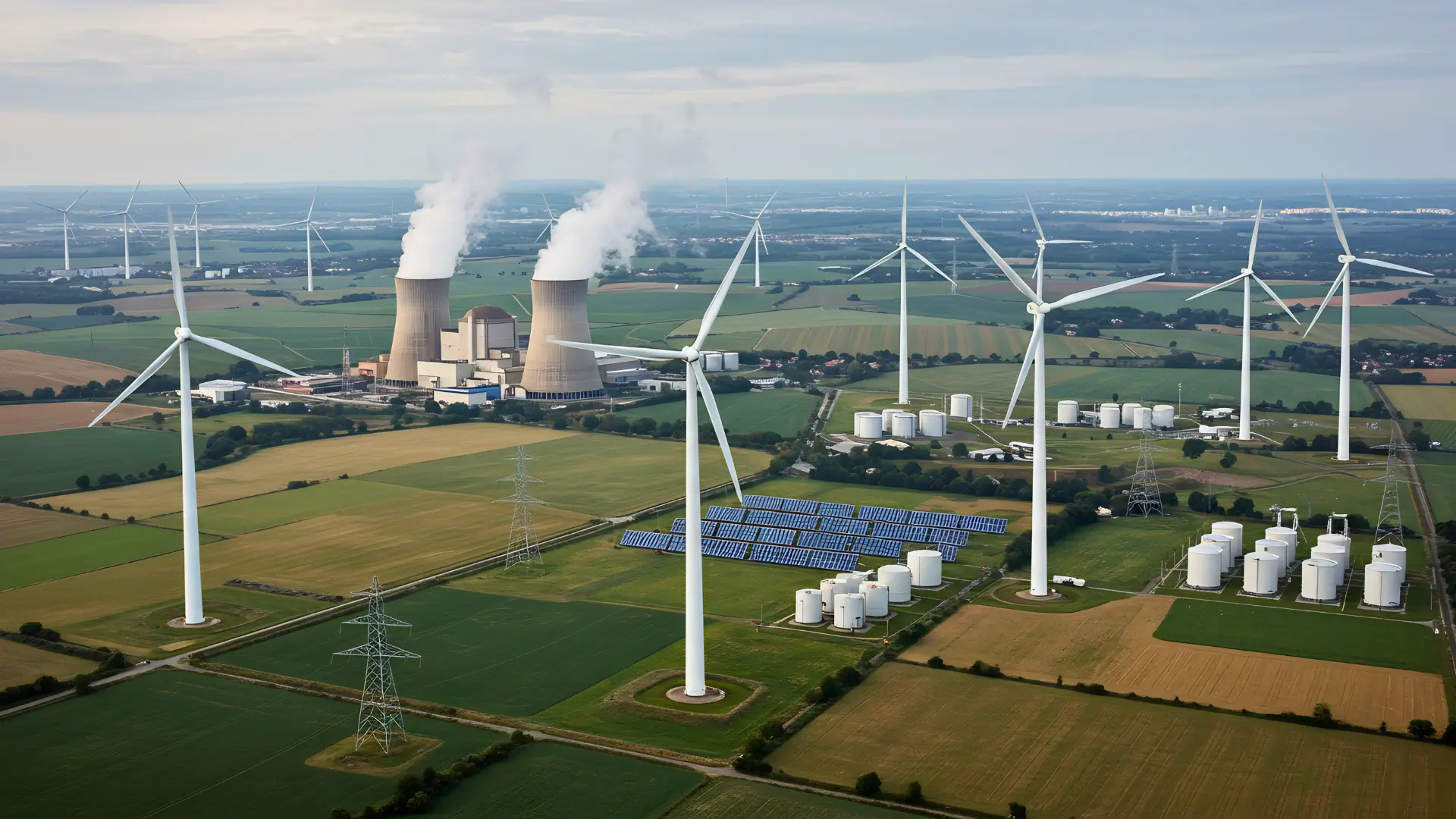
A lifecycle-assessment-based study of France’s energy scenarios up to 2060 challenges conventional wisdom. Behind the promises of renewables, nuclear power sometimes emerges as the option with the lowest environmental impact, with low overall emissions across the entire life cycle.
Not all low-carbon mixes have the same environmental footprint: what life-cycle analysis reveals
When discussing decarbonized electricity, everything seems to be equal. Yet, recent scientific research challenges this view. The global environmental impacts vary markedly depending on the chosen mix. Accordingly, this finding reshapes the ranking of low-carbon solutions and their priorities.
These studies rely on life-cycle analysis. In practice, this method has become standard in numerous scientific journals. It examines the entire system, from extraction to recycling. In doing so, it highlights the hidden costs often absent from public debates and from simplified comparisons.
Nuclear-rich scenarios reduce infrastructure and material needs
First, a key point becomes clear quickly. Scenarios that do not involve building new nuclear power plants require more equipment. Indeed, the output of intermittent energies remains low. Therefore, installations must be multiplied to compensate. Consequently, this greatly increases the material needs across the entire energy system.
Next, storage further complicates the equation. Batteries and hydrogen become essential to stabilize the grid. However, these solutions incur losses and additional impacts. Thus, the system becomes more dependent on complex industrial supply chains that reinforce its overall footprint.
Scientific comparison of environmental impacts: nuclear, wind, and solar scrutinized
In their study, researchers at RTE (the French electricity transmission system operator) compared several electricity sources. They used eleven environmental indicators. For example, they account for climate, toxicity, and resources. Photovoltaics often appears the most impactful. This is explained by substantial cumulative impacts linked to its manufacture.
Hydropower, for its part, achieves the best overall results. Nuclear also ranks favorably. However, certain limits exist, notably regarding radiation. Nuclear waste remains a sensitive topic as well. Despite this, its solid environmental performance is confirmed in several analyses.
Finally, the researchers broaden the analysis to more than twenty indicators. They employ methods such as ReCiPe. The trends remain the same. Photovoltaics still dominates the impacts. Thus, materials weigh heavily in the comprehensive environmental life-cycle assessments studied.
Implications for France’s energy strategy: policy trade-offs and environmental priorities
Overall, the six scenarios studied reveal a consistent pattern. The higher the share of nuclear, the lower the impacts. Production becomes denser and more stable. It requires fewer infrastructures. Thus, this limits the indirect environmental effects tied to the mass deployment of equipment.
Nevertheless, renewables remain essential. They replace fossil fuels and accompany the transition. However, their development must be kept in check. A rigorous energy planning becomes crucial to avoid material and technical excesses.
Finally, these analyses come with significant limitations. They do not incorporate the risks of major accidents. This point remains central in public debate. Despite that, the results invite reconsidering certain ideas. They rest on robust scientific data that guide future choices.

Contact details
Address:
Farmers Forum,
36, Dominick Street,
Mullingar,
Co. Westmeath,
Ireland
Phone:
+353 (0)44 9310206
Or email us:
For technical issues please check out our FAQ's page or email - [email protected]
For general Queries email - [email protected]
Request to add event to our Calendar - [email protected]
Send us your mart reports - [email protected]
Suggestions and feedbacks - [email protected]
News Items / Press Release - [email protected]
To Advertise on Farmers Forum - [email protected]