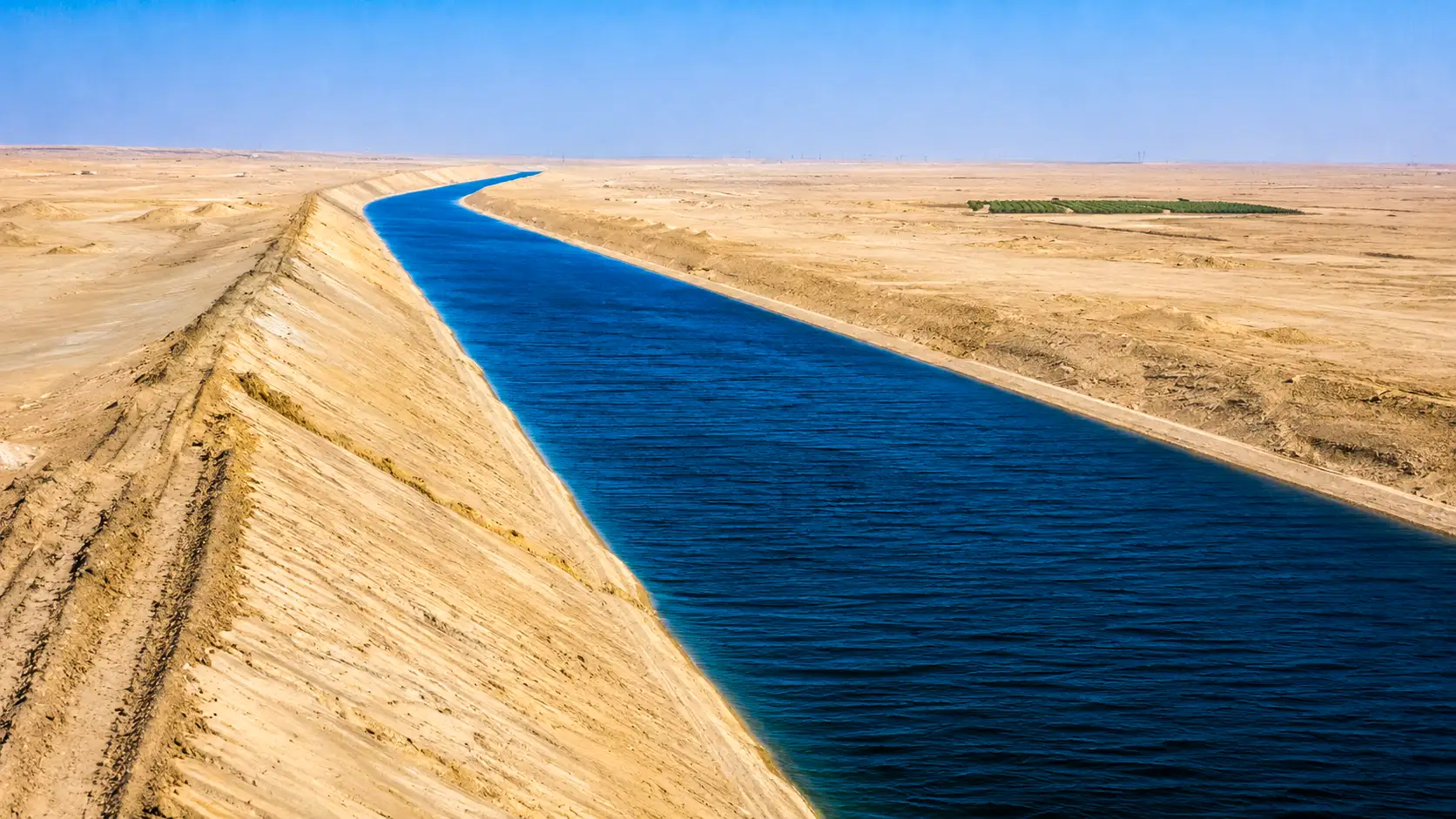
In the heart of the Libyan Desert, one of Egypt’s most ambitious hydraulic efforts aimed to turn sand into cultivable land. Nearly thirty years after its launch, the water from Lake Nasser barely irrigates a fraction of the targeted territory, far from the initial promises.
How Hosni Mubarak dreamed of turning the Egyptian desert into a new agricultural land
In 1997, Egyptian President Hosni Mubarak unveiled an extraordinary project. It was meant to redraw the country’s economic future. The Toshka Project, also known as the New Valley initiative, ambitiously aimed on paper to raise the share of arable land from 6% to 35% of the national territory.
At the time, most Egyptians lived on a narrow strip along the Nile. The cultivable space there was dwindling year after year. The objective was thus to relieve this overcrowded zone. It also sought to open new urban and agricultural hubs capable of hosting generations in search of land.
Mubarak then imagined a transformed country. In his vision, water would eventually push back the sands on a lasting basis. The Libyan Desert, previously hostile to any cultivation, was to become the symbol of an Egypt capable of taming its most arid environment.
The Sheikh Sayed Canal and the Mubarak Station, monumental works on Lake Nasser
The project rests on a network of canals. Their purpose: to divert the waters of Lake Nasser, the vast reservoir formed by the Aswan Dam, toward Egypt’s western desert lands. The Sheikh Sayed Canal, stretching 310 kilometers, was to carry water to the Baris Oasis.
A second component completed the system: a 72-kilometer canal directly linking Lake Nasser to the Toshka depression. Opened in 2003, this connection relies on the Mubarak Pumping Station. Its 24 giant pumps could, in theory, move up to five billion cubic meters of water per year.
Why most Toshka pumps never ran at full capacity
Behind this technical showcase, reality proved more modest. Of the 24 pumps installed, only four to six actually operated on a daily basis. The station thus functioned at only a tiny fraction of its theoretical capacity.
Several factors explain this bottleneck. Operating costs remained high. Private investors were hard to convince. The lands themselves were ill-suited for intensive agriculture without constant maintenance. To this, there was the enormous evaporation caused by an unforgiving sun. By the end of the 2000s, the verdict was pronounced: the project was labeled a mega-failure.
In 2016, however, President Abdel Fattah el-Sisi revived the initiative. About 4 square kilometers of land were allocated to build a new city at Toshka. But investors remained reluctant, since roads, electricity, and water networks would still be their burden. As a result, several announced companies withdrew without laying a single stone.
What Toshka reveals about future tensions around water and wheat in Egypt
The Toshka story goes beyond a mere urban-planning misadventure. It mainly illustrates the growing tensions around water in a region where this resource is increasingly contested. The geopolitical upheaval of 2022, tied to the war in Ukraine, even pushes Egypt to reinvest in this project that had long been abandoned.
The country remains heavily dependent on imports of Russian and Ukrainian wheat. This dependence intensifies the stakes of food security behind the project. Toshka thus remains an ambivalent symbol: an audacious vision, but also a reminder of the limits that nature imposes, even on the most extravagant undertakings.

Contact details
Address:
Farmers Forum,
36, Dominick Street,
Mullingar,
Co. Westmeath,
Ireland
Phone:
+353 (0)44 9310206
Or email us:
For technical issues please check out our FAQ's page or email - [email protected]
For general Queries email - [email protected]
Request to add event to our Calendar - [email protected]
Send us your mart reports - [email protected]
Suggestions and feedbacks - [email protected]
News Items / Press Release - [email protected]
To Advertise on Farmers Forum - [email protected]