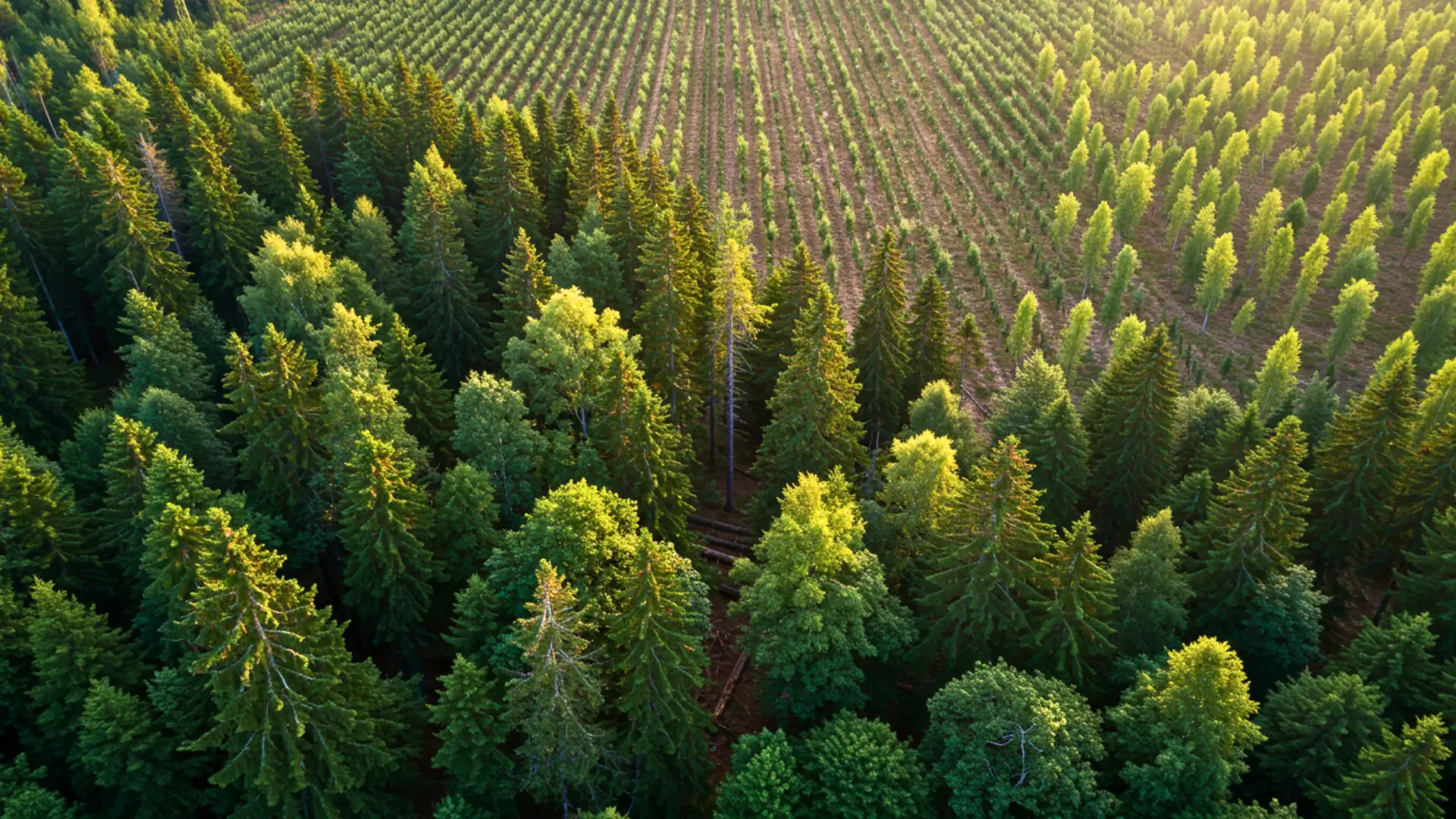
Replanting trees seems to be a simple solution in the face of climate change. Yet, recent research shows that this strategy, widely used by the forestry industry, masks a reality far more complex and concerning for carbon storage.
Replanted forests store up to 83% less carbon per hectare than primary forests
Forests are often touted as major allies in the fight against warming. Yet, in practice, they do not perform the same. Thus, a study published in Science shows that forests planted by humans and their ecological limits store up to 83 % less carbon per hectare than older, primary forests.
This result, in fact, challenges previous estimates. Indeed, researchers estimate that the real gap reaches a level 2.7 to 8 times higher than official figures. Therefore, large-scale replanting does not effectively compensate for the destruction of ancient carbon-rich ecosystems.
Forest soils hold the majority of carbon and disappear with exploitation
Contrary to common belief, trees do not dominate carbon storage. In fact, in the boreal forests studied, scientists observe that soils contain about 64 % of the total carbon stored in forest soils, compared with only 30 % in the trees.
Moreover, this underground storage takes centuries to build. Thus, intensive exploitation disturbs these reserves and releases carbon into the atmosphere. Consequently, young plantations do not recreate these complex biological equilibria in the short term.
Additionally, deadwood also contributes to this balance, accounting for about 6 % of the global carbon storage. Yet, in exploited forests, operators often remove these elements, further reducing storage capacity and impoverishing the ecosystem.
Intense yet unseen forestry exploitation that profoundly reshapes ecosystems
Nordic forestry is often regarded as sustainable. Yet again, the data tell a different story. Indeed, in Sweden, between 2003 and 2019, operators harvested nearly 1.4 % of forests each year, a particularly high harvesting rate.
At the same time, this pace is about six times higher than what is observed in the Amazon. However, the cuts remain discreet from space, because industries replant quickly. Thus, this strategy sustains the illusion of continuity, while the deep ecological structure evolves markedly.
Consequently, this transformation reduces biodiversity and weakens carbon storage. In particular, monocultures, chosen for their yield, do not recreate the biological complexity of natural forests.
Preserving old forests and restoring degraded habitats offer a stronger climate lever
Thus, researchers draw a clear conclusion. First, protecting existing old forests provides a much stronger impact than multiplying plantations. Indeed, these habitats have accumulated carbon over centuries and maintain a unique ecological stability and irreplaceable.
Moreover, restoring degraded areas also constitutes a solid path. By letting natural dynamics unfold, we gradually recreate conditions favorable for carbon storage and the durable return of biodiversity.
Finally, these strategies require time and a better understanding of natural mechanisms. In other words, limiting oneself to planting trees sustains a persistent illusion of a climate solution, without truly addressing the scale of the problem.

Contact details
Address:
Farmers Forum,
36, Dominick Street,
Mullingar,
Co. Westmeath,
Ireland
Phone:
+353 (0)44 9310206
Or email us:
For technical issues please check out our FAQ's page or email - [email protected]
For general Queries email - [email protected]
Request to add event to our Calendar - [email protected]
Send us your mart reports - [email protected]
Suggestions and feedbacks - [email protected]
News Items / Press Release - [email protected]
To Advertise on Farmers Forum - [email protected]