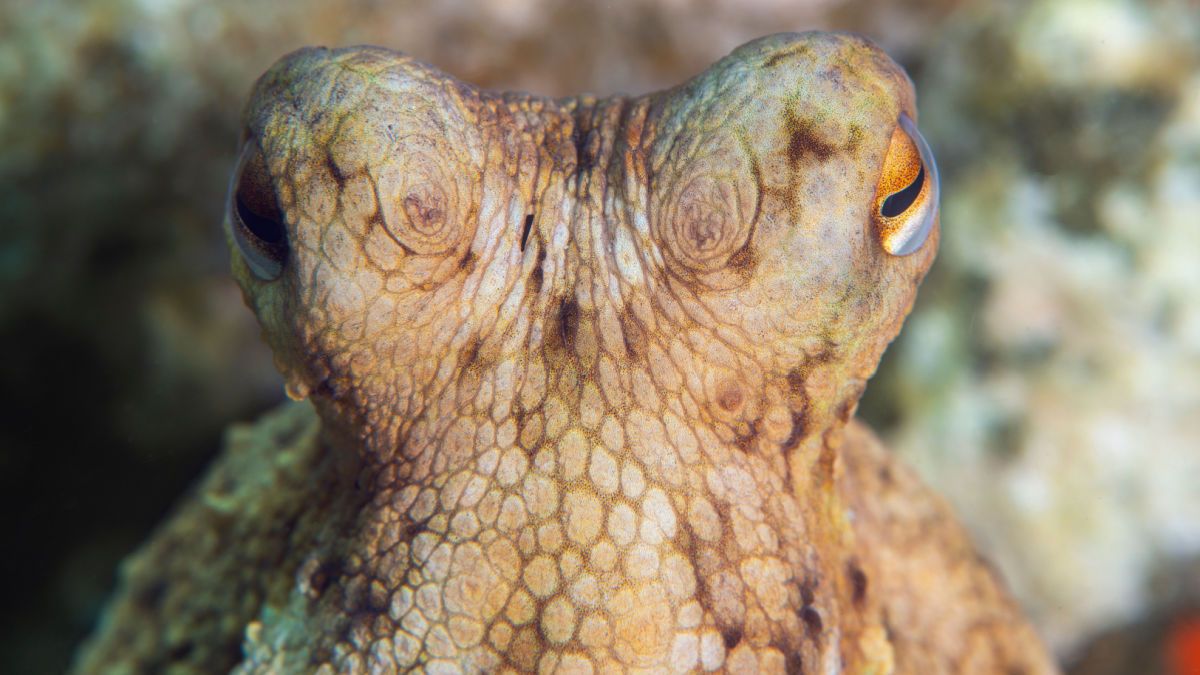
Remarkably intelligent creatures, octopuses are also renowned for their ability to squeeze into tiny spaces. Researchers have recently delved into the details of their contortions.
Clever and Supple
Belonging to the cephalopod order, the octopuses lack a backbone: they possess a soft, sponge-like body, except for their rigid buccal region, which helps them crack the shells of their prey, including crabs, lobsters and bivalve mollusks.
While they are known for pushing their eight arms, their head and their mantle (a bulbous structure housing their gills, their three hearts, their digestive and reproductive organs, and their ink sac) into holes with a diameter at least equal to that of their beak, until now the precise method of operation had remained unclear.
To investigate further, Wenci Xin and colleagues at the National University of Singapore placed common octopuses (Octopus vulgaris) and maya octopuses (Octopus maya) in plexiglass boxes featuring openings that varied in size relative to the cartilaginous sheath surrounding their central nervous system.
While O. maya never risked passing through the smallest gap, O. vulgaris slipped through both types of openings, employing distinct approaches, which the study’s authors—published in the Journal of Experimental Biology—characterize as resembling the flow of a liquid through a narrow space.
How does an octopus fit through a tiny hole? Scientists filmed three slipping through gaps and broke the moves into simple building blocks that soft robots could copy.
https://t.co/es8xwiF3Eu
Image: Diego Delso, CC BY-SA 4.0 https://t.co/WSEPJJCG0w
— Orbital Insights (@orbital_station) November 7, 2026
Aquatic Contortions
To overcome the larger opening, the octopuses began by slipping one of their two left anterior arms through first. They then brought through up to five more, two of which served as anchor points. Using their suction cups, they clung to the wall and pressed on these so as to pivot the remaining limbs, then their head and mantle.
For the smallest opening, the animals could not engage as many arms at once, necessitating a two-step approach for the final phase. Their mantle was ultimately compressed to allow them to pass the gap completely.
According to the team, such contortions, lasting no more than about twenty seconds, could potentially guide the design of soft robots. “Until now, rescue and exploration devices possessed snake-like bodies, which limited the number of sensors and actuators that could be integrated,” concludes Xin.
Last year, a mangled octopus surprised scientists by developing an extra limb.

Contact details
Address:
Farmers Forum,
36, Dominick Street,
Mullingar,
Co. Westmeath,
Ireland
Phone:
+353 (0)44 9310206
Or email us:
For technical issues please check out our FAQ's page or email - [email protected]
For general Queries email - [email protected]
Request to add event to our Calendar - [email protected]
Send us your mart reports - [email protected]
Suggestions and feedbacks - [email protected]
News Items / Press Release - [email protected]
To Advertise on Farmers Forum - [email protected]