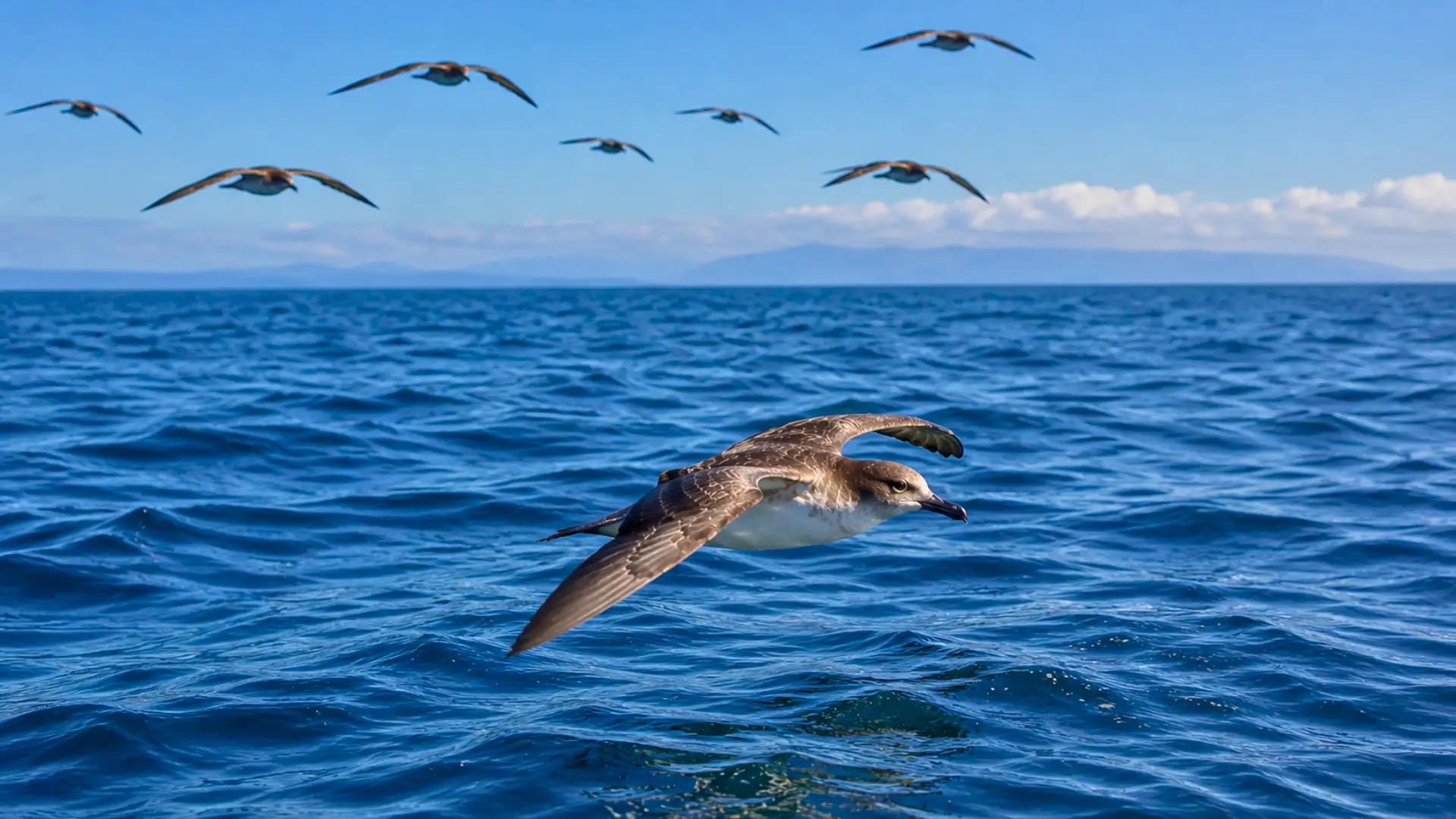
Every year, millions of birds cross the Pacific without ever getting lost. But what happens when this natural compass goes awry? Between Australia and Alaska, an ancient migration falters and reveals disruptions far larger than previously imagined.
A millimetric migration between Australia and Alaska, long thought infallible
Every spring in the southern hemisphere, the slender-billed puffin (Puffinus tenuirostris) embarks on a vertiginous journey. In fact, more than 30 million individuals depart the Australian coasts to reach Alaska, covering up to 15,000 kilometers. Thus, this migratory ballet, clockwork precise, has fascinated biologists for decades.
What makes this migration so exceptional is its nearly perfect precision. In practice, the birds return each year to the same feeding and resting zones, guided by invisible cues. In fact, magnetic fields, ocean currents and the position of the sun form a set of signals that science is only beginning to decipher.
Massive strandings and hungry birds, early signs of an invisible imbalance
In recent years, something has gone awry. More and more often, undernourished, disoriented puffins wash ashore on Australian beaches, sometimes dead. Notably during a marine heatwave in 2023-2024, about 629,000 adult individuals perished, a figure that deeply affected the scientific community.
Moreover, autopsies reveal troubling clues. On one hand, some birds have stomachs full of invisible microplastics; on the other, many show signs of famine. Consequently, the warming seas alter the distribution of plankton and fish, depriving these travelers of their usual resources.
Trajectories that shift and reveal oceans in deep disruption
The phenomenon is not limited to Australia. Indeed, in Alaska as well, unusual observations are emerging. Thus, puffins appear in zones where they had never been seen before, as if their internal map had become blurred. From there, this unexpected movement intrigues as much as it alarms.
These anomalies could be linked to major climatic disturbances. For example, marine heatwaves, increasingly frequent, modify currents and displace food-rich zones. Consequently, the birds, forced to adapt, take new, sometimes risky routes.
In this context, for researchers, these changes constitute a valuable indicator. Indeed, puffins act as true sentinels of the oceans, revealing imbalances invisible to the human eye. Thus, their behavior becomes a large-scale warning signal.
Indigenous knowledge and modern science united to decipher a global ecological crisis
Facing this situation, a novel collaboration has taken root. Scientists now work hand in hand with Indigenous communities in Australia and Alaska. These communities possess a valuable ecological memory, passed down from generation to generation.
Thanks to tiny tags attached to some birds, researchers are attempting to reconstruct their routes with unprecedented accuracy. Yet scientific data alone are not enough. In addition, local observations help detect subtle changes often overlooked by modern tools.
Ultimately, this cross-pollination of knowledge sheds light on a broader reality. About 220 migratory bird species rely on these fragile ecosystems. When these routes wobble, an entire balance threatens to tip. And what if these birds, in silence, are telling the story of an ocean changing faster than expected?

Contact details
Address:
Farmers Forum,
36, Dominick Street,
Mullingar,
Co. Westmeath,
Ireland
Phone:
+353 (0)44 9310206
Or email us:
For technical issues please check out our FAQ's page or email - [email protected]
For general Queries email - [email protected]
Request to add event to our Calendar - [email protected]
Send us your mart reports - [email protected]
Suggestions and feedbacks - [email protected]
News Items / Press Release - [email protected]
To Advertise on Farmers Forum - [email protected]