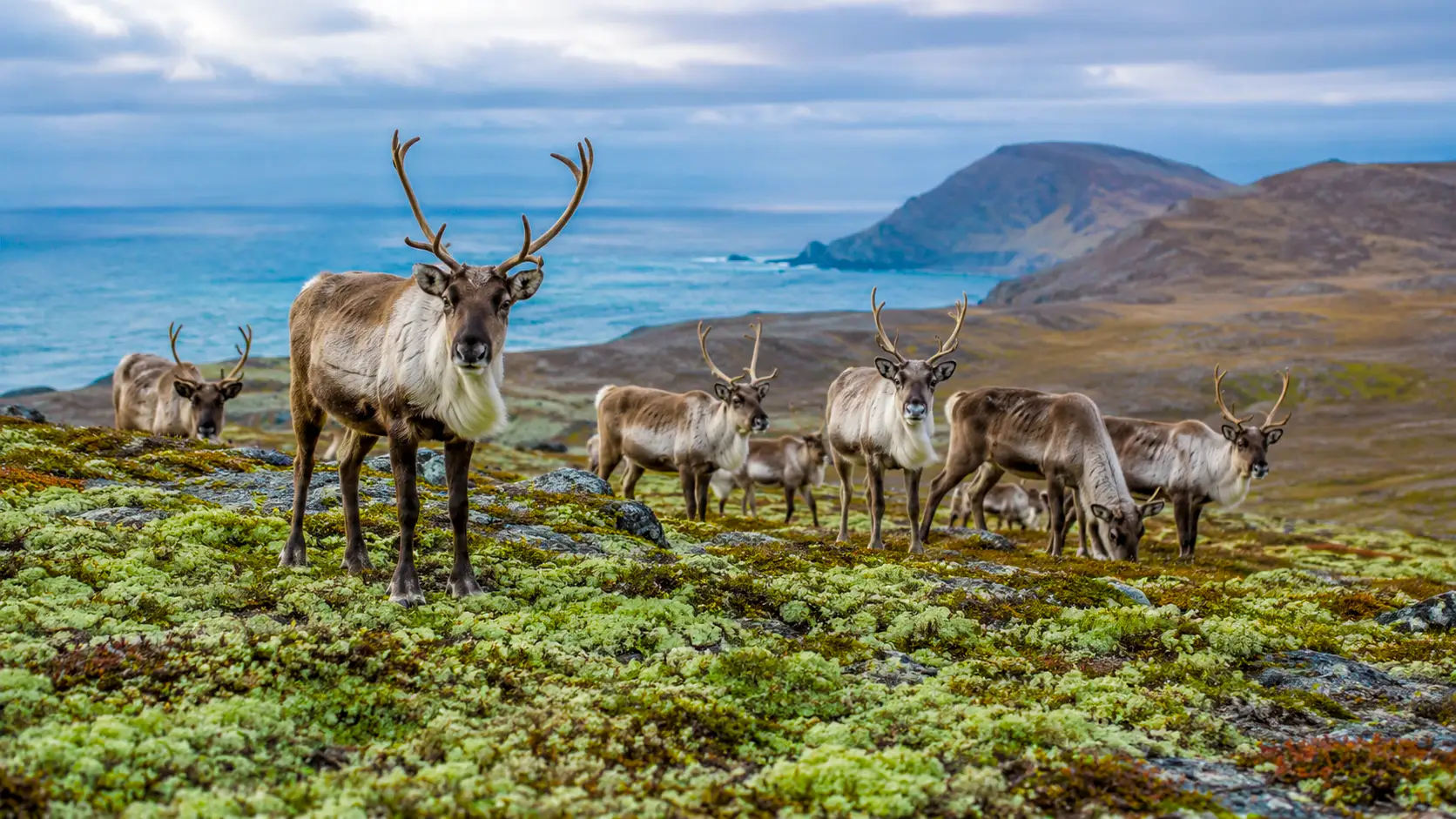
Twenty-nine reindeer arrive on a remote island off Alaska in 1944. Nineteen years later, their numbers reach 6,000 individuals. Three years after that, only 42 remain. Yet neither hunting nor predators explains this brutal decline.
In 1944, American coast guards drop 29 reindeer on a remote island in the Bering Sea as a precaution against shortages
In August 1944, World War II is in full swing. The U.S. Coast Guard establishes a radio station on Saint Matthew Island, Alaska. Nineteen men settle there to operate it. The site remains one of the most isolated in the country.
As a precaution, the army also transports 29 reindeer from Nunivak Island. A barge carries them over more than 200 miles to Saint Matthew. The objective is to maintain a living meat reserve. Yet, no one at the time imagines what awaits these animals on an island without predators, blanketed by a thick lichen carpet.
From 29 to 6,000 heads in less than twenty years, the reindeer population explodes with no predators to slow it down
Thirteen years later, biologist David Klein arrives on the island. He discovers 1,350 reindeer, against 29 released in 1944. These animals appear to be in good health, almost too robust. Their weight exceeds that of domesticated reindeer by 24 to 61 percent, depending on sex.
Klein already notes localized overgrazing, with no real cause for worry. A healthy herd, a finite resource, and no top predator in the ecosystem create, in theory, an extreme scenario. This mechanism would go on to prove itself six years later, in a radical way.
In 1963, Klein returns to the island with other scientists. The herd has grown to 6,000 heads, or 47 reindeer per square kilometer. Yet the body size of the animals has diminished since 1957. The ratio of young to adults also declines markedly.
In a few winter months, the 6,000-head herd collapses to 42 survivors with no fawns remaining
Klein cannot return to the island until 1966, due to transport limitations. Coast guards already speak of bleached skeletons on the tundra. On site, with a biologist and a botanist, the team ultimately counts only 42 living reindeer, with no fawns.
In a matter of winter months, the herd plummets by 99%. This decline is not gradual over several seasons. The collapse happens almost overnight, at a biological scale. Neither hunting nor a predator can explain a drop of such magnitude and speed.
A recent scientific reassessment attributes the reindeer’s collapse to an extreme winter rather than hunger alone
For a long time, the prevailing narrative pointed to the sole overexploitation of the lichen. A re-evaluation by Frank Miller, published in Rangifer, nuances this scenario. The herd had grown at an annual rate of 1.32 for nineteen years. Ultimately, all mortality occurred during the winter of 1963-1964.
David Klein later shares his intuition with two climatologists, Martha Shulski and John Walsh. Together, they reconstruct the winter’s harsh weather. Readings from nearby islands show extreme cold and heavy snowfall. That thick snow layer would have hardened enough to prevent the reindeer from reaching the remaining lichen.
With only one fertile female and a male probably sterile, reproduction would have been impossible. The Saint Matthew reindeer then disappeared in the 1980s. This case, known as overshoot and collapse, still fuels entire ecology courses. It finally serves as a reminder that a triumphantly expanding population can be followed by a silent collapse.

Contact details
Address:
Farmers Forum,
36, Dominick Street,
Mullingar,
Co. Westmeath,
Ireland
Phone:
+353 (0)44 9310206
Or email us:
For technical issues please check out our FAQ's page or email - [email protected]
For general Queries email - [email protected]
Request to add event to our Calendar - [email protected]
Send us your mart reports - [email protected]
Suggestions and feedbacks - [email protected]
News Items / Press Release - [email protected]
To Advertise on Farmers Forum - [email protected]