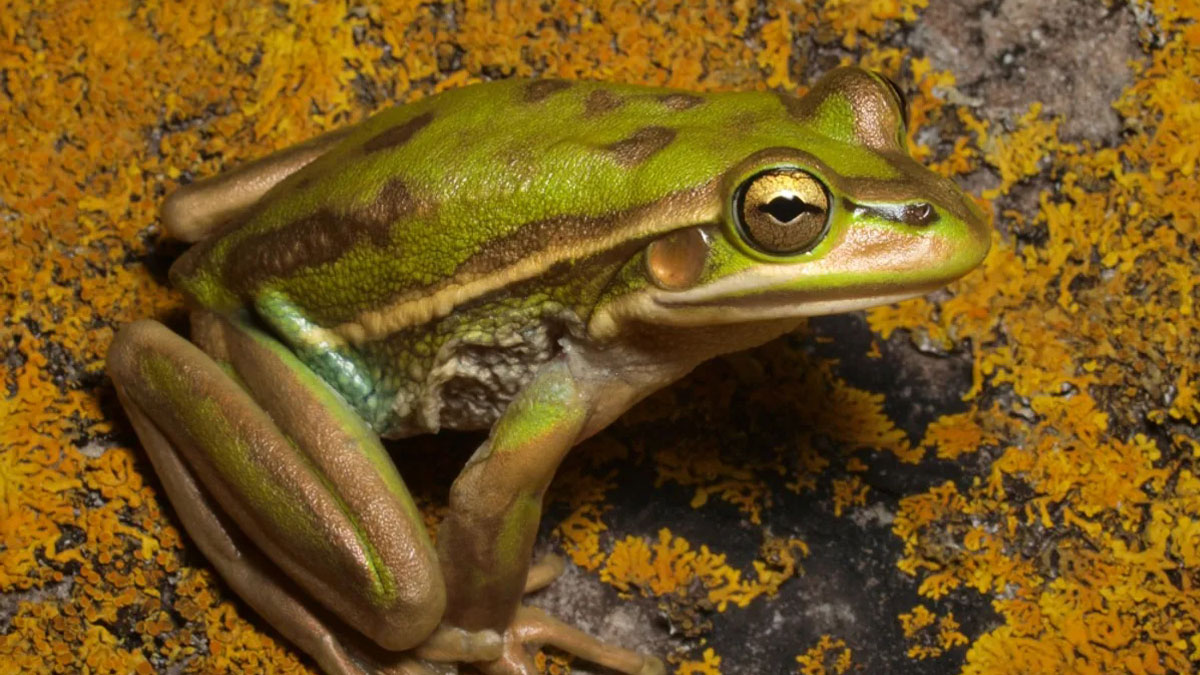
An optical phenomenon well documented in insects and birds, iridescence is notoriously rare among amphibians. By examining a well-known Australian frog species, researchers have highlighted a particularly striking example.
A Well-Kept Secret of Dryopsophus aureus
Originating from eastern Australia, the green and gold frog (Dryopsophus aureus) ranks among the country’s larger frog species, tipping the scales at around fifty grams. Renowned for its insatiable appetite and its capacity to gulp down large numbers of insects, this stout amphibian also presents a tempting target for wading birds, snakes, fish, and wild canids.
To better understand the anti-predator strategies of this creature described in 1827, biologist John Gould and colleagues from the University of Newcastle collected three adult specimens, a male and two females, on Kooragang Island in New South Wales. Their examination revealed a bright, metallic sheen confined to the inner surfaces of their thighs.
“Iridescence is an extraordinary optical effect that is regularly observed in birds, and is characterized by a color change of tissues depending on the angle of observation,” explain the authors of the new study, published in the journal Austral Ecology. “By manipulating these frogs, the skin on the inner side of their thighs shifted from a deep blue to turquoise hues, while the outer side retained its typical green-speckled shade.”
The fact that this pair of “shorts” is visible only when the frog leaps suggests an unusual case of “flash coloration,” aimed at startling and disorienting its predators. “Iridescence would strengthen this visual signal to maximize its effects,” advances Gould.
Complex Skin
If the discovery of an iridescent example in a creature long known to science for nearly two centuries suggests that it might concern other species previously described, it also broadens our understanding of blue pigmentation, a rarity in the animal kingdom.
Among frogs, the blue color results from the diffusion of light by microscopic skin structures. While it was previously thought that their distribution was largely random, the optical phenomenon observed in D. aureus points to a more intricate organization.
“These findings show that the skin of amphibians is considerably more complex than was originally assumed,” concludes Gould.
Previously, a study had revealed that iridescence allowed beetles to camouflage themselves effectively.

Contact details
Address:
Farmers Forum,
36, Dominick Street,
Mullingar,
Co. Westmeath,
Ireland
Phone:
+353 (0)44 9310206
Or email us:
For technical issues please check out our FAQ's page or email - [email protected]
For general Queries email - [email protected]
Request to add event to our Calendar - [email protected]
Send us your mart reports - [email protected]
Suggestions and feedbacks - [email protected]
News Items / Press Release - [email protected]
To Advertise on Farmers Forum - [email protected]