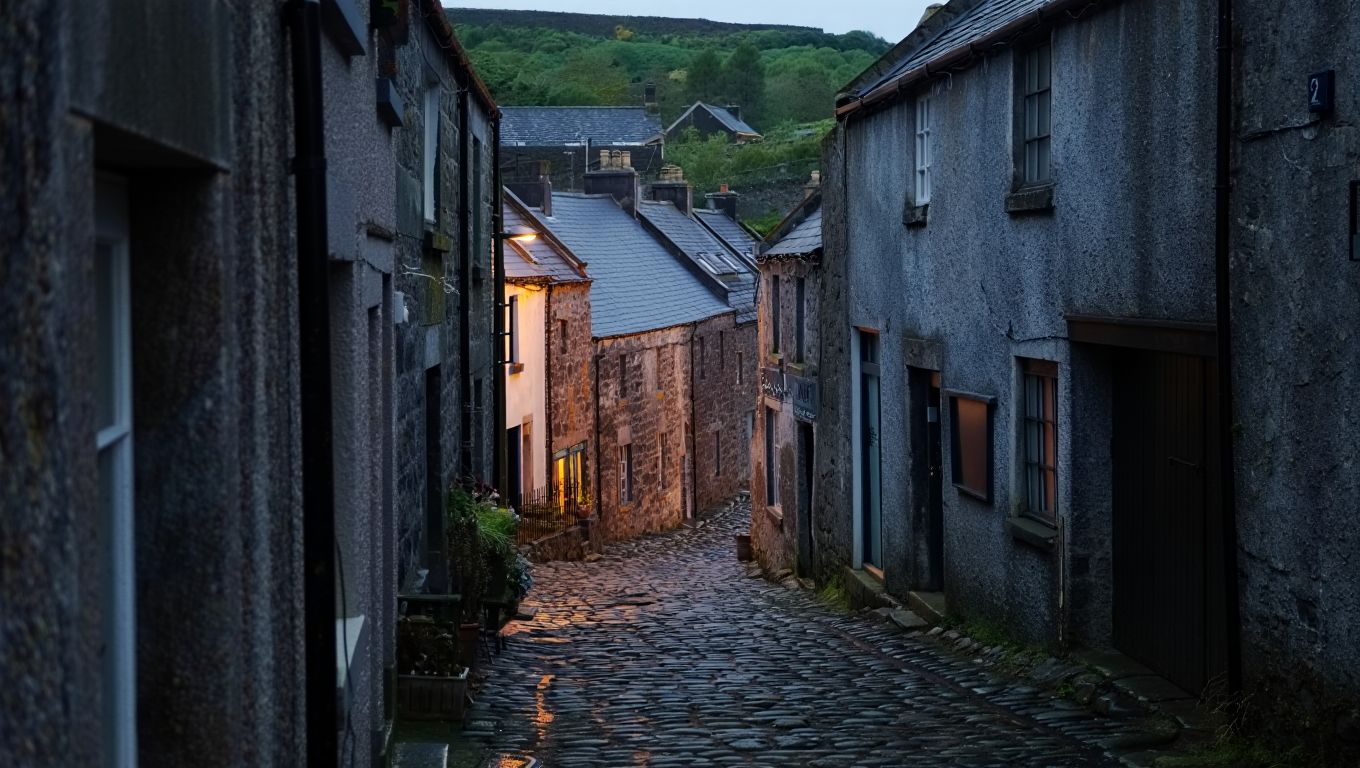
The first glimpse of Carlingford feels like a trick of the eye. Ivy-softened stone climbs toward a mountain that falls so steeply it could be Alpine. Then a gull cuts the sky, a fiddle stirs in a doorway, and you remember you’re on the edge of the Irish Sea.
Pastel façades wear salt and weather like badges of honor. Lanes are narrow, slate-roofed, and perfectly crooked. “It’s the kind of place where your camera keeps lying,” a traveler told me, “but your feet know better.”
Stone, Sea, and Sky
The town is cupped between Carlingford Lough and Slieve Foye, a stage set of water and height. On some afternoons the clouds snag the ridge like torn wool. Boats lean at low tide, their hulls painting stripes of shadow on silver mudflats.
You follow a thread of lanterns toward King John’s Castle, a toothy silhouette that frames the lough like a living postcard. The Tholsel gate narrows your step and widens your imagination. Every second doorway hints at a former guild, a mint, a granary gone to laughter and stout.
Locals speak of the mountain like a neighbor, not a backdrop. “When the wind turns north, you can smell the gorse before you see it,” someone says, pouring tea that tastes faintly of peat and rain.
August, When It Peaks
The year crescendos in August, when the town moves at a bright clip. Evenings stretch like warm elastic, and windows bloom with geraniums that refuse to fade. Seaweed dries on ropes, the air tasting of iodine and hot rope.
Festivals ripple through weekends, none louder than the oysters, shucked with the speed of gossip and the ceremony of a toast. A fiddler turns the corner, and a bodhrán answers from somewhere behind the next lintel. “The town breathes in eight languages,” a server laughs, “but everyone orders the same pint.”
Heath purples the lower slopes, and blackberries bruise your fingers on hedges older than most maps. The water is bracing, but the lough’s long reach warms with the sun like a shallow bowl.
Medieval Texture Up Close
Here, time catalogs itself in textures, not plaques. King John’s Castle throws a long shadow, but it’s the Mint’s exquisite windows that pull you close, an education in craft and trade. Taaffe’s Castle bears its angles like a well-cut jacket, stubborn against wind, modern glass winking from old bones.
Cobblestones give a satisfying argument under your boots. Signs switch between English and Irish with the easy code-switch of a bilingual daydream. Pubs wear firelight in the afternoon, reeling off sessions that feel spontaneous until you realize they’ve been rehearsed for centuries.
Even the cafés seem cut from an older grammar, where windows are for watching weather and doorways are for gossip. A cyclist ghosts by, wheels whispering like a small, satisfied stream.
Ways to See It
- Climb toward Slieve Foye on the Táin Way for a mountain-at-your-back, sea-at-your-feet perspective.
- Time your walk to low tide and trace the shore, pockets filling with shells and small, round stones.
- Aim your lens at the Tholsel at blue hour, when the streetlamps praise the masonry.
- Drift out on a kayak at sunset and let the ridge redraw its profile in bronze water.
- Book an oyster tasting, pair with a briny stout, and ask for the oldest story they’re willing to tell.
After Dark and Early Light
Night turns the town intimate, tucking the streets into a velvet hush. The lough becomes sheer ink, and the castle walls look closer, like they’ve taken one step forward to listen to the music. Glass clinks, a door creaks, and a laugh falls into the street like a coin.
Morning returns all the angles. Buns steam in windows, deliveries chime against old stone, and gulls referee the harbor with comic authority. “You wake to the same view,” the baker says, “but it’s always a different morning.”
Why It Feels Alpine, Yet Isn’t
The trick is the sudden elevation, that mountain that seems to jump right into the water. The streets meet it at sharp grades, façades stacked like chalets in a postcard you swear you’ve already mailed. But the palette is pure island: lichen-flecked granite, doorframes the color of fennel and sea.
Sound gives it away: the lilt of voices, the slip of rain, the steady drum of a bodhrán underfoot. Even the food speaks with a local accent—oysters fat with tide, chowders thick as fog, butter that tastes of grass and patience.
Come for the photogenic paradox, stay for the everyday truth. The camera may flirt with Alpine fantasies, but the heart learns the grammar of this coast quickly: stone, music, tide, and a town that chooses to be itself, especially when summer is at full stretch.

Not a genuine pic