
Since January 12, 2026, regional health agencies systematically search for twenty PFAS in every drinking-water control campaign. This marks a real methodological shift: previously testing was done selectively, upon reports or industrial suspicion. Since then, testing has become universal, done all the time.
The initial large-scale results outline a picture that is not what was expected. The regulatory limit — 0.10 microgram per liter for the sum of twenty PFAS — is almost never exceeded. A broad Anses campaign conducted between 2023 and 2025, covering about 20% of water distributed in France, found only nine exceedances across 627 tap-water samples.
However, the most prevalent PFAS in French water is not part of these twenty. Trifluoroacetic acid, TFA, was quantified in 92% of samples, at an average concentration of 1.15 µg/L and up to 25 µg/L near Salindres, in the Gard region. A water that is perfectly compliant today can thus contain ten, fifty or two hundred fifty times the limit that applies to the other twenty. TFA will join the monitored list in January 2027. It’s the kind of lag between the indicator and reality that we had already encountered with indoor air quality: what we measure structures what we see, and what we do not measure administratively does not exist.
We have revisited official figures, filtration results measured by independent laboratories, and the real five-year cost of each solution. With a precise objective: to enable decision-making, which neither alarmist pages nor reassuring pages allow.
What the regulations require exactly
The framework comes from European Directive 2020/2184 on the quality of waters intended for human consumption, transposed into French law at the end of 2022 and fully applicable since January 2026.
| Parameter | Value | Status |
|---|---|---|
| Sum of 20 PFAS in distributed water | 0,10 µg/L (100 ng/L) | Quality limit applicable in France |
| PFAS totals | 0,50 µg/L | Alternative parameter provided by the directive, not adopted by France |
| Systematic testing of the 20 PFAS | — | Mandatory since January 12, 2026 |
| Addition of TFA and the 6:2 FTSA | — | January 2027 |
France retained the stricter of the two options proposed by the directive: the sum of twenty identified substances, rather than the overall indicator at 0.50 µg/L. It is a protective principle in theory, and it also explains the current blind spot: a parameter defined by a list sees nothing outside the list.
A point the authorities themselves state and that the recaps omit systematically: these 0.1 µg/L are a management value, not a health threshold. To exceed it does not mean there is an established risk for consumers; to respect it does not mean there is nothing. It is a regulatory trigger that initiates measures, not a biological boundary.
What surveillance has actually found
The ANSES campaign remains the most solid source available. Thirty-five PFAS were investigated, with 647 samples of raw water and 627 samples of tap water, representing about a fifth of the water distributed in the country.
| Finding | Result |
|---|---|
| PFAS detected at least once in raw water | 20 of 35 |
| PFAS detected in distributed water | 19 of 35 |
| Exceedances of the 20 PFAS threshold in raw water | none |
| Exceedances in tap water | 9 samples, from 0,11 to 0,451 µg/L |
| TFA quantified | 92% of samples, average 1,15 µg/L, maximum 25 µg/L |
| TFMSA quantified | 13% of tap water samples, up to 4,9 µg/L |
TFMSA deserves a pause, because it illustrates the actual state of knowledge. This substance appears in more than one in eight samples of tap water, at measurable levels, and its toxicity and sources remain largely unknown. We cannot panic nor dismiss it: we observe that it is present, and no one yet knows what to say about it.
The TFA, for its part, is better characterized in terms of origin. Three sources accumulate: atmospheric deposits from the degradation of refrigerant gases, occasional industrial discharges, and the degradation of certain pesticides. This last route explains why TFA can be found in areas without industrial chemistry—it’s entering via agriculture and via air, not only through pipes.
Regionally, the data align with the national picture. In Auvergne-Rhône-Alpes, a region historically marked by industry, 3,273 PFAS analyses were conducted in 2025 on 2,474 installations. By June 15, 2026, two non-conformities were under management: a seven-subscriber hamlet in Ardèche under restricted use since November 2025, and a situation in Ain affecting about 2,790 residents. Seventeen other situations identified earlier had been resolved, through activated carbon treatment or blending resources.
Two active non-conformities in a region of eight million inhabitants: that is the figure to keep in mind before buying an osmosis device. The problem exists, it is localized, and it can be treated. This is not a nationwide drinking-water crisis.
Check your commune’s water
The sanitary control results are public, commune by commune, and accessible on the Health Ministry portal. ARS also publish regional summaries, often in spreadsheet format, with the measured values per distribution unit.
Three reading precautions.
Watch the date. A 2024 result may cover only a few substances. Analyses after January 2026 cover the twenty regulated PFAS; earlier ones did not always.
Look for the distribution unit, not the commune. A single commune can be supplied by several sources, with results varying by district. It is the network name that counts, not the postal code.
Don’t conclude from the absence of a exceedance to the absence of a substance. Water at 0.08 µg/L is compliant and contains PFAS. The sheets often display an overall conformity without detailing the values: you must consult the detailed table.
What filtration actually eliminates
This is the area where the market tells almost anything, yet independent measurements exist nonetheless.
Tests conducted by an European consumer organization on domestic filtering carafes measured high reduction rates: up to 96% for certain long-chain PFAS, and complete removal of the four PFAS retained by the European Food Safety Authority in its reference assessment. For TFA, the same carafe reduced water from 1,300 ng/L to 160 ng/L, an 88% reduction.
The most counterintuitive result concerns a premium gravity filter sold for over 400 €: complete elimination of long-chain PFAS, but only 15% for the ultra-short chain TFA. That is twenty-five times less effective than a 25 € carafe on the most common substance in French water.
| Technology | Long-chain PFAS | TFA (short-chain) | Note |
|---|---|---|---|
| Activated carbon alone | Good | Poor | Performance highly variable by model |
| Activated carbon + ion-exchange resin | Excellent (up to 96%) | Good (~88% measured) | Depends on strict cartridge replacement schedule |
| Premium gravity filter | Excellent | Very low (~15%) | High price, bulk |
| Reverse osmosis | Nearly total | Nearly total | Removes minerals from water and rejects several liters per liter produced |
The operational takeaway is clear: what makes the difference for PFAS is not price or device size, but the presence of an ion-exchange resin in addition to activated carbon. Many cartridges do not include it and merely improve taste. The label rarely appears on the packaging, often only in the technical specification.
Two limits to state honestly. A saturated cartridge releases what it has captured: a poorly maintained filter is worse than no filter, and the replacement schedule is not a commercial suggestion but a operating condition. And 96% elimination leaves 4%: for compounds that accumulate, filtration reduces exposure; it does not eliminate it.

Two common misconceptions to dispel
Boiling water does not eliminate PFAS — it concentrates them. Boiling causes water to evaporate and leaves the perfluorinated compounds behind, which are not volatile at that temperature. A pot of boiled water therefore has twice as many PFAS per liter. This is the exact opposite of what occurs with microplastics, where boiling followed by filtration yields measurable results. The act helps one contaminant and hinders another.
Boiled bottled water is not an obvious solution. Bottled waters are not PFAS-free — they come from aquifers subject to the same atmospheric deposition — and they bring their own contamination, notably plastic particles: a study counted up to 370,000 particles in a liter. Substituting one exposure for another is not a decision; it’s a relocation.
What happens when an exceedance is confirmed
The procedure is little known and explains why there can be several weeks between an analysis and public notification.
An isolated result above the threshold does not trigger a restriction. The analytical uncertainty on these measurements is around 30%, which makes an exceedance of a few percent inconclusive. A new sampling is therefore performed, analyzed by an accredited laboratory, and it is the confirmation that unlocks the next phase: sanitary assessment, then a decision by the authorities to restrict its use for drinking and cooking, or to implement a treatment.
The two technical responses used in France are granular activated carbon treatment at the production unit and blending of resources, which means diluting the contaminated resource with another. Seventeen situations were resolved by one or the other in the Auvergne-Rhône-Alpes region alone. These efforts take months and are costly, which is why use restrictions serve as a transitional measure.
For an inhabitant, the practical consequence comes down to a reflex: sign up for alerts from your water service whenever they exist, rather than waiting for the notification posted in the town hall. A restriction on use is communicated by mail and by notice posted in the town hall, two channels that few people check daily.
Putting water back into the bigger exposure picture
Water is the most monitored exposure pathway to PFAS, and by far. It is not the only one, and probably not the main one for an average French adult.
The other documented routes are: diet, notably seafood products and some crops grown on contaminated soils; food packaging treated to resist grease; non-stick coatings, especially when degraded; certain cosmetics; household dust; and treated technical textiles with water-repellent finishes.
The latter is the easiest to reduce concretely and the least discussed. Water-repellent and stain-resistant finishes applied to technical clothing, footwear, and some furnishings textiles still largely rely on PFAS compounds. A cheap sports garment purchased outside Europe often escapes composition controls—this is one of the blind spots of fast-fashion commerce we noted when discussing price penalties.
Stating this proportion is not a way to minimize the water issue. It is a way to avoid misdirected spending: installing a 400 € osmosis unit while renewing every season a technical wardrobe treated with PFAS is like plugging a hole with the faucet left on.

The real five-year cost
Assumption: a two-person household consuming 3 liters per day for drinking and cooking, i.e., 1,095 liters per year.
| Solution | Investment | Annual cost | Total 5 years |
|---|---|---|---|
| Tap water only | 0 € | 4 € | 22 € |
| Filtered carafe | 25 € | 52 € | 287 € |
| Filtered faucet | 60 € | 64 € | 382 € |
| Bottled spring water | 0 € | 164 € | 821 € |
| Under-sink osmosis | 400 € | 84 € | 822 € |
| Branded mineral water | 0 € | 328 € | 1 642 € |
The table holds two surprises. First: bottled spring water and under-sink osmosis end up at the same price over five years, within one euro. Except that the osmosis unit treats all drinking and cooking water, with no transport, no storage, and no packaging, and it continues beyond the fifth year for consumables alone. Second: branded mineral water costs seventy-five times as much as tap water, for a PFAS benefit that is not established.
A precision not shown on any packaging: cartridge prices are regularly promoted, using the same online pricing practices as the rest of the e-commerce market. The ten-second price-check method we described in relation to the thirty-day rule for price reductions applies fully to this market, where purchases are recurrent and thus particularly sensitive to the actual unit price.
Frequently asked questions
Are there PFAS in my tap water?
Very likely in measurable quantities, without exceeding the limit in the majority of cases. The ANSES campaign detected 19 PFAS among 35 sought in distributed water, with only 9 exceedances across 627 samples. The results for your commune are public on the Health Ministry portal, accessible by distribution unit.
What is the regulatory threshold for PFAS in drinking water?
0.10 µg/L, i.e., 100 nanograms per liter, for the sum of twenty identified perfluorinated substances. France chose this parameter rather than the 0.50 µg/L “PFAS totals” indicator provided by the directive. Authorities note that it is a management value, not a health threshold.
Is TFA regulated in drinking water?
Not yet. Trifluoroacetic acid is not among the twenty PFAS currently monitored, although it is quantified in 92% of samples in France at an average of 1.15 µg/L. It will be added to the list of controlled substances in January 2027, alongside 6:2 FTSA.
Does a filtered carafe remove PFAS?
Carafes combining activated carbon and ion-exchange resin achieve up to 96% reduction for some long-chain PFAS and about 88% for TFA, according to tests by a European consumer organization. Carafes with activated carbon alone are markedly less effective. Adhering to the replacement schedule governs the entire system: a saturated cartridge re-leaches what it has captured.
Does boiling water remove PFAS?
No, boiling concentrates them. Perfluorinated compounds are not volatile at that temperature: water leaves, they stay, and the concentration per liter increases. This is the opposite of the behavior seen with microplastics, where boiling followed by filtration yields measurable results.
Should we switch to bottled water because of PFAS?
Nothing proves it. Bottled waters come from aquifers subjected to the same atmospheric deposits and bring their own contamination in plastic particles. Over five years, branded mineral water costs about 1,642 € versus 22 € for tap water and 287 € for a filtered carafe.
What we would do
First, verify. Ten minutes on the official portal, looking for the distribution unit rather than the commune, and reading the detailed table rather than the conformity statement. Without this figure, any expense is blind.
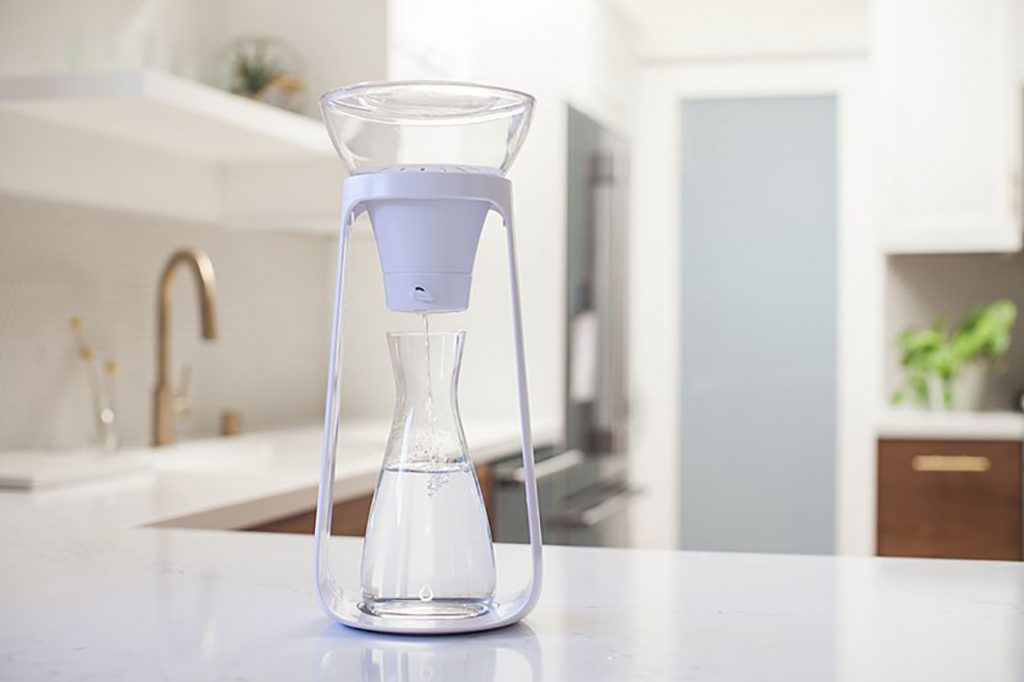
If the water is compliant and far from the threshold— the most common case—a carbon plus ion-exchange resin carafe, at 287 € over five years, reduces exposure by measurable amounts without any work installation. It’s the most favorable cost/benefit ratio in the table, provided you replace cartridges on time.
If the water approaches or exceeds the threshold, or if the network has a documented industrial history, the under-sink osmosis is the only domestic device that treats both long-chain PFAS and TFA effectively. Budget about 822 € over five years, plus an under-sink installation and additional water consumption to manage.
What we would not do: buy a several-hundred-euro filter without checking that it contains an ion-exchange resin, boil water thinking it purifies, or switch to bottled water costing 1,642 € over five years to exchange a poorly characterized exposure for another.
The topic will return in January 2027, when TFA enters the regulatory perimeter. Waters deemed compliant today will then change status, not because their composition has evolved, but because the list of things we look at will have grown. This page will be updated at that time.

Contact details
Address:
Farmers Forum,
36, Dominick Street,
Mullingar,
Co. Westmeath,
Ireland
Phone:
+353 (0)44 9310206
Or email us:
For technical issues please check out our FAQ's page or email - [email protected]
For general Queries email - [email protected]
Request to add event to our Calendar - [email protected]
Send us your mart reports - [email protected]
Suggestions and feedbacks - [email protected]
News Items / Press Release - [email protected]
To Advertise on Farmers Forum - [email protected]