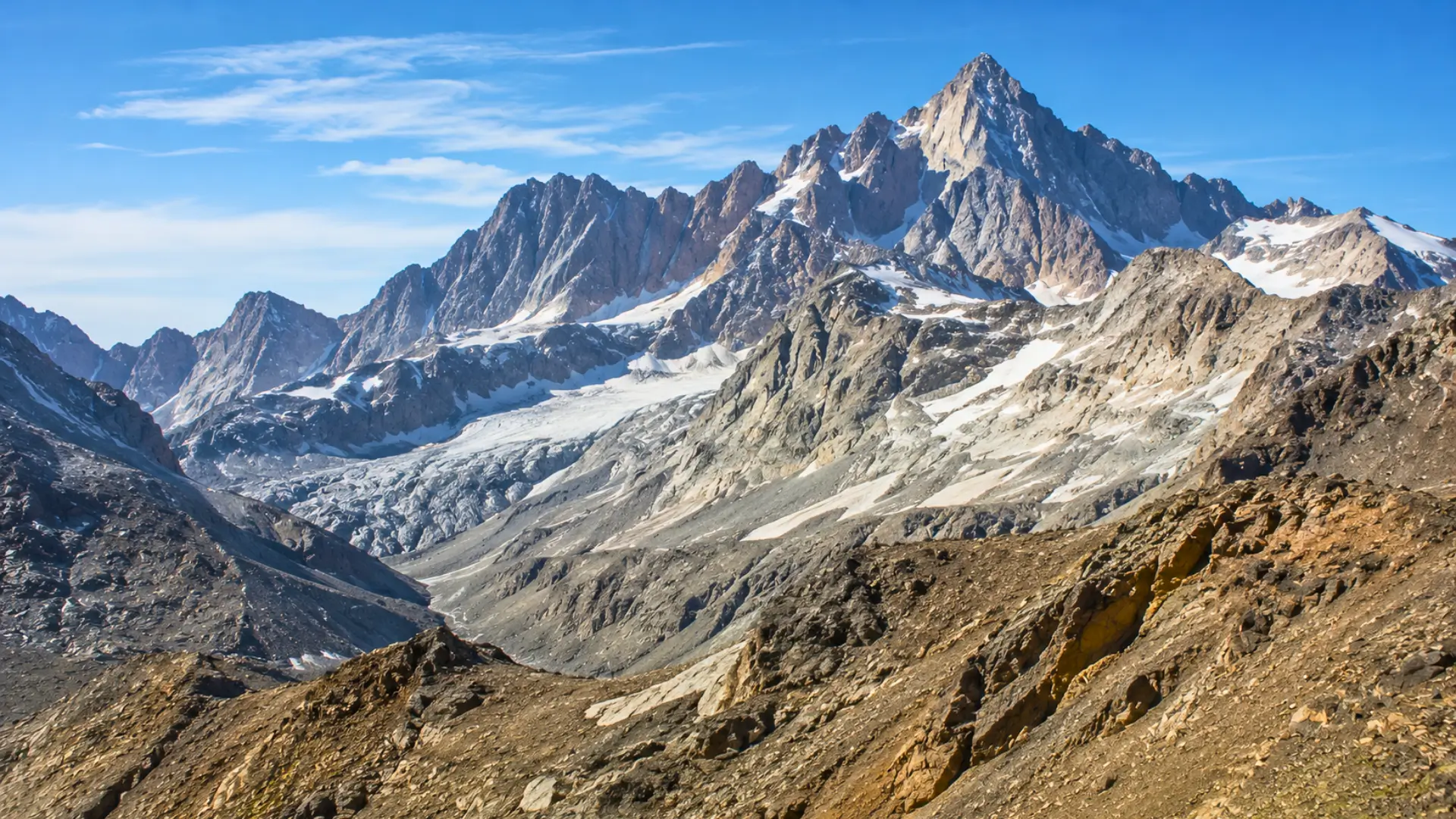
In the Écrins, the thawing of permafrost is no longer a distant abstraction. Trails shifted, shelters reinvented, torrents more brutal, chapels threatened: the high mountains are changing their face under warming. And this silent upheaval is already beginning to redraw human life up there.
When permafrost thaws, the walls of the Écrins suddenly become far more unstable
At 2,500 meters above sea level, a refuge isn’t supposed to shudder like a house hit by an earthquake. Yet in the Écrins massif, a massive rock slab detached itself during the summer of 2023. From then on, one truth stood out: when the permafrost thaws, the mountain can lose its invisible glue.
This deep-seated ground that has been frozen for at least two years acts as a natural cement within the rock faces. Yet when it warms, fractures open. Water seeps in, and then everything can tilt. In Switzerland, the PERMOS scientific network has been documenting for years a sustained warming of Alpine permafrost. Recent values remain abnormally high in depth.
In the Écrins, this is not a laboratory abstraction. It translates into more frequent rockfalls, recalibrated routes, and constant vigilance. Thus, the spectacular is no longer confined to the scenery. It also hides in a troubling idea: even the rock in the mountains is no longer truly stable.
In the Écrins, the alpine climbing season shortens and forces everyone to adapt
For a long time, high mountain life moved to a familiar tempo. Snow lingered longer. Crevasses remained well bridged, and rocks stayed relatively locked until mid-August. But this rhythm is disrupted. In many areas, the favorable window now closes earlier. Sometimes, as early as mid-July, heat already weakens the routes.
This shift in the calendar changes everything. Refuge keepers move up openings. Guides adapt the climbs, and enthusiasts come earlier. In certain rocky approaches located above 3,000 meters, crampons give way to sneakers at the end of summer. Yet behind this almost banal image, a deeper transformation emerges: the summer mountain looks less and less like yesterday.
At the Pré de Madame Carle, glacier retreat also transforms access and facilities
The Pré de Madame Carle has long embodied an almost accessible high mountain. It remains a broad gateway to the Glacier Blanc and the Écrins ridge. Yet this very popular site, which welcomes tens of thousands of visitors each year, is also subject to the new nervousness of the relief. Between glacier retreat, unleashed rocks and more unpredictable torrents, the landscape is changing rapidly.
When a glacier retreats, it leaves behind not a simple photogenic void. In fact, it releases masses of rock, alters the flows and makes floods more devastating. The Écrins National Park thus tracks the retreat of the Glacier Blanc. Its trend remains negative between 2012 and 2023, with a declining mean mass balance over the recent period.
The impact becomes tangible when a bridge disappears, when a parking lot is gnawed away, or when a torrent suddenly breaches its channel. After the extraordinary floods of 2024 in the range, the planning logic also changes. Heavy and durable structures are not always the best fit anymore. In high mountains, it is sometimes necessary to build light, dismantlable, and replaceable.
From the high-altitude refuge to the Chapel of Thabor, all mountain life must reinvent itself
One must climb above 3,100 meters to encounter one of the most striking symbols of this transforming mountain: the chapel of Mount Thabor. Set in a virtually unreal mineral landscape, it seems to challenge the centuries. Yet today it is not war or abandonment that threatens it. It is the slow subsidence of the frozen ground that supported it.
Cracks, lanyards, public closure: the edifice makes tangible what graphs sometimes struggle to show. For warming does not merely melt ice. It reaches places of memory and already amplifies the risks of landslides, floods, and destabilizations across the Alps. What is unfolding in the Hautes-Alpes thus goes beyond mere alpine scenery.
Refuges diversify their activities, while valleys rethink their access. Visitors themselves discover landscapes more unstable than they appear. Little by little, a question gains traction, almost as quickly as the heat: what will the mountain look like when we must learn not only to admire it, but to continually negotiate with its instability?

Contact details
Address:
Farmers Forum,
36, Dominick Street,
Mullingar,
Co. Westmeath,
Ireland
Phone:
+353 (0)44 9310206
Or email us:
For technical issues please check out our FAQ's page or email - [email protected]
For general Queries email - [email protected]
Request to add event to our Calendar - [email protected]
Send us your mart reports - [email protected]
Suggestions and feedbacks - [email protected]
News Items / Press Release - [email protected]
To Advertise on Farmers Forum - [email protected]