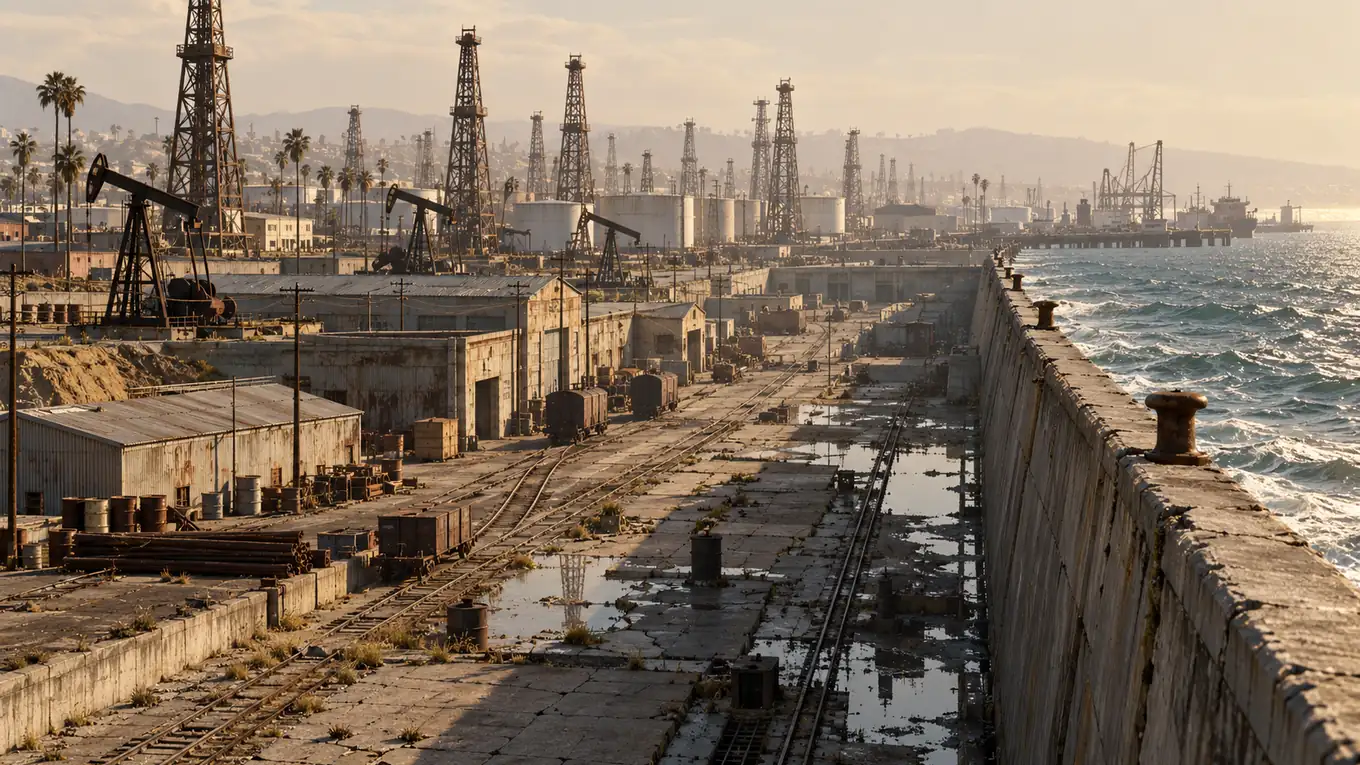
In the mid-20th century, a portion of Long Beach, California, sank by nearly 9 meters. The cause was intensive oil field exploitation. The injection of water into the subsurface, which halted the phenomenon, became a reference point in the fight against subsidence.
Discovered in 1932, the Wilmington oil field caused measurable subsidence as early as the early 1940s
The Wilmington oil field, discovered in 1932 beneath the Port of Long Beach and part of the southern Los Angeles metropolitan area, ranks among the most productive in the United States. According to the City of Long Beach, more than 3.7 billion barrels have been extracted.
By removing oil, water, and gas, operators drop the pressure in the reservoir. The sand and clay layers compact, and the surface follows the movement, as in many Chinese cities today. From the early 1940s, subsidence becomes measurable in the port area, before accelerating in the following decade.
In the center of the basin, the ground lost 29 feet of elevation, nearly 9 meters, over an area of more than 50 square kilometers
At the peak of the phenomenon, in the early 1950s, some areas were sinking by more than 60 centimeters per year. In 1958, the subsidence bowl covered about twenty square miles, more than 50 km². In its center, the elevation loss reached 29 feet, nearly 9 meters, the equivalent of a three-story building.
Damage then multiplied. Thus, quays, roads, rail lines, and pipelines became deformed, while dikes had to be erected to prevent the sea from flooding the port. Moreover, the movements of the subsurface cut many wells, and the City recorded 95 wells seriously damaged.
The military shipyard on Terminal Island was among the most affected sites. In 1958, the federal government filed lawsuits against the operators, a case eventually settled amicably.
From 1958 onward, the massive injection of saline water into the reservoir stabilized the ground in less than ten years
The same year, California passed a law requiring operators to coordinate their efforts to repressurize the field. The challenge was also legal, since hundreds of operators shared the reservoir, now organized into common units.
The principle involves injecting saline water into the rocks to replace the fluids extracted and restore pressure. Tests had begun as early as 1953, but the operation only fully gained momentum toward the late 1950s. According to a 1970 study in the journal Water Resources Research, 2.1 billion barrels of water had been injected by the end of 1968.
Indeed, the subsidence was halted in the mid-1960s, and the injection even improved oil recovery.
The ground never returned to its original level and remains monitored twice a year by the City of Long Beach
After stabilization, the surface rose slightly in some areas, by up to about twenty centimeters. However, part of the port remains several meters below its original altitude, as the compaction of the rocks is largely irreversible.
Today, the City measures the ground’s altitude every year in May and November, under the oversight of the California State Lands Commission. Thus, the volumes injected are adjusted to continually balance production and injection. The Long Beach example is regularly cited in regions where fluid pumping causes the ground to sink.

Contact details
Address:
Farmers Forum,
36, Dominick Street,
Mullingar,
Co. Westmeath,
Ireland
Phone:
+353 (0)44 9310206
Or email us:
For technical issues please check out our FAQ's page or email - [email protected]
For general Queries email - [email protected]
Request to add event to our Calendar - [email protected]
Send us your mart reports - [email protected]
Suggestions and feedbacks - [email protected]
News Items / Press Release - [email protected]
To Advertise on Farmers Forum - [email protected]