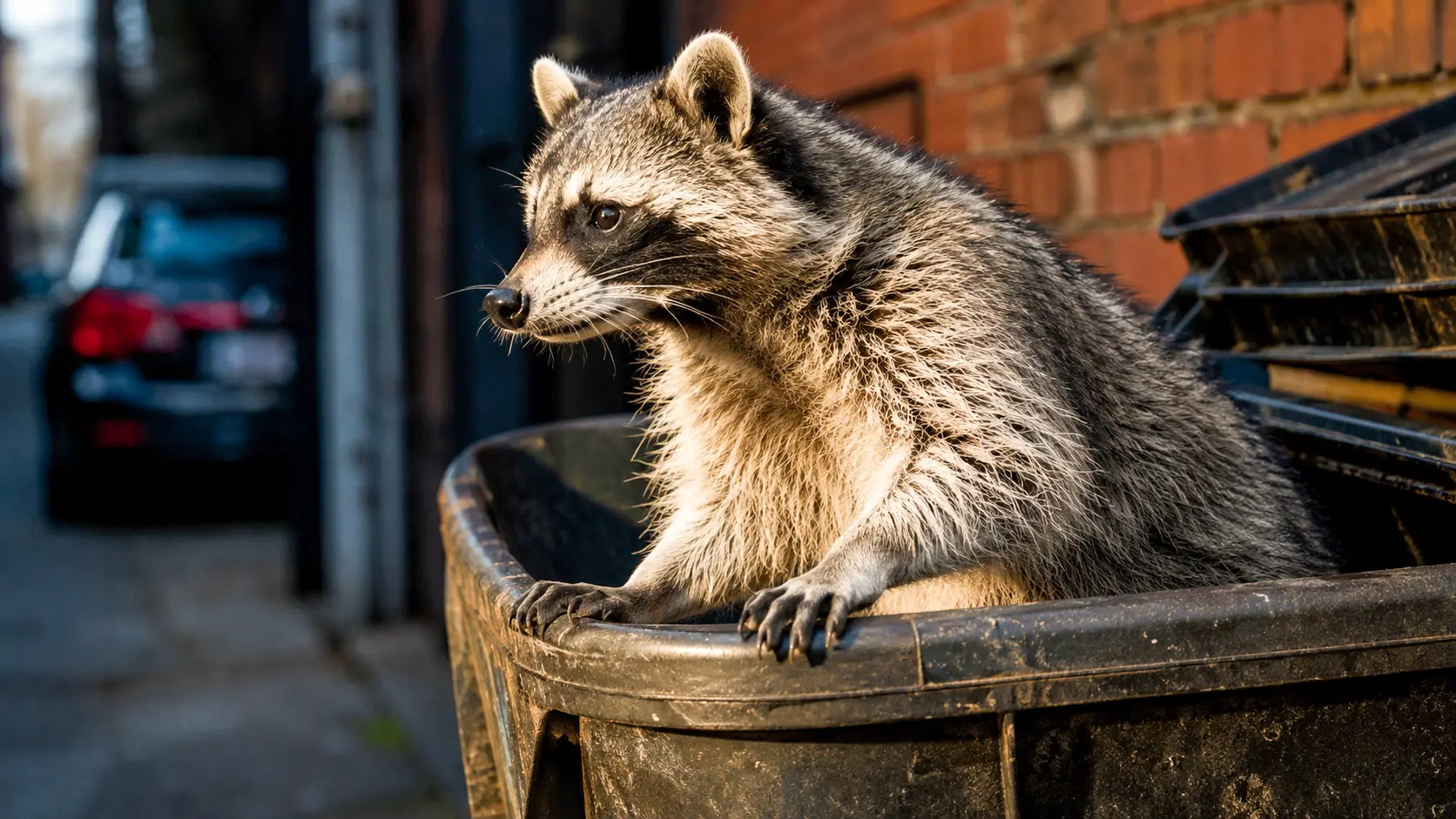
In the city, raccoons have a shorter snout than their rural cousins. This trait is typical of domesticated species. Yet, no one has trained them. It is the trash bins that, generation after generation, shape this silent evolution.
A 3.56% shorter snout: what 20,000 raccoon photos reveal
The figure is precise: 3.56%. It is the gap in snout length between urban raccoons and their rural American counterparts. The detail may seem minor. Yet it intrigues biologists. It indeed corresponds to a signature well known among domesticated species.
The study comes from the University of Arkansas at Little Rock. The biologist Raffaela Lesch directed the work, published in early October 2025 in Frontiers in Zoology. For this, the team did not capture any animals. They instead exploited the archives of iNaturalist, a participatory platform nourished by walkers’ observations.
Sixteen undergraduate and graduate students participated in the analysis. Each examined between 1,000 and 1,200 shots, before the results were pooled. In total, nearly 20,000 photographs of raccoons were thus scrutinized across the contiguous United States.
A known biological mechanism: the subtle role of neural crest cells
Scientists speak of the domestication syndrome. It’s a set of recurring traits in species brought under human control: shortened snout, floppy ears, loss of pigmentation. Already, two centuries ago, Charles Darwin had identified this pattern when comparing dogs and cats to their wild cousins.
The strongest explanation points to the neural crest. This group of cells migrates early in the embryo to shape the snout’s cartilage and pigmentation. Some mutations would slow its proliferation. The result: a shorter snout, but also a dampened fear of humans, two effects arising from the same mutation.
The trash bin sorts: natural selection without training or human intention
In the city, no one selects which raccoon will reproduce. It is the garbage cans that perform the sorting. The boldest individuals, and the least aggressive toward humans, gain easier access to edible waste. Consequently, they survive better, reproduce more, and pass these traits on to their offspring.
The urban environment changes the rules of the game. Large predators are almost absent there. Food, on the other hand, is abundant and easily accessible. As a result, this unprecedented ecological pressure favors, generation after generation, the animals most docile toward humans. Without training, without cages, without intention.
Unlike wolves turned into dogs, no one pets or selects these raccoons for their docility. Journalist Pasquale Nardone followed this dossier for RTBF. According to him, their snout has become about 4% shorter than that of their rural cousins.
Methodological biases and next steps: caution is warranted
Some researchers point to a bias, however. iNaturalist users photograph mostly visible animals near homes or parking lots. This inflates the urban sample. Moreover, the site Snopes noted that part of the gap could be explained by climate, rather than by proximity to humans alone.
The team led by Raffaela Lesch plans to 3D-scan raccoon skulls. The objective: cross these data with genetic and hormonal markers. They will then study opossums and armadillos to verify whether the same pattern repeats among other discreet city dwellers of American towns.

Contact details
Address:
Farmers Forum,
36, Dominick Street,
Mullingar,
Co. Westmeath,
Ireland
Phone:
+353 (0)44 9310206
Or email us:
For technical issues please check out our FAQ's page or email - [email protected]
For general Queries email - [email protected]
Request to add event to our Calendar - [email protected]
Send us your mart reports - [email protected]
Suggestions and feedbacks - [email protected]
News Items / Press Release - [email protected]
To Advertise on Farmers Forum - [email protected]