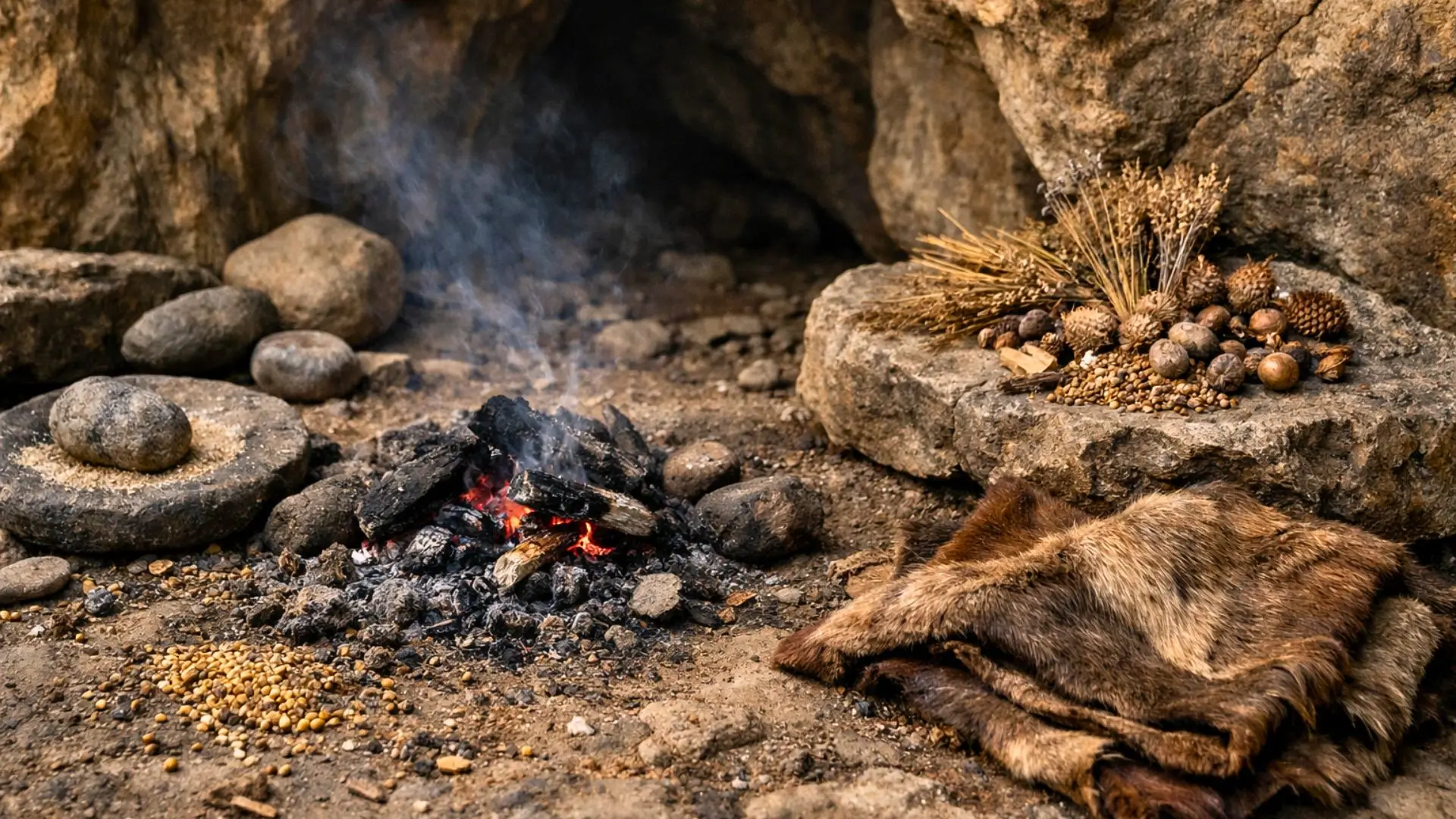
Our ancient Neanderthal cousins did not live by meat alone. Charred remains dating back 70,000 years, discovered in Iraq, reveal a surprising plant-based cuisine: soaking, pounding, and cooking. A food culture far more complex than previously believed.
Shanidar, Iraqi Kurdistan: 70,000-year-old charred remains, the oldest cooked meals ever studied
The Shanidar cave sits in the Zagros Mountains, about 800 kilometers north of Baghdad. This famous Neanderthal site yielded the bones of nine individuals in the 1950s and 1960s. Moreover, the Shanidar Cave houses the famous “flower burial,” which suggests an intentional burial of their dead.
More recently, researchers uncovered charred fragments in old hearths at the site. Chris Hunt and his team at Liverpool’s John Moores University thus analyzed these remains with a scanning electron microscope. Hence, these fragments constitute the oldest evidence of cooked food ever examined by science.
These studies appear in the scientific journal Antiquity and rely on an analytical method rarely applied to such ancient remains. Indeed, the scanning electron microscope allows the detection of plant cellular structures still visible in the charcoal. From there, the researchers could precisely identify the plants Neanderthals used in their preparations.
Soaking, pounding, and heating legumes: Neanderthal already applied multi-step culinary techniques
The analysis reveals clear traces of soaking and pounding the seeds. Among the identified species are the bitter vetch, wild chickpea, and wild pea. Neanderthal then mixed these legumes with wild herbs and heated them with water.
Since Neanderthals did not make pottery, researchers propose that he soaked his seeds in folded animal skins. Furthermore, he did not remove the seed coats before cooking. This allowed him to retain the natural bitterness, revealing an active search for pronounced flavors.
Recreated recipe: a hazelnut-flavored, chewy flatbread that explains Neanderthal dental wear
The team reproduced the recipe using seeds gathered near the caves. The resulting dish resembled a granular flatbread. The hazelnut flavor was indeed pleasant, but the texture made chewing particularly challenging.
Chris Hunt personally tasted this reconstruction. He drew a clear conclusion: this diet largely accounts for the severe wear on Neanderthal teeth. Moreover, pounding with local stones produced a texture inevitably rough and abrasive for the jaws.
This experiment also sheds light on a broader debate about Neanderthal cognitive abilities. Indeed, reproducing a multi-step recipe requires foresight, memory, and knowledge transmission. These clues thus show that food culture existed well before the appearance of agriculture, about 10,000 years ago.
Greece and Iraq, 60,000 years apart: two Paleolithic caves reveal a shared and far more sophisticated culinary culture
In parallel, researchers examined charred fragments from the Franchthi Cave in southern Greece. Homo sapiens occupied this site about 12,000 years ago. Yet, the techniques and ingredients identified there closely resemble those at Shanidar.
Although separated by 60,000 years and thousands of kilometres, the two caves share striking commonalities. Ground legumes, wild herbs, mustard, wild pistachio: both groups cooked everything in water. These findings thus show that the Paleolithic was not purely carnivorous and rudimentary.

Contact details
Address:
Farmers Forum,
36, Dominick Street,
Mullingar,
Co. Westmeath,
Ireland
Phone:
+353 (0)44 9310206
Or email us:
For technical issues please check out our FAQ's page or email - [email protected]
For general Queries email - [email protected]
Request to add event to our Calendar - [email protected]
Send us your mart reports - [email protected]
Suggestions and feedbacks - [email protected]
News Items / Press Release - [email protected]
To Advertise on Farmers Forum - [email protected]