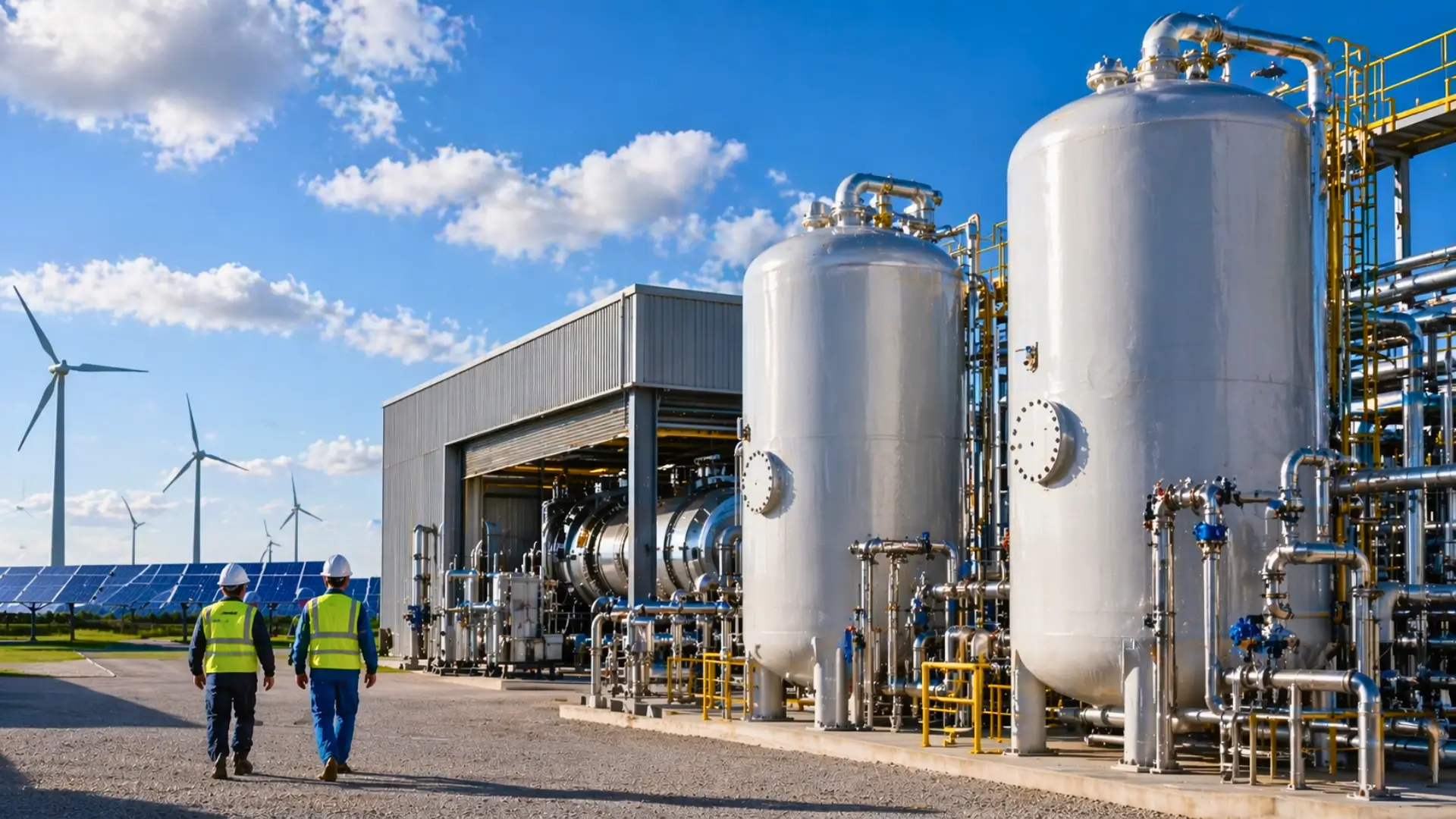
What if a simple, clean, and inexpensive solution already exists to store renewable energy? MIT researchers highlight an astonishing technology capable of turning air into a giant battery. But behind this alluring promise lies an unexpected obstacle.
Liquefying Air to Store Electricity: An Ancient Thermodynamic Principle Reimagined
In the public imagination, storing energy evokes lithium batteries or hydroelectric dams. Yet, a quieter alternative has existed for decades: Liquid Air Energy Storage, or LAES. Its principle rests on a nearly poetic idea: to cool air until it liquefies to capture excess energy.
In practice, the available electricity is used to compress and then cool the air to around −196°C. At this temperature, it becomes liquid and can be stored in compact tanks. When energy is needed, this air is heated, expands rapidly, and drives a turbine. A simple yet ingenious mechanism, inspired by classical thermodynamic cycles.
This system does not depend on mountainous terrain nor on rare resources. It operates with ambient air, available anywhere on Earth. This simplicity has long intrigued engineers, but it is now at the heart of discussions, propelled by the climate emergency and the growing need for long-duration storage.
A technology free of rare metals, flexible and already cost-competitive for storage
One of LAES’s major advantages lies in its minimized environmental footprint. Unlike conventional batteries, it uses no critical metals such as lithium or cobalt. No risk of chemical pollution, no problem of complex recycling. Just air, compressed, cooled, and released.
Another often-underestimated benefit is its flexibility. Installations can be deployed in industrial zones, near power grids, or even in regions lacking dedicated infrastructure. This ease of deployment stands in stark contrast to other storage technologies that are more constraining.
According to a recent study published in the journal Energy and conducted by MIT researchers, the updated storage cost is about €53 per megawatt-hour. A particularly competitive figure that places LAES among the most promising options to accompany intermittent renewable energy sources.
Profitability still fragile despite attractive cost and promising performance
Despite its technical merits, LAES faces a far more complex economic reality. The researchers analyzed its profitability using several decarbonization scenarios in the United States. Verdict: in most cases, the technology remains financially non-viable without very specific conditions.
Only a scenario of rapid and mass decarbonization by 2035 would allow meaningful profitability. And even then, it would be limited to certain states such as Texas or Florida. This reliance on optimistic assumptions makes investors cautious about a technology that remains promising nonetheless.
The problem does not lie with operating costs, but rather with insufficient return on investment. Initial infrastructures remain costly, and the revenues generated from energy storage do not always offset these expenditures under current market conditions.
Subsidies and efficiency gains: the two levers to unlock LAES’s potential
Facing this impasse, several avenues are emerging. The first is to improve the system’s energy efficiency, notably by optimizing thermal cycles or recovering more heat during compression and expansion phases. Every gain, even a small one, can influence overall profitability.
Another solution, more political, relies on public intervention. The researchers estimate that subsidies covering 40 to 60% of the costs could be enough to make the technology viable. A lever already used for other emerging energies, but it raises questions about investment priorities, as every euro invested becomes strategic in the race toward decarbonization.

Contact details
Address:
Farmers Forum,
36, Dominick Street,
Mullingar,
Co. Westmeath,
Ireland
Phone:
+353 (0)44 9310206
Or email us:
For technical issues please check out our FAQ's page or email - [email protected]
For general Queries email - [email protected]
Request to add event to our Calendar - [email protected]
Send us your mart reports - [email protected]
Suggestions and feedbacks - [email protected]
News Items / Press Release - [email protected]
To Advertise on Farmers Forum - [email protected]