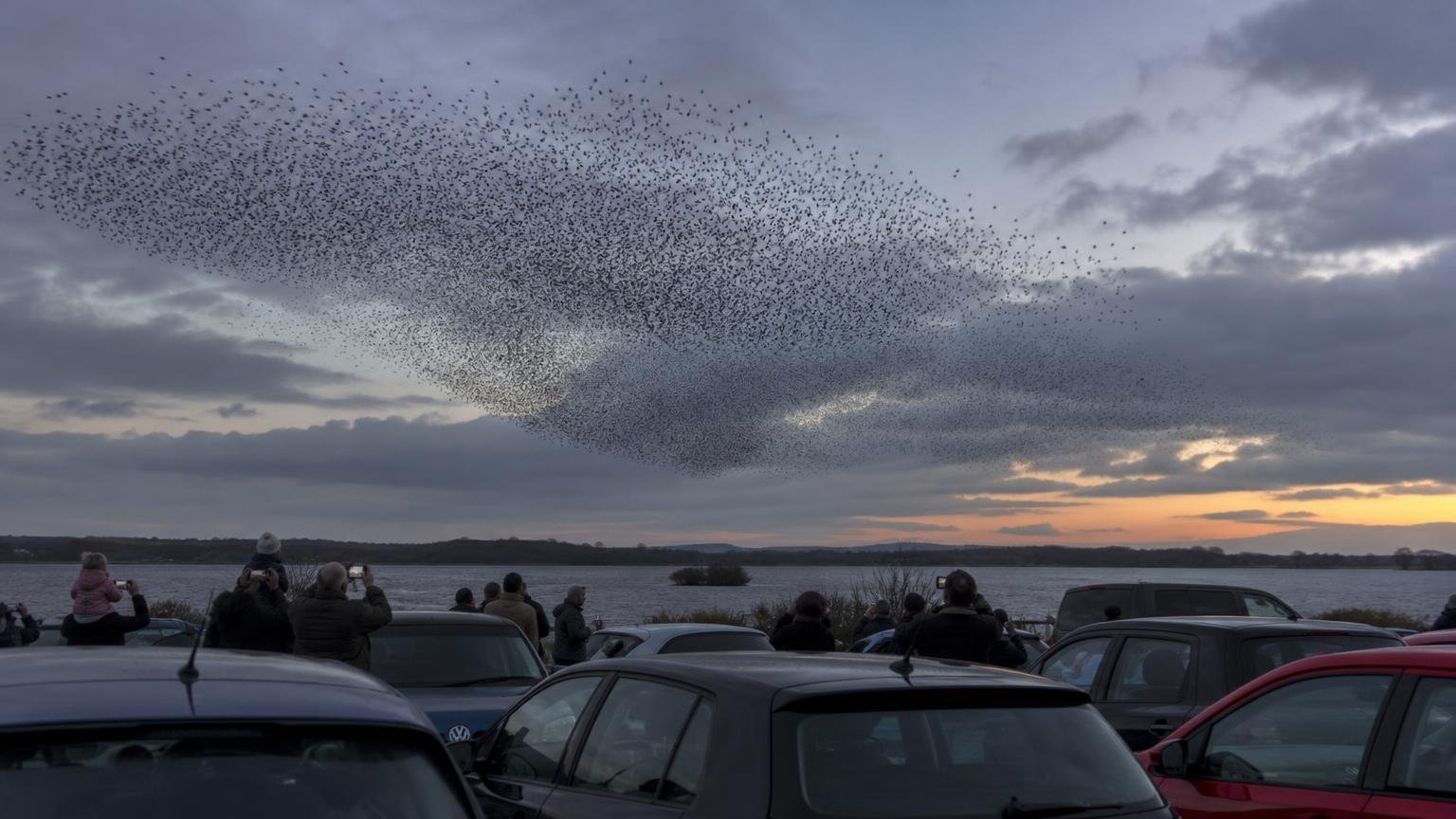
The first cold Saturdays of late autumn draw people to the water as if by a magnet. Headlights thread along hedgerows, boots knock on tarmac, and breath turns to ghost in the air. Children pull at sleeves. A hush settles that isn’t silence, just a held note, waiting for a cue.
The Hour the Lough Holds Its Breath
By four the car park is brimming, and the day has narrowed to its last edge. Reeds comb the wind. The lake is a sheet of pewter, puckered where coots make furrows. Then a smudge appears — not a line, not a flock, a thought beginning to take shape.
More arrive. They lift from fields and pylons, from church eaves and hawthorn, from miles of pasture sewn with dung and seed. The low sky takes them, and they take the sky. No one speaks for a beat. The murmuration begins like ink dropped in water.
Body of Smoke, Heart of Sparks
The birds draw calligraphy across the clouds, strokes thick and thinner, the whole thing tilting and folding like a sleeve of smoke. A hawk stitches the flank and the pattern tightens, a flexing muscle under a living skin. It is choreography without a choreographer, a riddle solved in the air.
“Look,” someone whispers, “they’re not crashing. How do they all know?” The answer is both simple and astonishing. Each bird tracks about seven close neighbors, matching speed and angle. The rule is local, but the effect is vast: information ripples through the group faster than any single wing can beat. Safety in numbers; beauty as a byproduct.
A Pop-Up Community on the Shore
Around the lough, strangers become brief kin. Thermoses pass; a flask lid becomes a cup; a dog whines but does not bark. A farmer counts under his breath, as if numbers could hold what the eyes can’t hold. Teenagers trade jokes and phone screens, chasing a frame that will stay when the light has gone.
“I come for the sound,” an older woman says. “That tight rush, like a coat being shaken.” Someone else mutters, half to himself: “We used to see this above the mill chimneys. Different smoke, same shape.”
How the Pattern Survives the Season
The reedbeds are the destination, but the flight is the festival. They gather to keep warm, to swap news of fields and predators, to roost where water thins the scent of fox and marten. Cold compresses the calendar; food scatters the map. Each dusk re-plots the graph of hunger and shelter.
Scientists call it a phase transition — a system poised on the edge of order and chaos. Enough birds, enough pressure, and the collective mind turns fluid. Fall a little later, and they’re simply birds again, dropping into the dark like ash that remembers it was fire.
How to Watch Without Disturbing
To be near this is a privilege, and a small duty. The lough has room for us, if we take up less room.
- Stand back from the reeds and keep dogs on a lead; the roost is fragile when the light is thin.
- Dim phone screens and avoid flash; these are eyes built for dusk, not a stadium of lamps.
- Leave no trace: what doesn’t belong to the water doesn’t belong to the shore either.
Weather, Light, and the Grammar of Wind
On bright days the show is ink on vellum; on dull days it’s charcoal on slate. A north wind hardens the edges; a south wind loosens them. Rain softens the clatter to a felted hum. The sound is not just wings; it’s air telling you the sentence it’s about to finish.
Photographers talk about ISO and shutters, but the best setting is patience. Let the birds draw the frame and your body be the tripod. Sometimes the finest image is the one your nerves keep, a tremor tucked under the ribs for the bus home.
The People Who Wait
You start to notice the regulars: the teacher with binocs patched by tape, the runner who finally stops, the pair who always bring an extra blanket. Even the lake has a face by now — a mood you read like weather, a crease between the eyes at the hint of a hawk.
There’s comfort in the return, a calendar written in wings. After a week of spreadsheets and queues, of headlines that scrape like grit, this is a public prayer without the bother of words.
When the Lights Go
One last fold, a sudden pour, and the mass drops into reeds with a sound like rain reconsidering. The spectacle collapses into a thousand private rests. The sky, newly emptied, looks larger for having been so full.
Engines cough. Doors thud. A child tries the word “murmuration” and laughs at its length. The lake steadying. The dark arriving. Somewhere in the reeds a single bird mutters, then another, and the night takes their measure. Tomorrow, if weather and hunger agree, the script will be rewritten over our heads, and we will come to read it, one more time.

Contact details
Address:
Farmers Forum,
36, Dominick Street,
Mullingar,
Co. Westmeath,
Ireland
Phone:
+353 (0)44 9310206
Or email us:
For technical issues please check out our FAQ's page or email - [email protected]
For general Queries email - [email protected]
Request to add event to our Calendar - [email protected]
Send us your mart reports - [email protected]
Suggestions and feedbacks - [email protected]
News Items / Press Release - [email protected]
To Advertise on Farmers Forum - [email protected]