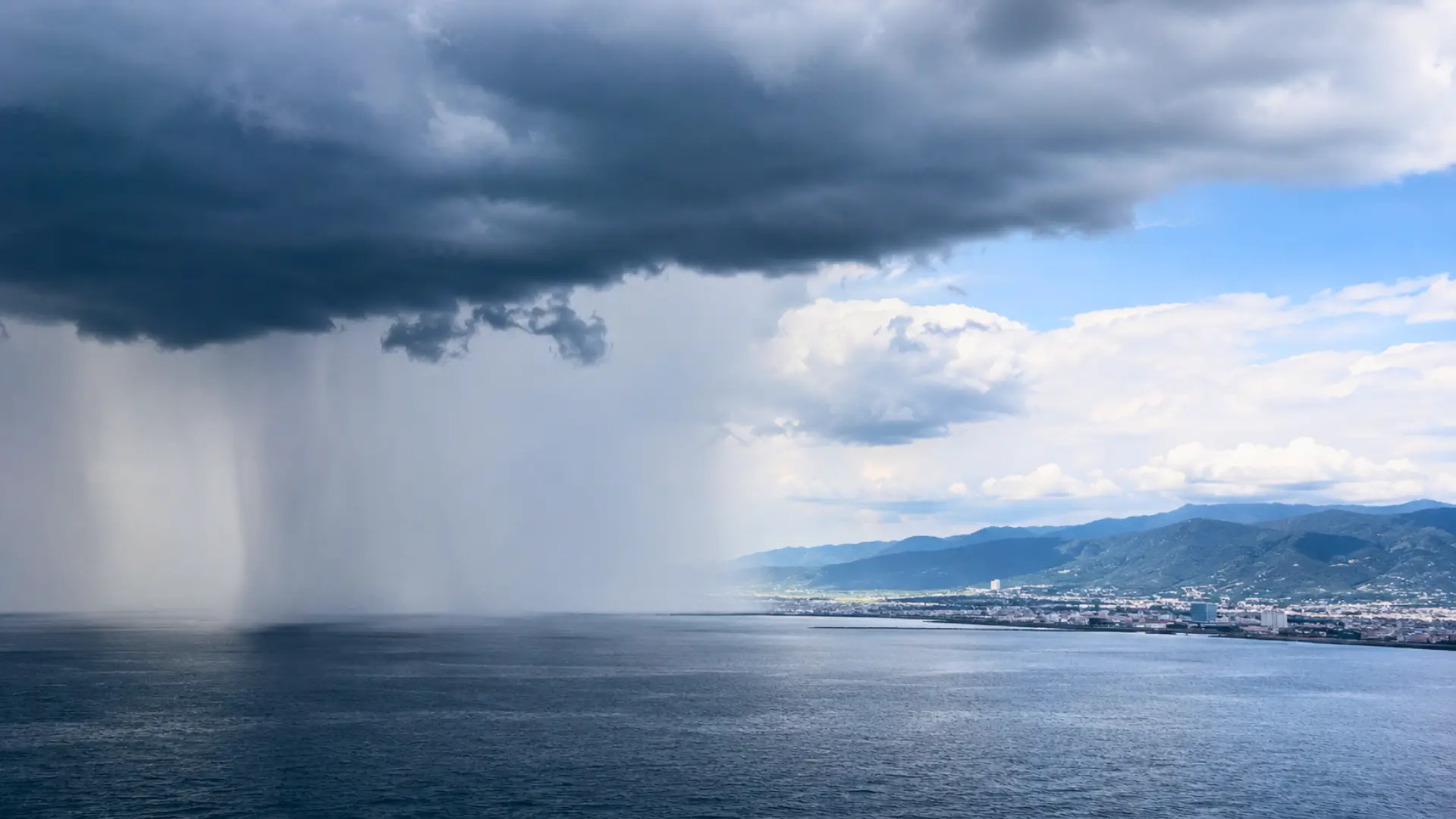
What if, in order to prevent a catastrophic downpour from hammering a city, the solution was to make it fall somewhere else earlier? In Japan, this nearly counter-intuitive idea is gradually leaving the simulations to take to the skies, with a dizzying objective: to dampen extreme rainfall.
Raining down the sea before it reaches cities: Japan’s surprising wager
Cloud seeding isn’t a new idea. Indeed, since the 1940s, this technique involves injecting particles into certain clouds. These particles then promote the formation of ice or rain. Today, Japan is exploring a bolder variant. It aims to trigger an anticipatory rainfall to limit impacts in inhabited areas.
Concretely, the idea rests on a principle that appears simple at first glance. Rather than waiting for a weather system to land on land, researchers try to act earlier. Thus, they mainly target maritime zones. The objective is to slightly alter the cloud’s evolution upstream. Moreover, the Moonshot program of the Japan Science and Technology Agency supports this research into extreme phenomena.
In Toyama’s sky, experiments serve as a dress rehearsal for a much larger idea
Early in 2026, Japanese teams conducted trials around Toyama. These tests targeted snowy clouds under real conditions. They thus allow direct intervention in the atmosphere. The challenge is to understand how a cloud reacts to a disturbance. Indeed, computer models do not always suffice to predict these reactions.
Dry ice is among the tools tested. In a cold cloud, it can trigger the rapid formation of crystals. Then, these crystals grow until they fall under their own weight. The process seems simple, but it depends on many factors. Notably, winds, humidity and the cloud’s structure play a key role.
However, one must not confuse these trials with another study published in 2026. It appeared in Natural Hazards and Earth System Sciences. It rests on numerical simulations related to Hiroshima’s extreme rainfall in 2014. Moreover, the results suggest that well-placed seeding could alter precipitation distribution.
Behind these clouds lies a science-fiction-worthy objective: to act on typhoons
Japan is not only interested in heavy rainfall. In reality, the program also targets typhoons. At Yokohama University, researchers are studying ways to weaken these cyclones. They test light interventions in systems that are nevertheless extremely powerful. The aim is to reduce damage without completely disrupting the storm.
The Moonshot Goal 8 project sets a clear ambition. By 2050, it would involve acting on certain extreme events. This could concern their intensity or their trajectory. Yet the idea is not to control the weather. It is rather to influence highly unstable systems with limited actions.
Nevertheless, the atmosphere remains unpredictable. Two almost identical situations can evolve differently. Thus, every assessment becomes complex. If rain decreases after an intervention, proving the exact cause is difficult. Researchers must therefore compare with a scenario that never existed.
Modifying a deluge may seem seductive, but no one yet knows how far to go
One essential question remains. What happens to the water displaced by these interventions? Indeed, rain avoided in one zone could reappear elsewhere. Researchers must therefore study indirect effects. Moreover, they incorporate social and environmental impacts into their analyses. Weather is no longer merely a physical phenomenon.
The seeding techniques vary depending on the substances used. Some rely on silver iodide, others on dry ice. Each method thus raises different questions. That is why the Japanese program imposes strict rules. It emphasizes safety, transparency, and public dialogue.
If this research bears fruit, disaster management could be profoundly transformed. Dams and weather alerts would no longer be the sole tools. Now, an intervention in the sky could become an additional option. Yet one question persists: how far can a society intervene in the atmosphere without losing control?

Contact details
Address:
Farmers Forum,
36, Dominick Street,
Mullingar,
Co. Westmeath,
Ireland
Phone:
+353 (0)44 9310206
Or email us:
For technical issues please check out our FAQ's page or email - [email protected]
For general Queries email - [email protected]
Request to add event to our Calendar - [email protected]
Send us your mart reports - [email protected]
Suggestions and feedbacks - [email protected]
News Items / Press Release - [email protected]
To Advertise on Farmers Forum - [email protected]