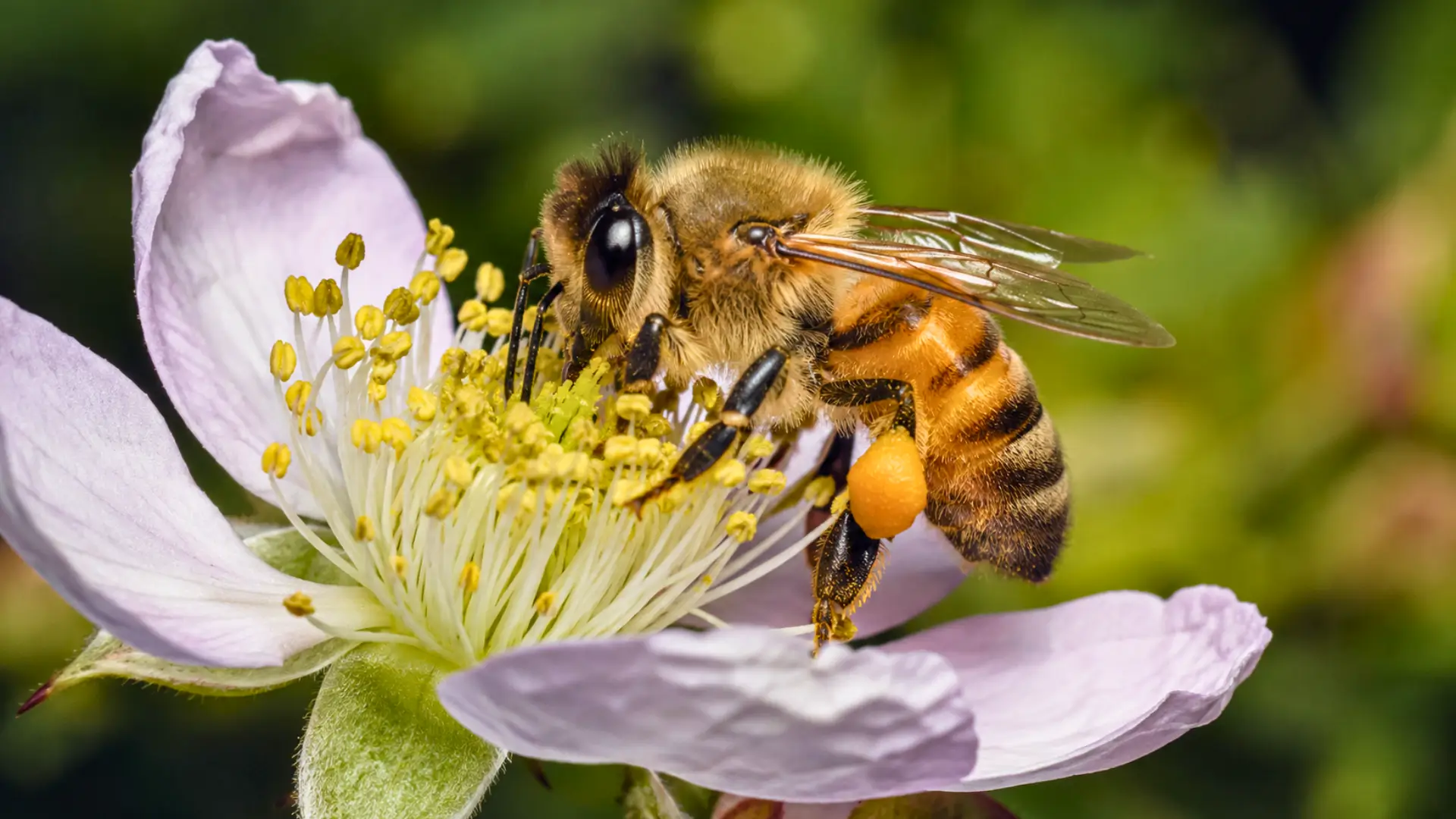
The answer may seem simple at first, then it immediately grows more complex. For a 500‑gram jar of honey, you must count not only the bees but also the journeys, the flowers, the time, and an astonishing living logistics. And it is precisely this gap that makes honey so fascinating.
What a jar of honey really represents at the scale of a hive
A 500‑gram jar of honey gives the illusion of a banal product. Yet, behind that very ordinary weight, the figures most commonly cited tell a different story. To produce a pound of honey, roughly 454 grams, a colony can visit nearly two million flowers. It also covers tens of thousands of kilometers.
The figure that unsettles most hinges on a tiny detail. In its lifetime, a worker bee manufactures only about one twelfth of a teaspoon of honey. In other words, a single 500‑gram jar does not result from the heroic labor of a lone bee. It condenses a vast sum of lives, flights, and exchanges that seems almost unimaginable.
That is where confusion takes root. Whether we consider the number of bees mobilized during a harvest or the volume produced by a single bee over its life, the total can vary greatly. For 500 grams of honey, one must count on the collective labor of several thousand bees, typically estimated at around 6,000 to 8,000 workers engaged. Yet the honey inside a jar remains, above all, a profoundly collective achievement.
How the hive transforms a very diluted nectar into stable honey
The nectar that enters the hive is not yet honey. It arrives extremely diluted, often loaded with water, and must be transformed by several bees. Some forage. Others receive the harvest, add enzymes, deposit it in the cells, and then fan the air to lower the moisture content.
This mechanism feels vertiginous. Without a visible leader or a posted plan, the colony divides tasks with redoubtable efficiency. Added to this is the famous waggling dance. This language of movement communicates distance, direction, and even the quality of a floral source, within the dark, buzzing bustle of the hive.
Behind every jar, millions of flowers and a living logistics
A foraging bee returns with only a tiny amount each trip. On a sortie, she typically visits between 50 and 100 flowers before returning. What seems negligible from an insect’s perspective becomes colossal when an entire colony repeats this gesture thousands of times, day after day, during the right blooming window.
That is why a jar of honey also tells a landscape. It requires countless flowers, compatible weather, reasonable distances, and a strong enough colony to sustain the effort. Local honey, therefore, is never merely a scented sugar. It is almost a miniature map of the territory, captured in a golden substance.
Global figures are dizzying. The FAO notes that more than 75% of food crops rely at least in part on pollination. About 35% of the world’s agricultural production also benefits from it. Honey is thus not merely a tasty product; it reveals the strategic role of pollinators in our food system.
Why this little jar also tells the fragility of bees today
In France, the topic is anything but abstract. INRAE estimates that the annual mortality of domestic honeybee colonies now sits between 20 and 30 percent. That figure is roughly twice the natural level. Parasites, food scarcity, pesticides, climate change, and pressure from the Asian hornet compose an increasingly unstable environment.
Recent data indeed speak of rollercoaster seasons. FranceAgriMer described a 2024 campaign in marked decline, weighed down by a wet, cold, windy spring. By contrast, the estimate InterApi published at the end of 2025 pointed to French production rising to 38,300 tonnes. It is the best level since 2014, but with wide regional disparities.
Perhaps that is where the humble 500‑gram jar becomes most puzzling. Its price never fully reflects the number of flowers visited, the fragility of the colonies, or the enormous role that bees play in orchards, kitchen gardens, and crops. The next spoonful of honey may taste less like a simple gesture and more like a reminder of a living balance that has become precarious.

Thank you Liam Kennedy for this valuable information about the relativity of a jar of honey to the thousands of precious lives serving in its production. My son Stanley Devlin, in Durban South Africa, is not a beekeeper but considers it his soul’s labour of love, for the last 6 years to produce weekly on the stove about 1.5L of orange nectar (boiling two oranges – sliced and cut into 1/8ths wedges – for 5 minutes and stirring in 3 cups of white sugar, to infuse overnight), which he pours in measure between about 5 trays for the daily droves of bees visiting for their daily fill, the disappear. We don’t know where they live, but that is no concern. The impetus is that bees survive. I built 2 hives from old pallettes, totally sealed (roof locked), bar 3 entrance holes for any bee swarms needing refuge at any future time. This feeding task is no burden at all for anyone to begin and undertake, especially for high-school kids. I hope more publicity is given out along these lines of producing simple nectar feeders, to encourage people to participate in saving bees. Thanks.