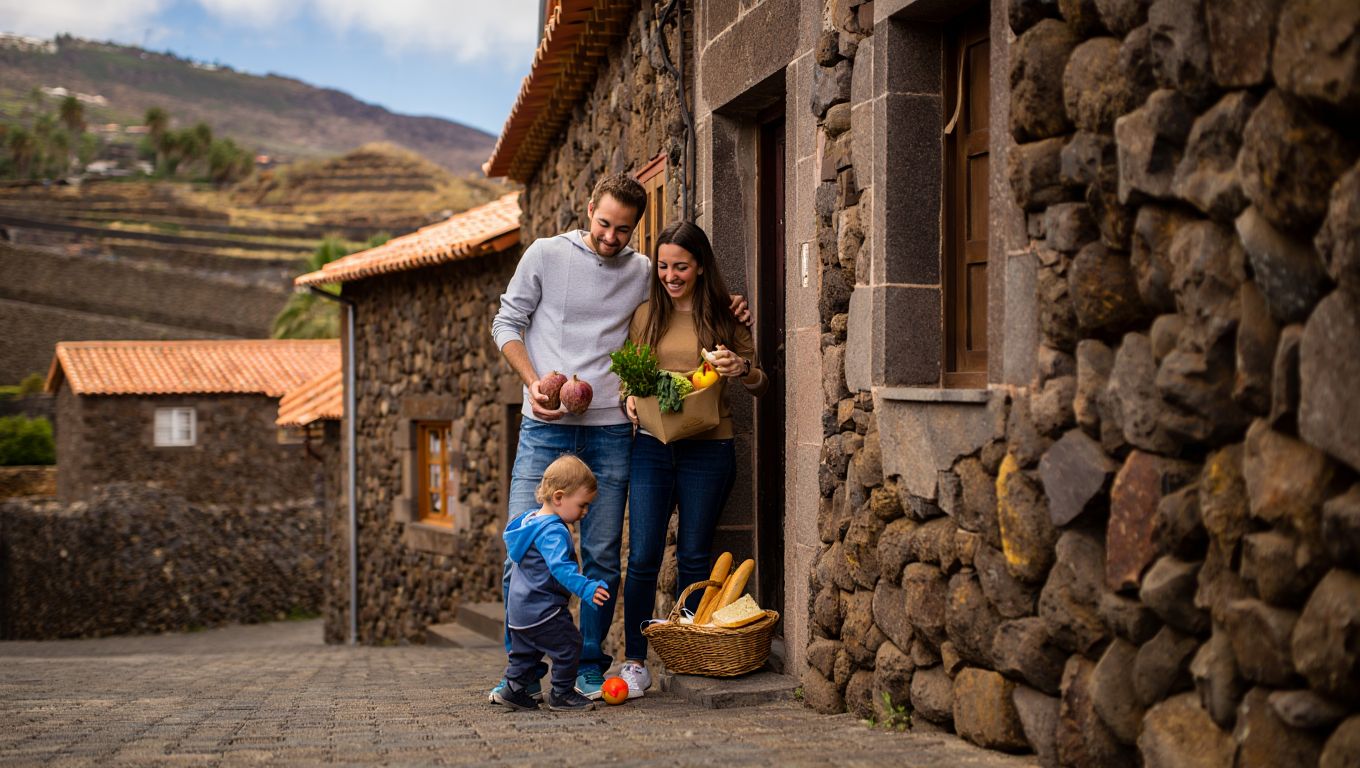
The fog rolled over the Donegal hills the morning Orla and Jamie decided they’d had enough. They weren’t chasing palm trees, they were chasing breathing room. Within three months, the couple and their two kids had swapped a semi‑detached in Letterkenny for a terraced home high above the Atlantic, on cobbled streets threaded through a Canarian hill town.
“People think it’s a holiday move,” Jamie said, sipping coffee on a narrow balcony lined with geraniums. “We didn’t come for cocktails on the beach. We came because the numbers finally made sense.”
Letterkenny arithmetic vs Canary calm
In Ireland, their spreadsheet was a monthly anxiety check. In Tenerife’s north, it became a permission slip. Cooler nights, a gentler climate, and prices shaped by local life rather than resorts changed the equation.
- Rent: from about €1,350 for a 3‑bed in Letterkenny to about €800 in La Orotava’s old quarter.
- Childcare: from roughly €900 for full‑time crèche to about €320 at a local guardería.
- Utilities: from around €280 (electricity, heating, bins) to about €110 (no heating, lower use).
- Internet/mobile: from €75 to about €35 for fast fibre and two SIMs.
- Groceries: from about €650 to roughly €500, thanks to markets and seasonal produce.
- Transport: from around €300 (fuel, insurance) to roughly €180, with cheaper petrol and modest insurance.
- Eating out: from about €250 to around €120, as cafés price for locals.
“All in, our outgoings fell by almost half,” Orla said. “Not because we live like monks, but because the baseline is simply lighter.”
Why a hill town, not a beach resort
The family chose elevation over oceanfront. Up here, trade winds keep days mild and evenings cool enough for a light jumper. Rents loosen the further you drift from the coast, and cafés serve wrinkled potatoes and mojo to neighbors, not package‑tour brunch to strangers.
They landed in La Orotava, all wooden balconies, stepped lanes, and views that climb toward Teide. “We wanted a place that breathes workaday life,” Jamie said. “A school bell, a hardware shop, a greengrocer who remembers your name.”
The hill towns run on supermarkets small enough to greet you, markets loud with tomatoes, and festivals that take over the plaza without bankrupting your weekend.
What everyday life looks like now
Mornings start with clouds snagging on rooftops and the smell of sweet pastries from the corner bakery. Maeve walks to public school with a bright satchel, Finn toddles to guardería with a banana and a stubborn grin. Orla logs on to her Irish employer at a wooden desk, fibre humming at 600 Mbps.
“I used to huddle by a rattling radiator,” she laughed. “Now the windows are open, and the heating bill is just a memory.”
Lunch might be chickpeas with spinach, a plate of papas, or a €1 cortado that tastes like permission to slow down. Afternoons mean homework in two languages, a park laddered with pine needles, or a bus to Puerto de la Cruz for the sea’s rocky pulse.
Evenings are simple: a terrace, a view, and the quiet triumph of not watching the bank balance like a meter.
Trade‑offs you feel, not just count
The move carried friction. Paperwork took afternoons of patient queues: the NIE number, the padrón, and health cover while residency processed. “It wasn’t hard, just sequential,” Jamie said. “You learn to bring copies of everything.”
Language sits like a friendly hurdle at the edge of every day. The kids soak Spanish like sponges, while their parents stumble, smile, and keep going. “I’ve learned a humility that costs nothing,” Orla said. “And a habit of rehearsing my sentences in the stairwell.”
They miss grandparents, of course, and the bogs after rain. Flights are cheaper than nostalgia, but neither erases the ache of a Sunday roast via video call. Sometimes the calima blows dust from the Sahara, and the sky turns tawny like old glass. Sometimes the road curves tighter than your patience.
But the ledger on the right‑hand side—time, space, money—keeps changing how the left‑hand side feels.
How they made the leap in 90 days
They started with a candid budget, three columns wide: current spend, target spend, and “what if” ranges. A week’s scouting trip followed, not to the beach, but to neighborhoods, schools, and the market at dawn.
“Remote work was our keystone,” Orla said. She asked for location flexibility, traded some meeting hours for earlier starts, and kept Irish tax residency advice from a professional. They searched rentals on Idealista, filtered for long‑term contracts, and messaged in plain, polite Spanish.
Once in town, they registered on the padrón, applied for their NIE, opened a local account, and set up health coverage—public for the kids, temporary private policies for adults until paperwork cleared. They joined a WhatsApp group for the barrio, learned which bakery sells out by ten, and found a pediatrician whose waiting room has a pirate ship.
“We didn’t chase a dream,” Jamie said. “We built a modest, workable plan, then walked it one step at a time.”
The odd thing, Orla says, is how the savings echo far beyond the spreadsheet. With rent lower and bills tamer, she buys back hours that used to be spent calculating survival. The kids carry two alphabets in their backpacks. Dinner is simpler, laughter longer, and the horizon—mountain, ocean, sky—wide enough to feel like a daily raise.

I enjoy reading your blog. It all s great. But the beautiful weather we are having has lifted all our spirits. I’m here in the little wooden coastal cottage at Inishowen Head in North Donegal. The cottage was built as a cafe in the thirties and when I was a child it was wood out as well as inside. Our boundary is a ditch with all kinds of beautiful plants and shrubs, especially the blue Hydrangeas. It’s really a very magical place. In the 10 years we have owned it this is most enjoyable.
These people dont exist, written with AI. Also picture of the people and the so called journalist are AI
Did I miss it, but who are they ?