The first heating bill arrives in a few weeks
A home heated with electricity in France uses on average 4 312 kWh over the heating season, from October to March. At the regulated price, that amounts to roughly €836 for a single winter. The same house, cooled all summer, costs €59. The ratio between the two items ranges from 10 to 75 depending on configurations, and that is not abnormal: increasing from 5 to 19 °C in January requires producing a 14-degree gap, whereas cooling from 33 to 26 °C in August only asks for 7.
This is the item where a household has the most to gain, and it is also where the most false ideas circulate. The first of these concerns the price of the kilowatt-hour: it’s the figure everyone compares, and it’s the wrong one.
The verdict in one sentence: the real cost is calculated in euros per useful kilowatt-hour, including the equipment’s efficiency, which places a heat pump around €780 per year, while direct electric heating exceeds €2,400 and no electric radiator, regardless of its price, consumes less than another.
The price of the kWh: the figure everyone watches
Here are the rates recorded for 2026, in euro cents per kilowatt-hour. These are the figures that feed the usual comparisons.
| Energy | Price per kWh | Note |
|---|---|---|
| Wood pellets in blocks | 4.20 to 6.30 c€ | Reserved for silo-equipped setups |
| Logs | 7.00 c€ | The cheapest fuel accessible to all |
| Pellets in bulk | 7.1 to 7.4 c€ | Truck-deliverable, silo required |
| Pellets in bags | 7.5 to 8.0 c€ | The most common format for households |
| District heating network | 7.72 c€ | Available only in certain towns |
| Natural gas | 12.76 c€ | Excluding subscription |
| Domestic fuel oil | 18.51 c€ | New installations banned since 2022 |
| Electricity, base tariff | 20.01 c€ | Regulated rate, base option 6 kVA |
| Propane in a tank | Up to 15.72 c€ | Off-grid solution |
Read as is, the ranking seems straightforward: wood dominates, electricity costs three times more than pellets. Yet this table does not tell you what you pay to heat your living room. It tells you what you pay to buy raw energy, not the same thing.
The real calculation: the cost of the useful kilowatt-hour
Between the energy purchased and the heat that arrives in the room, there is a piece of equipment, and this equipment has an efficiency. A condensing boiler returns about 90% of what it consumes. A pellet stove, 85%. A heat pump, on the other hand, produces 3 to 4 kWh of heat for 1 kWh of electricity consumed: its efficiency exceeds 300% because it does not generate heat; it relocates it.
The table then changes completely. For a need of 12,000 kWh of heat per year, which corresponds to a properly insulated 100 m² house:
| System | Efficiency | Cost per useful kWh | Annual bill |
|---|---|---|---|
| Air-water heat pump | COP 3 | ~0.065 € | ~780 € |
| Pellet stove or pellet boiler | 85% | ~0.082 € | ~990 € |
| Gas condensing boiler | 90% | ~0.116 € | ~1 390 € |
| Oil boiler | 85% | ~0.129 € | ~1 550 € |
| Propane boiler | 90% | ~0.178 € | ~2 130 € |
| Electric radiators | 100% | ~0.200 € | ~2 401 € |
The gap between the top and bottom of the table reaches €1,620 per year. Over ten years, that’s more than €16,000, which is the price of installing an air-to-water heat pump, with or without subsidies deducted.
Two observations that are almost always missing in this type of comparison. First, the COP announced for a heat pump is measured under standardized conditions: in very cold weather, it falls, and a heat pump sized badly will fall back on its electric resistance, bringing it back to the cost of direct electric heating. Second, pellets saw a spike in 2022 that doubled their price in a few months. A fuel that is cheap today is not necessarily cheap for ten years.
The installation cost, the other half of the equation
| Equipment | Installation | Annual bill | Cost over 10 years |
|---|---|---|---|
| Electric radiators (6 units) | 600 to 4 000 € | ~2 400 € | ~24 600 to 28 000 € |
| Gas condensing boiler | 3 000 to 7 000 € | ~1 390 € | ~16 900 to 20 900 € |
| Pellet stove | 3 000 to 8 000 € | ~990 € as main supplement | ~12 900 to 17 900 € |
| Air-water heat pump | 10 000 to 16 000 € | ~780 € | ~17 800 to 23 800 € |
| Pellet boiler | 10 000 to 20 000 € | ~990 € | ~19 900 to 29 900 € |
The rankings tighten up, and that is where subsidies become decisive: a heat pump subsidized up to €5,000 outruns a gas boiler over ten years. Without aid and with a €16,000 installation, it remains behind.
The pellet stove holds a particular place. On paper, it offers the best investment-to-bill ratio in the table, but it heats a volume, not a house: in a partitioned or multi-story dwelling, a supplement is necessary, and the calculation degrades.
One word on the carbon footprint, since it increasingly enters decisions and the energy performance certificate (DPE). For 15,000 kWh useful, there are about 85 kg CO₂ with a heat pump, 325 kg with pellets, 1,766 kg with natural gas, and 2,181 kg with fuel oil. The gap between the first and the last is a factor of 25.
The myth that costs French people the most
This is the most useful section of this dossier, and it can be summed up in one physics sentence: all electric radiators have an efficiency close to 100%. A convector at €40 turns one kilowatt-hour of electricity into one kilowatt-hour of heat. A dual-core inertia radiator at €1,200 does exactly the same. It cannot do better, because nothing is lost: every kilowatt-hour consumed becomes heat in the room.
The consumer association UFC-Que Choisir is categorical on this point and terms the idea that an inertia radiator “keeps heating after it’s turned off” as a deceptive marketing claim. It merely dissipates, with a delay, the heat it has already consumed.
| Type of radiator | Price | Consumption for the same comfort | What really changes |
|---|---|---|---|
| Convector | €30 to €350 | Identical | Dry air, uncomfortable sensation, quick heat-up |
| Radiant panel | €40 to €800 | Identical | Better comfort, quick heat-up, good compromise |
| Inertia | €70 to €1,100 | Identical | Soft, stable heat, slow start |
| Dual-core | €300 to €1,200 | Identical | Speed and comfort combined, at a price that raises questions |
Where do savings on electric heating come from, then? In three things only: thermostat precision, scheduling, and the home’s insulation. Replacing six convectors with six high-end inertia radiators costs between €1,500 and €6,000 and will not lower consumption. Invest the same amount in insulating the attic, for instance, and you’ll likely see a bigger impact.
Scams to Avoid Before Spending a Dime
The energy-saver box reappears every autumn via telemarketing, with a promise of 20% savings on the bill. The salespeople often have precise personal information, which makes the call credible. The device does not reduce a residential household’s consumption: what the meter measures is active energy, and no box plugged into a socket decreases it by a fifth. The rule is simple: no serious savings are achieved without modifying either the equipment, the insulation, or the usage.
Renovation-energy marketing follows the same pattern. The details to demand before signing: complete identification of the company, an up-to-date RGE qualification to be eligible for MaPrimeRénov’, a detailed protocol, costs excluding VAT (HT) and including VAT (TTC). No payment before completion, and a 14-day cooling-off period applies for a contract signed outside a business location.
What lowers the bill without works
Before changing systems, there remains room for maneuver that ADEME quantifies precisely.
- Lower the comfort temperature by one degree, and you save about 7% of consumption. On a €836 electricity bill for heating, that’s around €60 for a single degree. Going from 21 to 19 °C in living rooms translates to about €120.
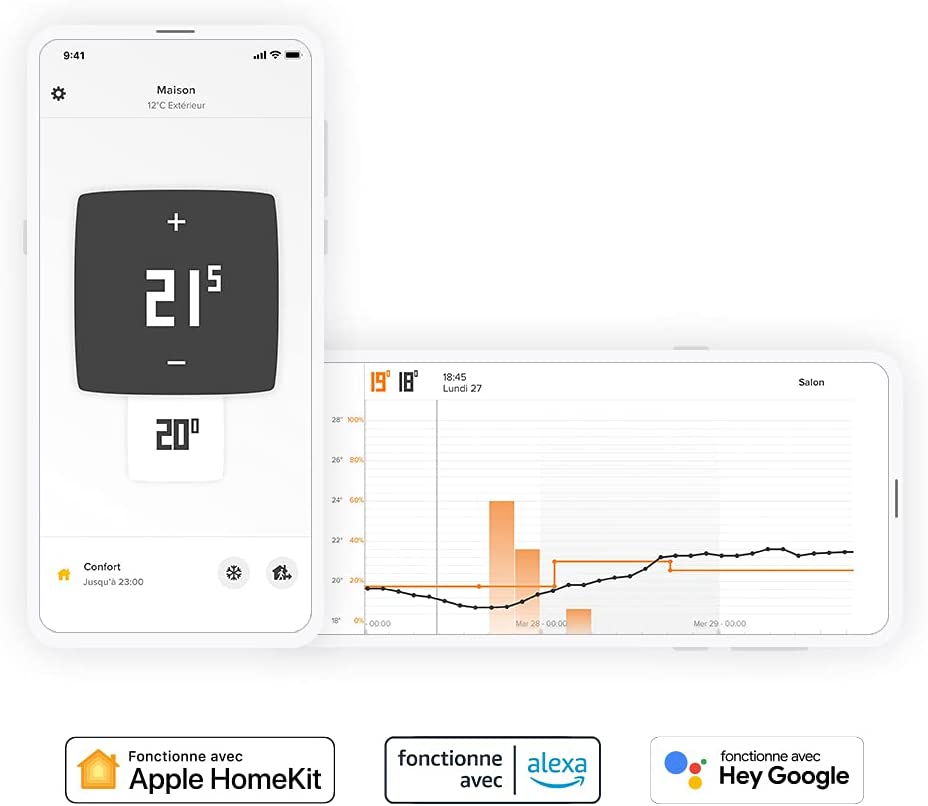
- A programmable thermostat can deliver up to 15% savings—up to €270 per year on an €1,800 electricity bill, and up to €210 on a €1,400 gas bill. It’s the best return on investment in this dossier: a connected thermostat costs between €150 and €250 and is paid back in a single heating season.
- Heat bedrooms to 17 °C instead of 20 °C—you sleep better, and the room spends twelve hours a day unoccupied.
- Purge radiators and service the boiler every year—a radiator with an air pocket heats poorly and costs as much.
- Close shutters and curtains at night, open them in the daytime on the sunny side. A single-glazed window loses most of its heat through radiation at night.
- Ventilate 5 to 10 minutes per day, with heating off. Dry air heats faster than humid air, and short ventilation costs less than continuous airing through a slightly ajar window.
- Avoid covering radiators with laundry or furniture, which blocks convection and nudges the thermostat toward overheating.
Combined, these gestures commonly account for 20 to 25% of the bill. It isn’t spectacular per item, but it’s immediate and free.
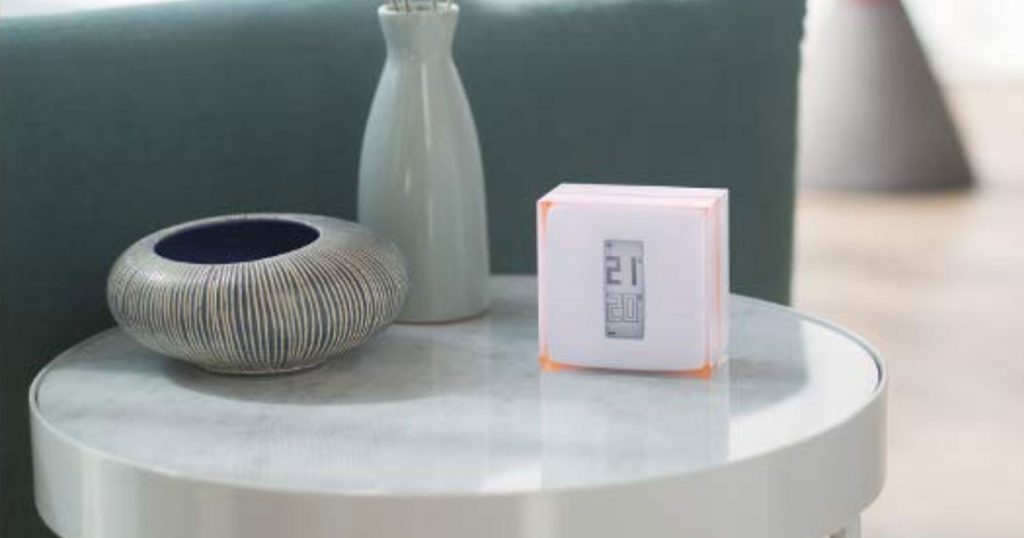
Useful gear: a tado° V3 connected thermostat for a boiler, or connected thermostat heads to control an existing central heating room by room—the cheapest solution when you can’t touch the boiler, such as in a condo.
The thermostat decree: what changed at the end of 2025
This is little publicized information, yet structurally important. Decree no. 2023-444 of June 7, 2023 made the installation of a programmable thermostat mandatory on existing residential heating systems by January 1, 2027. Decree no. 2025-1343 of December 26, 2025 postponed this deadline to January 1, 2030.
What remains in force: for new constructions with building permits filed from January 1, 2027, the obligation applies on that date. And there is an exemption when the installation is not technically or economically feasible, notably if the payback time exceeds ten years, with supporting evidence.
The practical consequence is counter-intuitive: postponement is not a reason to wait. A thermostat pays for itself in one heating season; obligation or not does not change this calculation. Owners bear the installation cost, tenants the maintenance.
Avaliable subsidies in 2026
MaPrimeRénov’ remains the main scheme to switch heating systems. The amounts by action, for a standalone installation:
| Equipment | Very low income | Low income | Medium | High |
|---|---|---|---|---|
| Air-to-water heat pump | €5,000 | €4,000 | €3,000 | Not eligible |
| Geothermal or solar-thermal heat pump | €11,000 | €9,000 | €6,000 | Not eligible |
| Air-to-air heat pump | Excluded from standalone measure; eligible only in a broader renovation | |||
The conditions to know before getting a quote: principal residence, dwelling at least fifteen years old, COP of at least 3.4, minimum power of 3 kW, and above all installation by a certified RGE professional. Without RGE, no aid.
Potential combinations further reduce the bill: energy-savings certificates open to all households, a heating boost for replacing an oil, gas or coal boiler, a zero-interest eco-loan up to €30,000 over twenty years, and VAT at 5.5% on air-to-water and geothermal heat pumps. In the case of a substantial renovation, the CEE are integrated into the overall aid rather than requested separately.
Which solution makes sense for your home
| Your situation | What makes sense | What does not |
|---|---|---|
| Apartment in a co-op, communal heating | Connected thermostatic heads, free actions, window/door insulation | Any change of the heating system, which is a co-op matter |
| Apartment, independent electric heating | Thermostat and programming, insulation, possibly a reversible air conditioner if allowed by the building | Replacing convectors with high-end inertia radiators: no savings in consumption |
| House, recent gas boiler | Keep it, maintain it, add a programmable thermostat | Replace a condenser boiler younger than ten years |
| House, old oil or gas boiler | Air-to-water heat pump with MaPrimeRénov’ and a heating boost: best subsidized case | Stay on oil, whose new installation has been banned since 2022 |
| Poorly insulated house, rated F or G | Insulate first — attic, then walls. A heat pump on a thermally leaky envelope will rely on its auxiliary resistance | Change the generator before the envelope |
| House with easy wood access | Pellet stove or log stove as the main heating for the living area | Count on it to heat a partitioned floor |
| Off-grid dwelling | Heat pump or pellets | Propane, at more than €2,100 per year for 12,000 kWh |
| Tenant | Free measures, thermostatic heads, door seals, thick curtains | Any heavy investment, which is the landlord’s responsibility |
Frequently asked questions
What is the cheapest heating in 2026?
The air-to-water heat pump, at around €780 per year for 12,000 kWh of heat, ahead of pellets at around €990. The calculation takes into account the equipment’s efficiency: the heat pump produces 3 to 4 kWh of heat for each 1 kWh of electricity, which offsets a kilowatt-hour price that is roughly three times higher than wood.
Does an inertia radiator consume less than a convector?
No. All electric radiators have nearly 100% efficiency: one kilowatt-hour consumed yields one kilowatt-hour of heat, regardless of the model. What changes is comfort, temperature stability, and thermostat accuracy. UFC-Que Choisir calls the claim that an inertia radiator “keeps heating after off” a deceptive marketing argument.
How much does electric heating cost per year in France?
About €836 for a heating season from October to March, based on an average consumption of 4 312 kWh at the regulated rate, i.e. nearly €140 per month over that period. For a 100 m² house needing 12,000 kWh of heat, the bill exceeds €2,400 per year.
Will a thermostat be mandatory in 2027?
More for existing homes. Decree no. 2025-1343 of December 26, 2025 moved the deadline from January 1, 2027 to January 1, 2030. The obligation remains applicable for new constructions where the permit is filed after this date.
How much can you save by lowering heating by one degree?
About 7% of consumption per degree, according to ADEME. On an €836 electric heating bill, that’s roughly €60 for a single degree. Moving from 21 to 19 °C in living spaces saves about €120 per season, with no investment required.
What subsidies exist for installing a heat pump in 2026?
MaPrimeRénov’ provides €3,000 to €5,000 for an air-to-water heat pump and €6,000 to €11,000 for geothermal, depending on income; households with higher incomes are no longer eligible for the isolated measure. Add energy-savings certificates (EEC), a zero-interest eco-loan up to €30,000, and a 5.5% VAT on air-to-water and geothermal heat pumps. Installation by a certified professional (RGE) is mandatory.
Do energy-saving boxes work?
No. These devices, sold by telemarketing with a promise of 20% savings, do not reduce the consumption of a residential dwelling. The meter measures active energy, and no plug-in box can subtract a fifth. The real levers are the equipment, the insulation, and the usage.
Verdict
Three decisions shape the heating bill, and they are not taken in the order suggested by the telemarketing.
The first is free: one degree less, hourly programming, radiators cleared and purged. Between 20 and 25% of the bill, available this week, with no quotes and no work. The second costs between €150 and €250: a programmable or connected thermostat, up to 15% savings according to ADEME, paid back in a single heating season. The postponement of the requirement to 2030 changes nothing about this calculation.
The third is a heavy investment, and it is the only one that deserves several quotes and some patience. A heat pump replacing an old oil or gas boiler remains the best-subsidized move in 2026, with up to €5,000 from MaPrimeRénov’ plus the CEE. But on an F or G-rated house, the order reverses: insulation comes first, or risk seeing the heat pump settle on its resistance in very cold weather and cost like a convector.
What remains the easiest savings to make is the one that costs nothing: do not replace six convectors with six inertia radiators and hope for lower consumption. Physics forbids it, and €1,500 to €6,000 would be better spent in the attic.

Contact details
Address:
Farmers Forum,
36, Dominick Street,
Mullingar,
Co. Westmeath,
Ireland
Phone:
+353 (0)44 9310206
Or email us:
For technical issues please check out our FAQ's page or email - [email protected]
For general Queries email - [email protected]
Request to add event to our Calendar - [email protected]
Send us your mart reports - [email protected]
Suggestions and feedbacks - [email protected]
News Items / Press Release - [email protected]
To Advertise on Farmers Forum - [email protected]