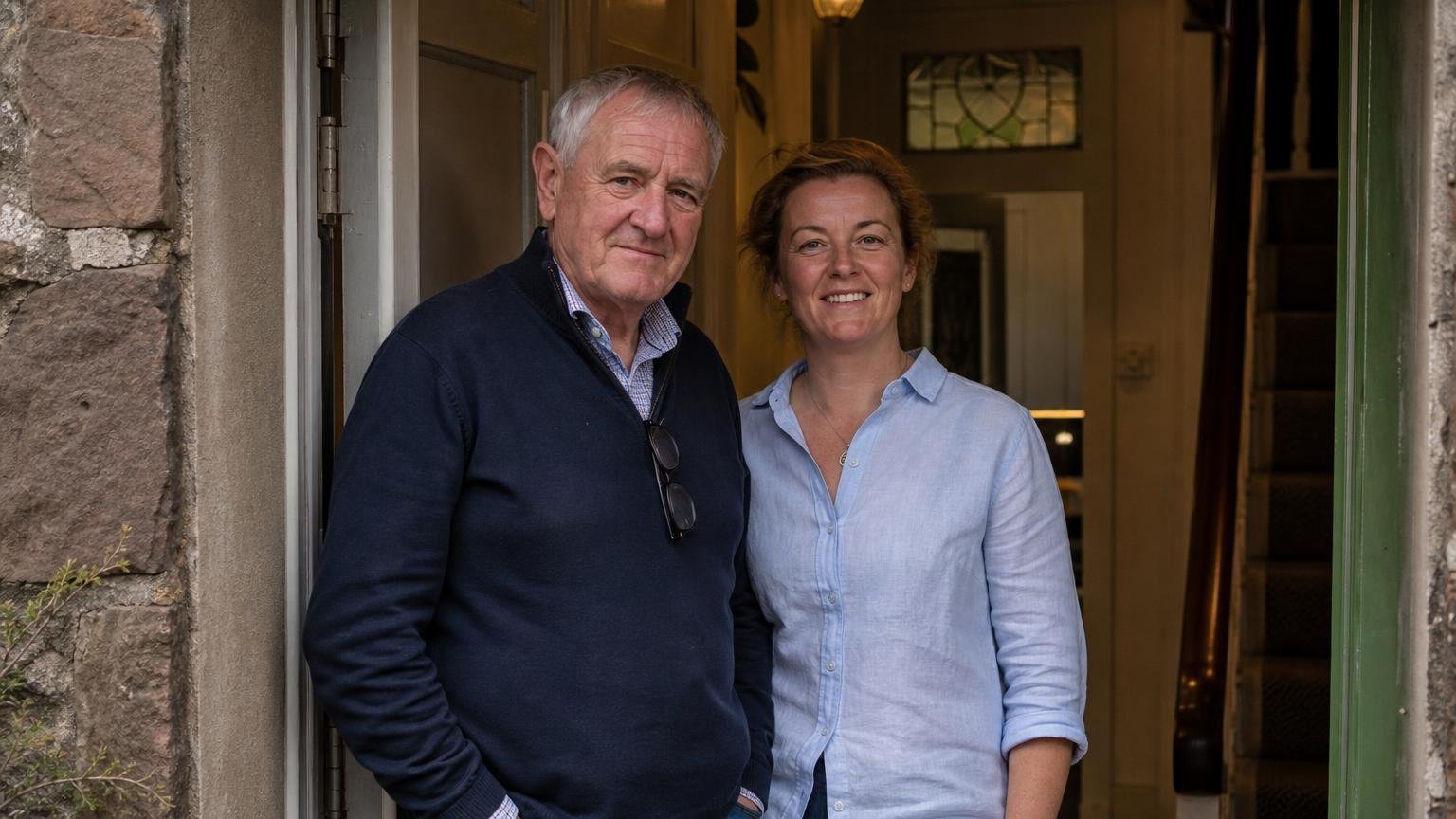
The wind comes in off the Atlantic, carrying a smell of salt and turf smoke that settles over a low, stone guesthouse at the edge of Donegal. Inside, a kettle ticks to a boil while a pair of voices move in counterpoint — one steady and seasoned, the other bright with momentum. He minds the fire and checks the weather; she tweaks the booking system and folds napkins into small, perfect sails.
“I swore I’d retire at seventy,” he says, half-smiling, half-grumbling. “I swore I’d never come back,” she replies, already setting a tray with scones that crack when you press a warm knife into them. Between the two of them, Grianán Guesthouse has become less a place to stay than a kind of tidy, sea-facing theatre.
The handover that wasn’t
The plan, such as it was, involved a handover, a watch passed from palm to palm. But life in small places resists sudden exits. He learned hospitality by doing — by lifting suitcases, by reading tides, by beating a rug clean under a sky of damp stars. She learned it in other cities, behind laptops and meeting tables, perfecting systems and tone-of-voice guides that travel well until they meet a Donegal storm.
“I didn’t want to let it just drift,” she says. “He didn’t want to just quit,” he adds. So they stayed, overlapping in a rhythm that feels both accidental and entirely right.
Two ways to make a welcome
His welcome is a handshake, a quick study of boots, and a joke about weather that makes the sky seem like a neighbor. Her welcome is a confirmation that sings, a map link that points to the final bend by the gorse, and a message sent just as your plane lands.
He knows which window sticks in an easterly, which guest will want an extra blanket, and the precise second black pudding goes from glossy to done. She knows how to keep bookings in one place, how to dance with the algorithms that send strangers to a door, and how to tell the story of a coastline in twelve images.
“People don’t travel for perfection,” she says. “They travel for texture.” He nods. “They travel for the pot of tea you didn’t have to ask for.”
What stays the same
The house sits on a rise, facing the waves, and some things refuse to learn new tricks. You can repaint, relight, rebrand, but Donegal keeps its own register.
- The peat fire that warms socks and stories
- The window seat where rain writes its slow poem
- The breakfast that tastes like farms and tidepools
- The front step where goodbyes turn into next year
“Tradition isn’t a museum,” she says. “It’s choreography you keep altering.” He lifts an eyebrow. “As long as the steps still end with a clean plate.”
Seasons, storms, and stubborn hope
In winter the sea grows shoulders, and the carpark is a field of wet light. They stack the wood a little higher, move the furniture a touch closer, and learn the schedules of buses like a second language. January brings walkers with red cheeks and librarians on quiet holidays. February brings the first gulls that sound like they’re scolding and singing at once.
Spring is when she launches ideas with names, small pilots that become habits. A “Storm Watch” rate when forecasts get spiky. A “Locals’ Friday” where dinner becomes a chorus. He pretends to be skeptical, then slips an extra loaf into the oven.
“Hope is a craft,” he tells a guest who asks about retirement. “You practice it until it looks like instinct.”
Guests who become kin
Some arrive grey with city, and you can watch the color leak back into their faces. They bring dogs that behave like children, and children who behave like detectives. He shows them shortcuts to a beach that hides at high tide. She points them to a café with coffee that bites like a soft wave.
The guestbook is a palimpsest of first times and sixth visits. You see handwriting grow more confident, notes that once said “perfect view” evolving into “see you in October.” Anniversaries return in the form of chocolates, postcards arrive in off-seasons from places with hotter light.
“Home isn’t where you live,” a returning couple writes, “it’s where you’re expected at half-past.”
The quiet, necessary repairs
Most of the work here is invisible. A hinge oiled when nobody is looking. A leak discouraged into a different direction. A kind word placed at the exact moment a long drive begins to feel like a mistake. She patches the website and edits the caption. He patches the lane and edits the skyline by cutting back the brambles a little each Sunday.
They disagree in soft voices. She argues for a new sign; he argues for the old one with the brush-painted swirl. They split the difference by sanding, staining, and keeping the swirl.
The future, seen from the porch
On clear nights the horizon looks closer, and plans feel possible. She sketches a winter festival with local singers and a stew that leans on thyme. He wants a small shed to cure fish like his father did. Between them, the calendar fills with the kind of promises that make a place feel inevitable.
“I thought I was making room for after,” he says, watching a pair of headlights ease up the lane. “Turns out we were making room for now.” She smiles, already at the door, already reaching for the teapot. The sea keeps its shoulder leaned against the coast, and the guesthouse glows like a low, steady star.

A Beautiful story well told,
Perhaps I will visit sometime.
P.
Beautiful wording Liam. You have the soul of an artist.
Fab story but where is the guesthouse and the name of it I really want to go there
Hi Liam.
Nice article about the Grianan guest house in Donegal.
I checked the web and could only find an inland hotel in north Donegal with that name.
Some extra info for intending guests would have been very welcome in your piece.
The name of the actual town it is in and the type of rooms available would also be helpful together with the contact details.Sounds like a place we would like to stay.
Keep up the good work.
Everybody wants yo write that, a picture postcard , Thankyou
Really lovely piece of writing.
Love the rhythm of this true story of an existing guesthouse in Donegal.💞
I enjoyed reading your artical Liam.
What is the name of of the Father / Daughter Guesthouse in Donegal.
I would like to take a drive up there with my Girls.
Kind regards
Your writing is like prose and poetry together
I want to visit there next spring or summer. Can you tell me how to find this jewel on the Internet. Is it north or sought or east or west donegal. I live right on the wexford southerly coast. Just would like to know exactly where on the map it is because my journey would be a very very long one…..
Lovely article. Just closed my Dublin B and B after 30 years in business so can relate to a lot of its content.
Hi Liam. It’s six thirty am. Traffic busy on the N17. People going places. This is when I leave to be transported into one of your reports/stories. You paint the picture. Sound smell & silence. Magic. Thanks.