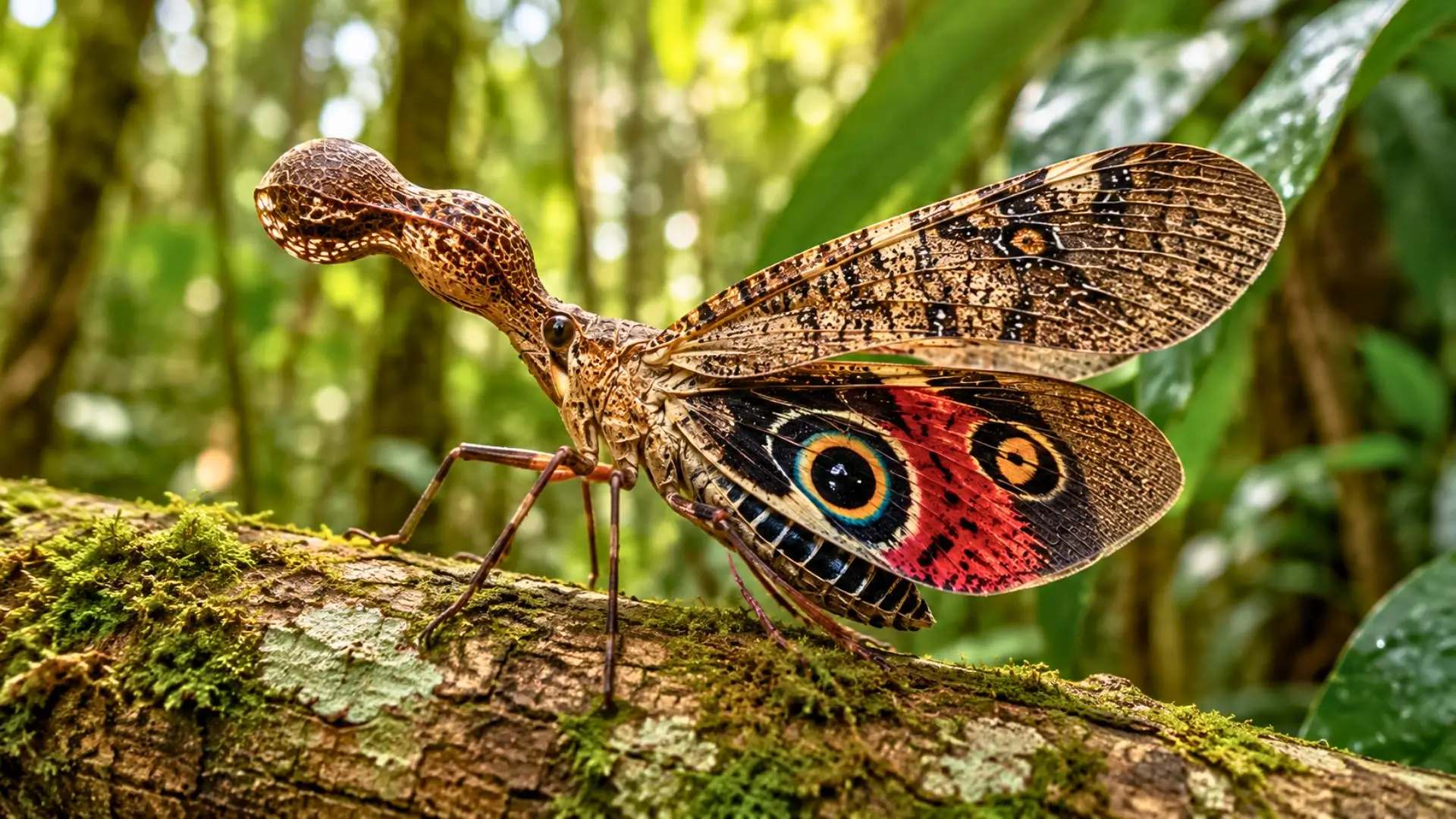
Hidden in the tropical forests of the Americas, the peanut-headed lantern fly intrigues with its distinctive morphology. Often mistaken for a butterfly, this cicada-like relative employs clever defensive strategies to scare off would-be predators, while remaining harmless to humans.
The Peanut-Head Secret: a Visual Trick That Effectively Fends Off Jungle Predators
This hemipteran insect primarily inhabits wooded regions spanning from Mexico to Peru. At first glance, its cranial cavity bears a hollow bump that evokes a peanut. This light feature drastically alters its silhouette, confusing nearby predators’ ability to interpret its form.
However, the ruse becomes obvious when the creature is viewed from the side. Indeed, the patterns on its skull perfectly imitate the appearance of a tiny reptile. Birds and monkeys thus believe they are facing a small caiman with sharp teeth.
Moreover, this morphological resemblance stands as a textbook example of protective mimicry. Through this optical illusion, the insect diverts attention and immediately repels attacks. This trait allows it to survive effortlessly in a harsh environment.
The Peanut-Head Lantern Fly’s Secret Defensive Techniques to Escape Tropical Predators
When the initial disguise fails, the peanut-headed lantern bug deploys a suite of graduated responses. First, its fused forewings provide optimal camouflage on the tree bark. The muted hues blend seamlessly into the vegetative backdrop, concealing its presence during rest periods.
Next, in the face of an imminent strike, the creature abruptly fans its hind wings. This action reveals broad dark eyespots reminiscent of the gaze of a nocturnal raptor. The dramatic visual jolt unsettles the attacker, while a foul odor is exuded as a final resort to permanently deter the foe.
Between Popular Legends and Biological Realities: a Totally Harmless Amazonian Insect
Despite a wingspan reaching up to fifteen centimeters, Fulgora laternaria poses no danger to humans. This insect has no sting and does not bite. Its mouthparts, a rigid straw-like rostrum, are used exclusively to extract plant sap.
Yet its singular appearance fuels persistent beliefs across Central America. Local populations sometimes call it the Machaca, after a myth claiming that a sting becomes deadly within a day without any immediate intimate contact. This superstition remains scientifically unfounded since the creature never pierces the skin.
Another historical misconception concerns its supposed nocturnal luminescence. In the 17th century, erroneous accounts misled the naturalist Carl Linnaeus during its formal classification. In reality, modern biological analyses confirm that this species produces absolutely no light.
A Subtle Canopy Inhabitant of the Amazon, Threatened by Tropical Forest Degradation
This master of mimicry thrives mostly out of sight, high in the treetops. Its presence in Costa Rica or deep within the Amazon basin remains discreet. Observers rarely notice it, as it blends perfectly with bark covered in lichens.
Today, the future of this species hinges directly on protecting its native habitat. The clearing of primary tropical forests weakens the balance of the canopy. Preserving these forest ecosystems remains essential to ensure the survival of this masterpiece of natural selection.

Contact details
Address:
Farmers Forum,
36, Dominick Street,
Mullingar,
Co. Westmeath,
Ireland
Phone:
+353 (0)44 9310206
Or email us:
For technical issues please check out our FAQ's page or email - [email protected]
For general Queries email - [email protected]
Request to add event to our Calendar - [email protected]
Send us your mart reports - [email protected]
Suggestions and feedbacks - [email protected]
News Items / Press Release - [email protected]
To Advertise on Farmers Forum - [email protected]