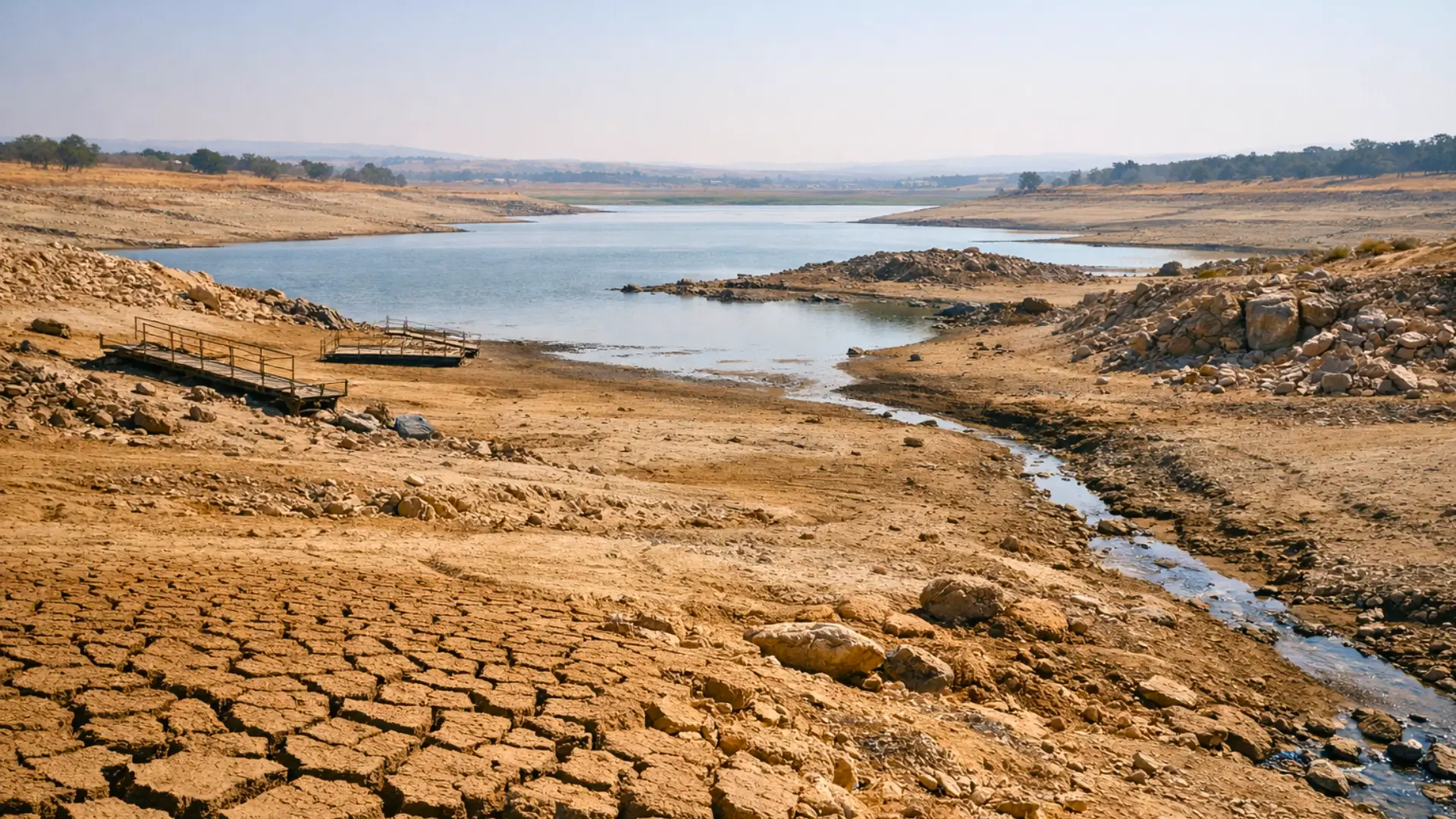
A silent transformation is crossing the continents. Climate warming, droughts, and massive groundwater pumping are driving down freshwater reserves. Satellites show that this hydrological imbalance is now accelerating on a planetary scale, worrying for the security of the planet’s water resources.
Satellites Reveal a Rapid, Global Decline in Continental Freshwater Reserves
Since the early 2000s, scientists have observed a decline in freshwater reserves across the continents. Rivers, soils, and glaciers are affected. Groundwater too. Thus, many indicators reveal a hydrological imbalance that is gradually taking hold.
These results come from two decades of satellite measurements. The GRACE and GRACE-FO missions track the variations in Earth’s water mass. With these data, researchers detect losses of terrestrial water with precision. Consequently, the drying of many regions is now clearly visible.
Whole Regions Enter Megadrought Phase With Planetary Consequences
Analyses show that several areas around the globe are now experiencing a structural drought. First in North America. But also in parts of Eurasia. Finally, the phenomenon affects the Middle East and North Africa, where water resources steadily dwindle.
In these territories, the expansion of arid zones is accelerating. Each year, vast areas become drier. Consequently, agricultural and ecological balances shift. Farmlands and forests must adapt to scarcer water.
In parallel, cities also feel this water pressure. Access to drinking water becomes more precarious. Moreover, agricultural irrigation depends heavily on local reserves. Thus, water management becomes a strategic issue for many densely populated regions.
Groundwater Aquifers Become the Main Source of Global Freshwater Loss
A large portion of this disappearance stems from groundwater aquifers. These underground reservoirs formed over thousands of years. Yet they are today pumped at high speeds. Intensive agriculture and urban demand explain much of this exploitation.
According to researchers, about 68% of terrestrial freshwater loss observed since 2002 comes from underground withdrawals. This finding appears in a study published in the scientific journal Science Advances. Thus, the importance of aquifers in the global water crisis becomes evident.
When this water is pumped, it often leaves the local cycle. It evaporates or returns to the oceans. Consequently, it does not quickly recharge the aquifers. This phenomenon also contributes to rising sea levels.
A Climate Turning Point Around 2014 Accelerates Droughts and Alters the Water Cycle
Researchers identified a major shift around the years 2014 and 2015. At that time, a powerful climate event occurred: the El Niño phenomenon. It altered precipitation patterns and worsened several droughts.
Since then, the situation has evolved rapidly. The Northern Hemisphere has lost more continental water. And this region houses a large portion of the world’s population. Many agricultural regions are also located in this hemisphere.
In light of these signals, scientists are calling for action. We must better manage freshwater. For example, artificial recharge of aquifers can help. Moreover, agriculture must curb certain withdrawals. Finally, international cooperation becomes essential to preserve water resources.

Contact details
Address:
Farmers Forum,
36, Dominick Street,
Mullingar,
Co. Westmeath,
Ireland
Phone:
+353 (0)44 9310206
Or email us:
For technical issues please check out our FAQ's page or email - [email protected]
For general Queries email - [email protected]
Request to add event to our Calendar - [email protected]
Send us your mart reports - [email protected]
Suggestions and feedbacks - [email protected]
News Items / Press Release - [email protected]
To Advertise on Farmers Forum - [email protected]