
As one of the few sharks to inhabit the frigid waters of the North Atlantic, the Greenland shark stands out for its size and extraordinary longevity, reaching several centuries.
The Inuit call it “Skalugsuak” after an old legend claiming that it originally lived in the urine pot of the sea goddess Sedna, and that its flesh could gnaw human skin. Elsewhere, this Arctic-dwelling vertebrate is more commonly known as the Greenland shark (Somniosus microcephalus).
It turns out that its mythical origins are not entirely fanciful: the tissues of this shark indeed contain a large amount of urea that participates in its osmotic balance and the control of its buoyancy. Consequently, before it can be consumed, its flesh must be boiled several times to remove trimethylamine oxide (TMAO), a neurotoxin whose effects resemble intoxication.
Not as massive or intimidating as its white shark cousin, the Greenland shark can still reach up to seven meters in length. It is distinguished by its elongated silhouette, gray-brown skin, a small head with a rounded snout and tiny eyes, to which bioluminescent parasites regularly attach, which would help lure its prey.
Proof of its elusive nature, the first photographs of a living specimen were taken in the mid-1990s. It typically resides at depths between 200 and 400 meters in the polar waters of the North Atlantic and the North Pacific, and it ranks among the few sharks able to tolerate Arctic temperatures year-round.
Equipped with very sharp teeth in the upper jaw and broad ones in the lower jaw, this relatively patient predator hunts squid, seals and porpoises, and all sorts of bony and cartilaginous fishes. An opportunistic carnivore, it does not hesitate to scavenge the carcasses of belugas, narwhals, and even terrestrial animals.
For years, scientists estimated that the Greenland shark lived, like most sharks, around a hundred years. Very recently, its longevity has been substantially revised upward, thanks to an innovative method.
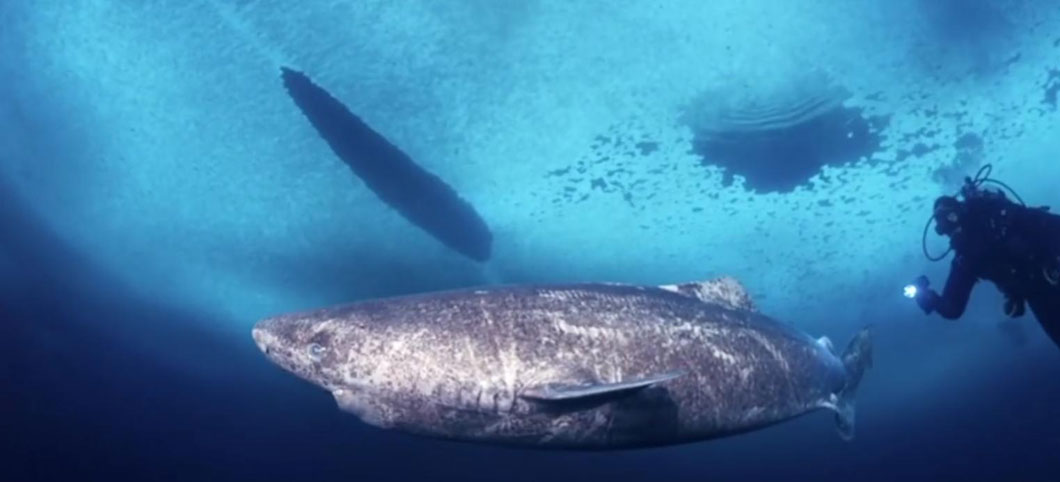
After capturing 28 specimens, scientists performed radiocarbon dating on their crystalline lenses. The results were simply astounding: a Greenland shark measuring five meters long was aged at around… 392 years! An exceptional lifespan for a vertebrate, far surpassing that of large terrestrial tortoises and bowhead whales.
Sexual maturity occurs when they reach at least four meters, corresponding to an age of about 150 years. The female can give birth to ten pups per litter, with newborns measuring around 90 centimeters in length.
For scientists, two main factors essentially explain this extraordinary lifespan. Because of their large size, Greenland sharks possess a metabolism that is markedly slower than that of most marine creatures, and this phenomenon is amplified by their constant residence in icy waters.
A slow metabolism also implies slower growth and delayed cellular aging. You can easily understand why the Greenland shark, brushing four centuries, is the elder of vertebrates, by a wide margin.
To go further, discover the 10 animals with the greatest longevity, and the one with the shortest lifespan.

Contact details
Address:
Farmers Forum,
36, Dominick Street,
Mullingar,
Co. Westmeath,
Ireland
Phone:
+353 (0)44 9310206
Or email us:
For technical issues please check out our FAQ's page or email - [email protected]
For general Queries email - [email protected]
Request to add event to our Calendar - [email protected]
Send us your mart reports - [email protected]
Suggestions and feedbacks - [email protected]
News Items / Press Release - [email protected]
To Advertise on Farmers Forum - [email protected]