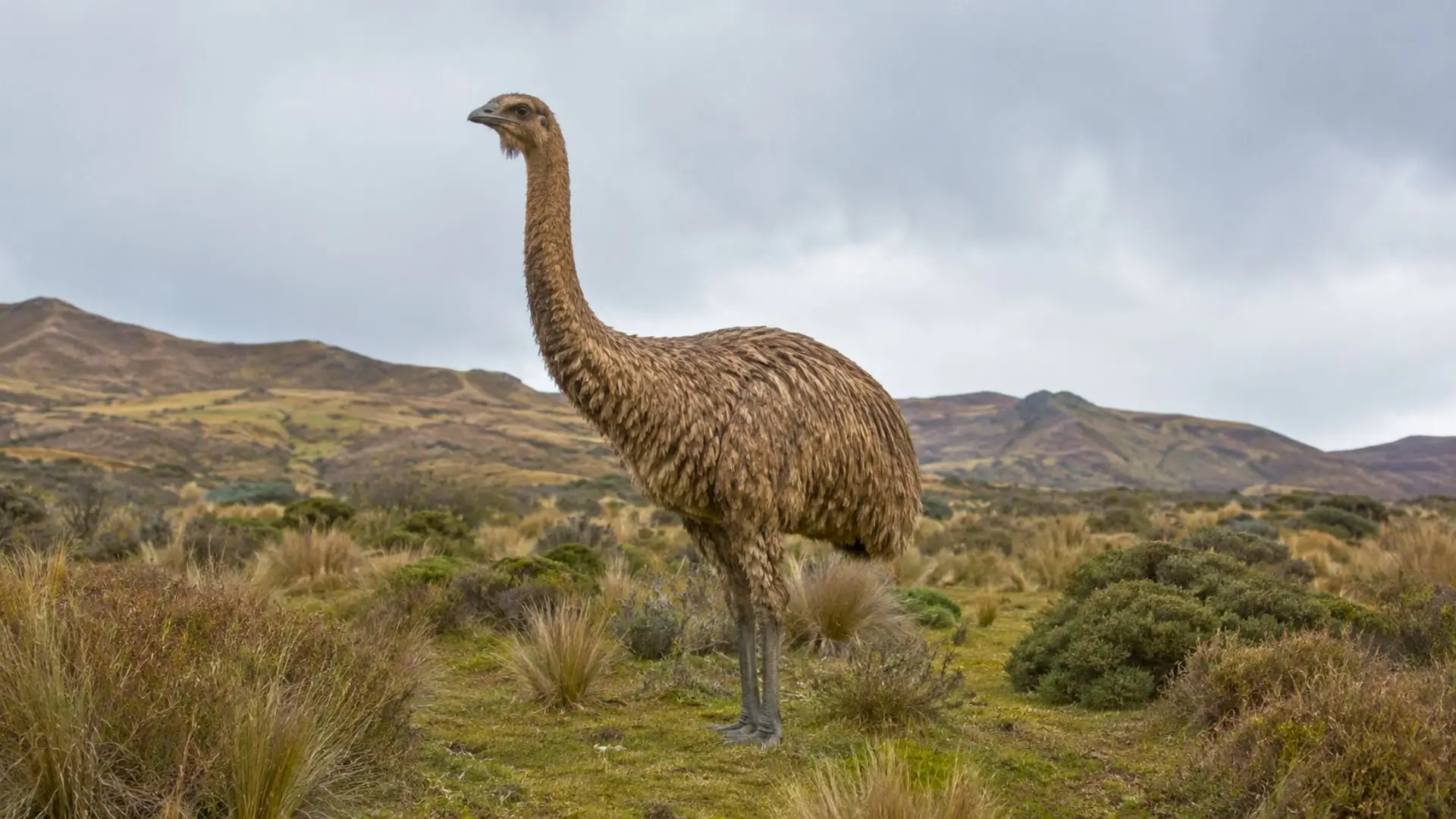
Twenty-six chicks emerged from a laboratory-made shell. For Colossal Biosciences, this test opens a path toward the giant moa of New Zealand. For several researchers, it highlights more the distance between a successful incubation and the reappearance of a vanished animal.
An artificial shell that imitates the egg’s breathing without replacing its full biological role
Colossal Biosciences, a US-based startup focused on de-extinction, announced the hatching of 26 chicks inside a 3D-printed structure. De-extinction refers to the effort to recreate a vanished animal, often by editing the genome of a closely related living species.
The device does not replace the entire egg. It mainly mimics the shell, that porous envelope which allows oxygen in and carbon dioxide out. In a natural egg, the shell also provides calcium, a mineral used by the embryo to form its skeleton.
The Colossal researchers therefore added this calcium separately and monitored the embryos in an incubator. The most accurate image isn’t that of a substitute mother, but that of a highly sophisticated incubator, capable of offering a direct window into development.
Why the giant moa’s egg size demands a solution that living birds cannot provide
The southern giant moa belonged to New Zealand’s flightless birds. The largest individuals surpassed 3 meters in height and weighed more than 200 kg. Their disappearance dates back about 600 years, following human arrival and intensive hunting.
The incubation challenge hinges on a simple fact. Moa eggs would have represented nearly 80 times the volume of a chicken egg and about eight times that of an emu egg. No living bird appears suited to laying eggs of that size.
Why reconstructing the moa genome remains the most fragile step despite advances in incubation
An artificial egg alone is not enough to recreate a moa. A genome is also required, that is, the complete set of biological instructions encoded in DNA. Yet ancient DNA tends to fragment over time, like a book whose pages have been soaked and torn.
Vincent Lynch, an evolutionary biologist at the University of Buffalo, notes that an edited bird would still be an edited bird, not necessarily a moa resurrected as such. This nuance matters, because Colossal has already showcased modern animals altered to resemble extinct species.
How the artificial egg could help threatened birds before aiding extinct species
The ex-ovo term refers to growth outside the natural shell. This approach isn’t entirely new, but Colossal says it aims for a more stable and larger system. Andrew Pask, the company’s chief scientific officer, presents the tool as a flexible incubation platform.
Critics also target the level of evidence. Louise Johnson, an evolutionary geneticist at the University of Reading, notes that the announcement still rests on limited published data. Without a peer-reviewed article, it is difficult to assess the true reach of the device.
This path could serve before de-extinction. Nicola Hemmings, an avian reproduction specialist at the University of Sheffield, emphasizes living species more. For threatened birds, preserving reproductive cells and improving incubation could have a measurable impact on populations tracked one by one.

Contact details
Address:
Farmers Forum,
36, Dominick Street,
Mullingar,
Co. Westmeath,
Ireland
Phone:
+353 (0)44 9310206
Or email us:
For technical issues please check out our FAQ's page or email - [email protected]
For general Queries email - [email protected]
Request to add event to our Calendar - [email protected]
Send us your mart reports - [email protected]
Suggestions and feedbacks - [email protected]
News Items / Press Release - [email protected]
To Advertise on Farmers Forum - [email protected]