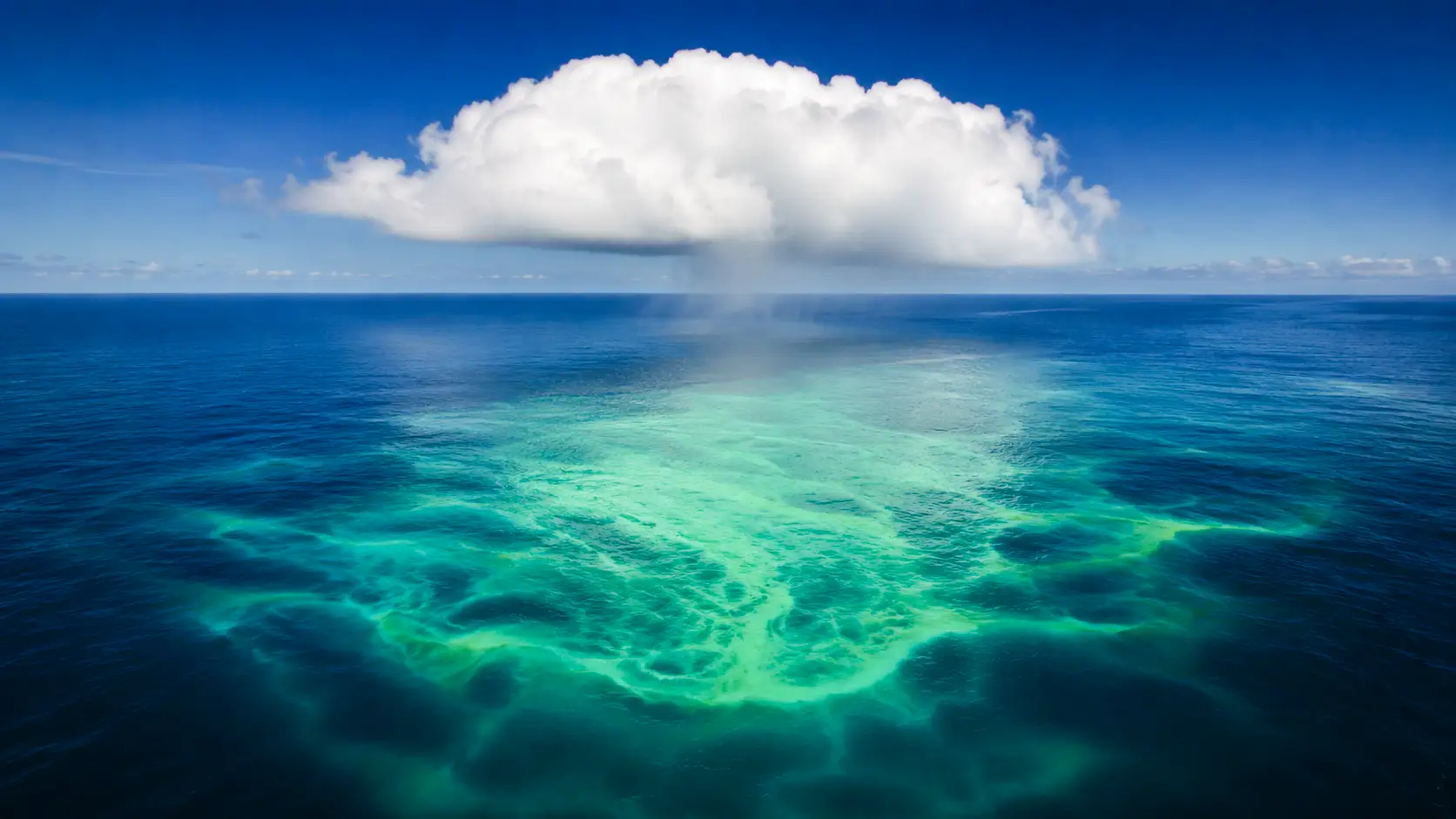
Marine microscopic organisms release a sulfur-containing gas at the surface of the water. As it rises into the atmosphere, this substance fosters the birth of clouds above the oceans. These measurements reevaluate a major biological mechanism, essential for refining the accuracy of projections of global warming.
Phytoplankton releases dimethyl sulfide, the marine molecule responsible for the coastal scent
The microscopic plant-like organisms drifting in the oceans produce a substantial share of Earth’s oxygen. In the course of their growth, these cells also release a particular molecule called dimethyl sulfide or DMS. This volatile compound escapes from the water to join the surrounding air.
This gaseous emission also explains a familiar sensation for walkers. The famous iodized coastal scent perceived during summer strolls along the shore arises directly from the secretions of this plankton. Without this ongoing biological activity, the marine atmosphere would not have that distinctive fragrance.
However, the impact of this gas extends far beyond coastal zones. Once released into the air, the DMS molecules begin a journey toward the upper atmosphere. There they trigger a sequence of physico-chemical reactions with direct consequences for the sky.
By what chemical process does this airborne volatile compound transform into droplets?
To form a cloud mass, ambient humidity requires a physical scaffold. The water vapor contained in the air cannot condense on its own; it must attach itself to microscopic solid or liquid particles called cloud condensation nuclei. Without these supports, the sky would remain entirely clear.
In the presence of oxygen and sunlight, dimethyl sulfide undergoes a rapid chemical transformation. It yields sulfur derivatives that assemble with one another through a process known as atmospheric nucleation. This clustering creates new seeds capable of gathering surrounding water droplets.
In offshore regions away from coastlines, plankton becomes the primary creator of cloud seeds
The air above continents carries a plethora of dust and industrial pollutants. By contrast, the atmosphere over distant maritime expanses is marked by extreme cleanliness. In these isolated sectors, the amount of suspended particles is particularly low, making every source of condensates strategic.
It is precisely within these wild spaces that plankton plays a decisive role. In the absence of other dust, sulfur compounds produced from DMS become the main reservoir of seeds for condensation. Modern atmospheric analysis instruments now confirm the importance of this biological input.
Previously, scientists struggled to assess this contribution with precision. The most recent measurements show that marine microorganisms produce cloud condensation nuclei far more than earlier estimates suggested. This discovery profoundly alters our understanding of gas balances above the oceans.
Why underestimating this sulfur gas forces scientists to revise future climate simulations
The presence of marine clouds directly influences the planet’s heat balance. By forming a white shield above the dark water, these cloud coverings reflect a portion of the sunlight back into space. An ocean rich in plankton thus promotes a natural cooling of the surface.
Since computer models have historically underestimated the reach of dimethyl sulfide, forecasts of how temperatures will evolve globally require adjustments. Accurately integrating this biological link will improve the reliability of projections of climate warming, particularly in isolated marine regions.

Contact details
Address:
Farmers Forum,
36, Dominick Street,
Mullingar,
Co. Westmeath,
Ireland
Phone:
+353 (0)44 9310206
Or email us:
For technical issues please check out our FAQ's page or email - [email protected]
For general Queries email - [email protected]
Request to add event to our Calendar - [email protected]
Send us your mart reports - [email protected]
Suggestions and feedbacks - [email protected]
News Items / Press Release - [email protected]
To Advertise on Farmers Forum - [email protected]