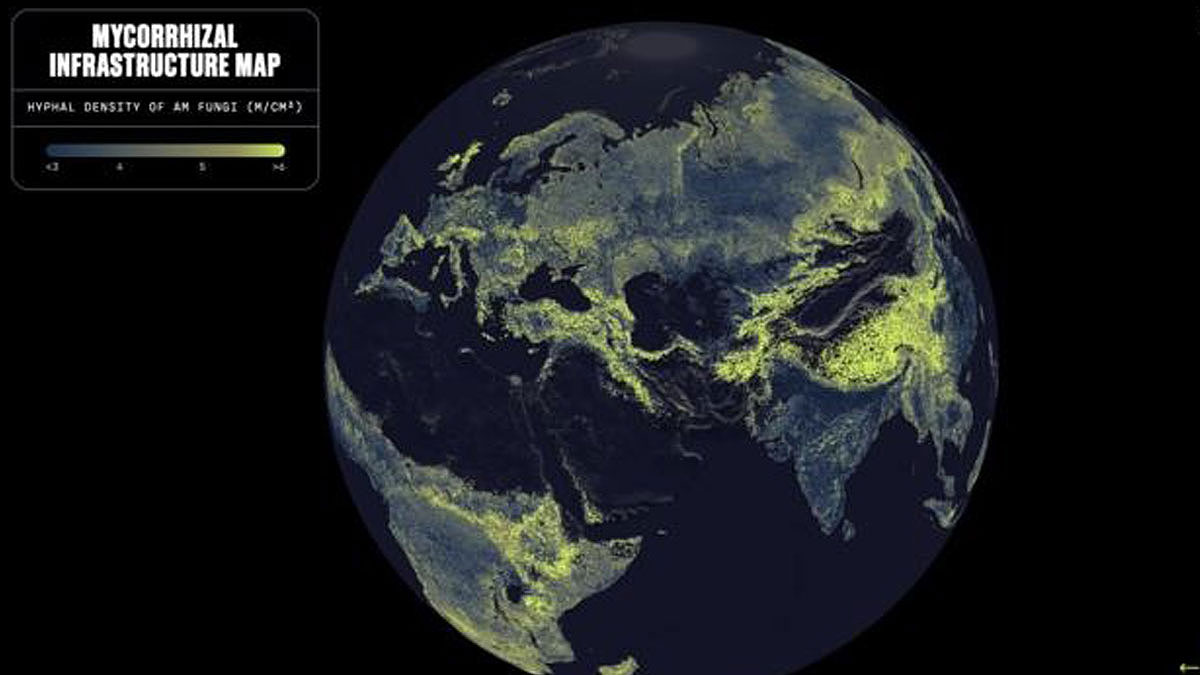
A rather dizzying scale. Researchers have unveiled the first global map of underground mycorrhizal fungal networks, playing a crucial ecological role.
Giant Underground Networks
Acting as an extension of their root system, these fungal organisms sustain a symbiotic relationship with roughly 70 % of known plant species. Providing them with water and essential nutrients that support their growth and bolster their resilience, they receive in return precious sugars.
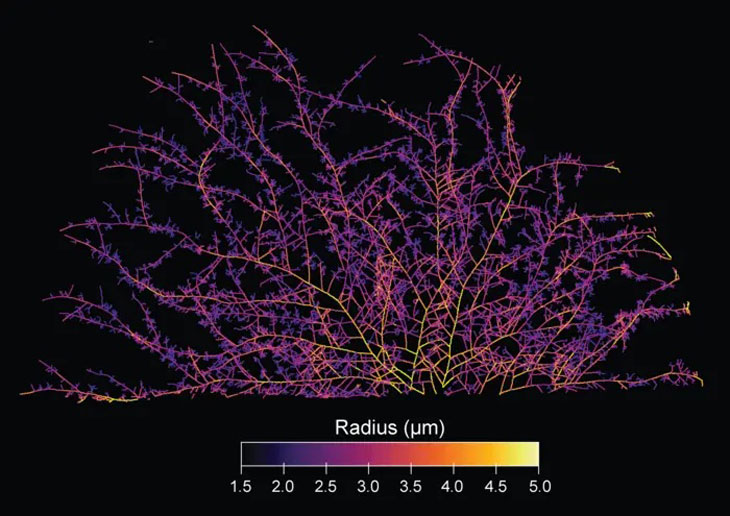
To refine the distribution of these fungi, which also helps regulate the planetary climate by fixing a significant portion of carbon, researchers collected more than 16,000 soil samples from across the globe. When combined with the high-resolution imaging of their tubular cells, or hyphae, these data enabled the creation of an unprecedented global model.
Grasslands host about 40 % of the Earth‘s arbuscular mycorrhizal fungal network, with the highest concentrations found in the floodplains of South Sudan, the Everglades (Florida), and the Tibetan Plateau. By comparison, agricultural lands show densities roughly 50 % lower. According to the team’s calculations, this essential underground infrastructure could sequester around 4 billion tonnes of atmospheric CO2 each year, accounting for about 11 % of human-caused emissions.
Overall, taken end to end, the networks spanning Earth’s arable layers would cover a distance of roughly 110 quadrillion (110 followed by 15 zeros) kilometers, which, by way of comparison, is a billion times the Earth–Sun distance and the equivalent of about 10 % of the diameter of the Milky Way. “A single teaspoon of soil would contain up to 10 meters of mycorrhizal network,” illustrates Justin Stewart of the Society for the Protection of Underground Networks.
Key Linkages Under Threat
Among the threats weighing on these keystones of subterranean ecosystems are their diminished concentrations in cultivated soils, and the very insufficient protection afforded to grasslands (according to SPUN, 95 % of their “biodiversity hotspots” would lie outside protected areas).
“Mycorrhizal fungi have shaped life on Earth for hundreds of millions of years,” write the authors of the new study, published in the journal Science. “This study marks an exciting advance in our understanding of this planetary circulatory system and suggests ways to better collaborate with fungi to address many of today’s challenges, from food security to climate change.”
Previously, a study had revealed that fungi communicate with one another using up to 50 “words”.

Contact details
Address:
Farmers Forum,
36, Dominick Street,
Mullingar,
Co. Westmeath,
Ireland
Phone:
+353 (0)44 9310206
Or email us:
For technical issues please check out our FAQ's page or email - [email protected]
For general Queries email - [email protected]
Request to add event to our Calendar - [email protected]
Send us your mart reports - [email protected]
Suggestions and feedbacks - [email protected]
News Items / Press Release - [email protected]
To Advertise on Farmers Forum - [email protected]