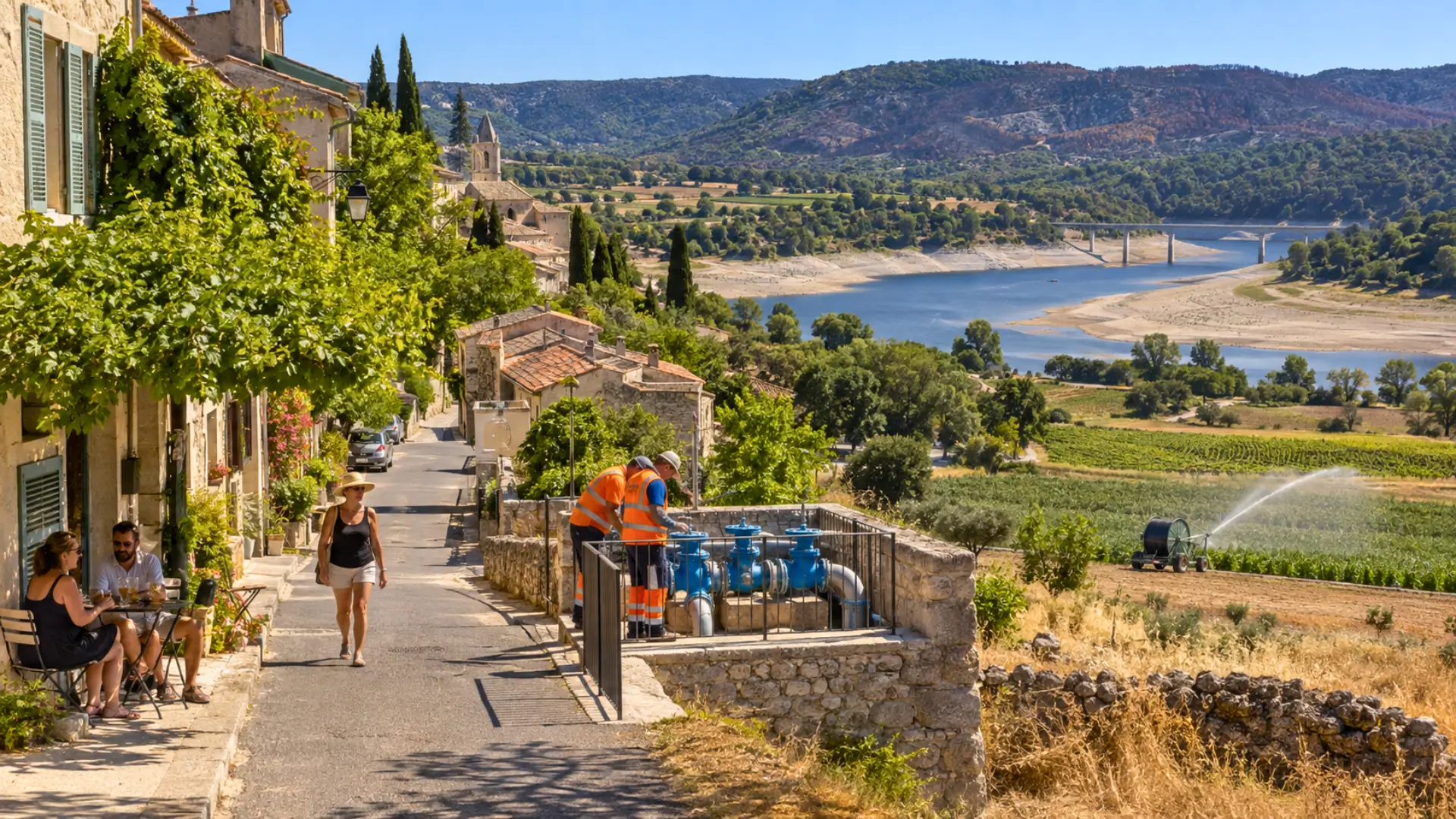
What if the climate in tomorrow’s France forces parts of the country to be rebuilt? After the summer of 2026, the hottest on record since measurements began in 1900, an official report sketches a France where water, agriculture, cities, infrastructure, and insurance must transform much faster than expected, across the entire territory.
The summer of 2026 offered a stark preview of the France the climate is preparing for tomorrow
The thermometer has issued a serious warning. With an average temperature of 24 °C, the summer of 2026 is the warmest on record in France since measurements began in 1900. Moreover, Météo-France notes 53 days of heatwaves, while rainfall deficits reach nearly 40%.
Yet this scene of dried soils and wildfires is no longer viewed as an isolated anomaly. Hence, the High Commission for Strategy and Planning now estimates that equipment designed for the old climate may no longer be sufficient. Roads, housing, water networks and farms are all affected. Adaptation therefore becomes a nationwide undertaking on a grand scale.
Behind the energy transition lies a challenge far broader than anticipated
For years, the climate battle was told largely in terms of CO₂. Yet the new report shifts the focus. Decarbonizing will not be enough if regions remain vulnerable to droughts, heatwaves and floods. At the same time, the country must learn to operate in a climate that has changed profoundly.
This logic aligns with the third National Plan for Adaptation to Climate Change. Its benchmark is impressive: preparing the Hexagon to about +4 °C by 2100, relative to the pre-industrial era. To achieve this, the program brings together 52 measures and more than 200 actions. These concern notably buildings, biodiversity, businesses, and territories.
The challenge goes beyond weather. Indeed, a France dependent on fossil fuels, on certain materials, and on imported agricultural inputs remains exposed to external crises. That is why the High Commission links climate adaptation and sovereignty. It thus advocates for more electrification, stronger industrial sectors, and agriculture less reliant on foreign suppliers.
Water and fields could become the first laboratories of this new France
In the countryside, adaptation could reshape familiar landscapes. In the future, crops, farming calendars, irrigation, and the use of inputs will have to contend with hotter and drier episodes. It is not merely about safeguarding yields; it is also about maintaining land-based food production even as resources become more uncertain.
Furthermore, water becomes a unifying throughline. When a resource once abundant becomes scarce for months on end, the choices become political. Who gets priority for supply? Which crops should be preserved? Where should new developments be built? How should resources be shared? Without common rules, the report fears the emergence of a climate-driven “every country for itself” among territories.

Contact details
Address:
Farmers Forum,
36, Dominick Street,
Mullingar,
Co. Westmeath,
Ireland
Phone:
+353 (0)44 9310206
Or email us:
For technical issues please check out our FAQ's page or email - [email protected]
For general Queries email - [email protected]
Request to add event to our Calendar - [email protected]
Send us your mart reports - [email protected]
Suggestions and feedbacks - [email protected]
News Items / Press Release - [email protected]
To Advertise on Farmers Forum - [email protected]