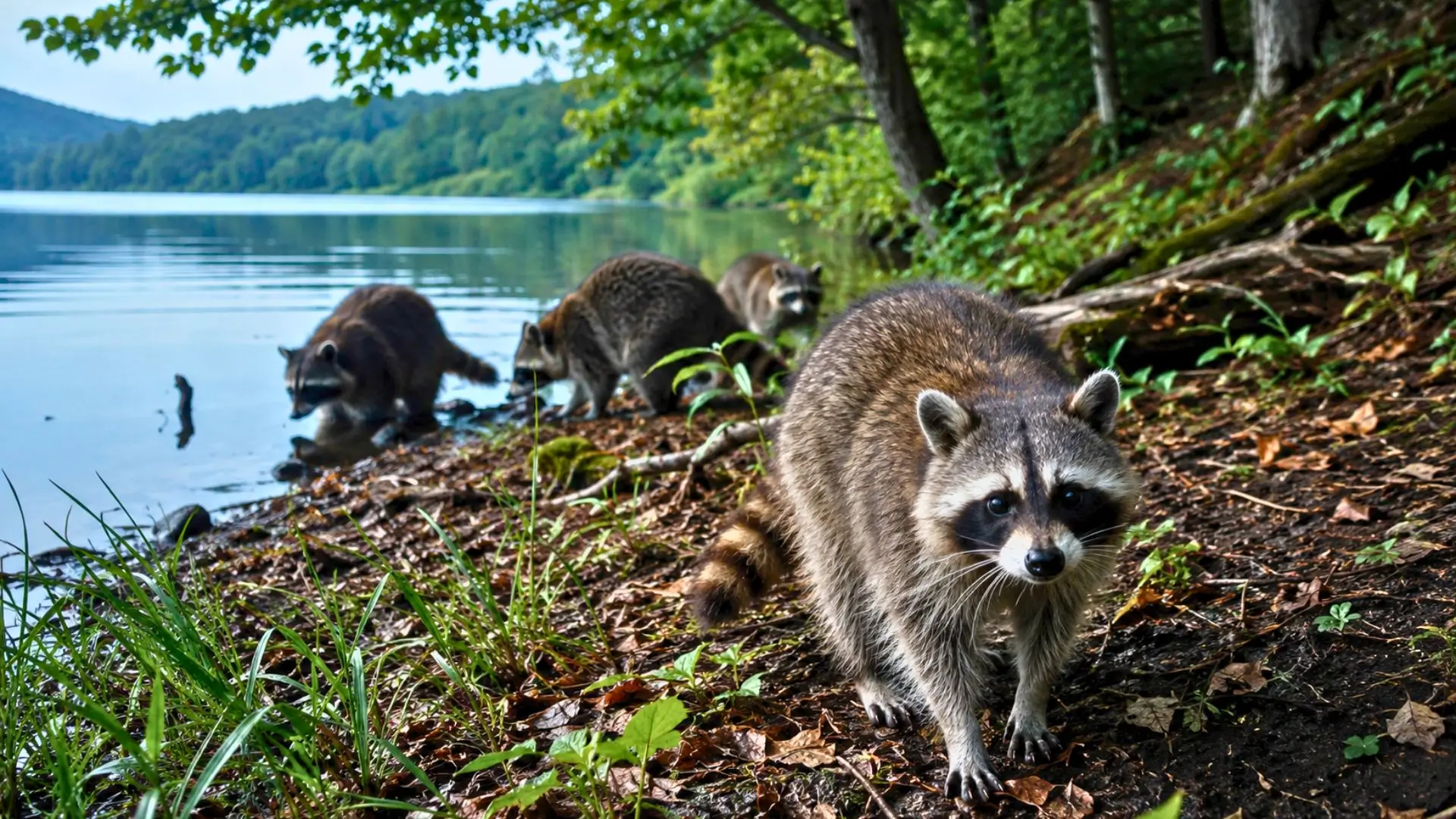
There were only four raccoons at the edge of a German lake in 1934. Nine decades later, the country would count up to two million raccoons. How could a handful of North American animals participate in one of Europe’s most astonishing biological invasions?
On the shores of the Edersee, four animals are released, unaware of what would follow
On April 12, 1934, near Lake Edersee in northern Hesse, two pairs of raccoons were deliberately released. The idea today may seem almost unbelievable: introducing this North American mammal to enrich the hunting fauna. Yet the experiment did not stay confined to the lake’s shores.
These four pioneers became the symbol of the story, but the real scenario is more complex. Researchers estimate that other releases or escapes probably reinforced this initial population. In other words, the German invasion is not the perfectly straight genealogical tree that popular lore sometimes portrays.
Eleven years later, 25 escapees open a second front in eastern Germany
In 1945, the tale takes another spectacular turn. In Wolfshagen, in Brandenburg, 25 raccoons escaped from a fur-breeding operation. A second founding population then formed far from Hesse, giving the species’ expansion a new stronghold in eastern Germany.
Genetics has since further complicated this narrative. Studies focused on European populations show that the raccoon’s establishment results from several founding events, not simply the four animals from Edersee. It is precisely this sequence of introductions that helped the species take root durably on the continent.
The result today surpasses all projections imaginable in 1934. A study published in 2025 in Ecological Indicators estimates that between 1.6 and 2 million raccoons now live in Germany, more than in any other country outside their North American native range.
Omnivore, nocturnal and opportunistic, the raccoon almost had the ideal profile
Why such success? The raccoon possesses a formidable asset whenever it arrives in a new environment: it can exploit almost anything. Forests, wetlands, gardens, rubbish, attics, or human food resources suit it. Researchers highlight its very broad ecological niche and its remarkable adaptability.
This flexibility comes with a downside for biodiversity. The Bundesamt für Naturschutz designates Procyon lotor among the established invasive mammals in Germany. Eggs, young birds, amphibians, reptiles or small animals can become part of its menu, locally adding pressure to native species already endangered.
By analyzing 21 years of hunting data from 398 German districts, researchers from Senckenberg and Goethe University Frankfurt reconstructed in 2025 the various phases of the expansion. Northern Hesse and Brandenburg emerge as the two major historical centers.
A recent study shows the invasion continues to change its face
But the invasion does not progress at the same pace everywhere. In some old strongholds, populations now appear close to a high-level stabilization. In southwestern Germany, by contrast, the spread remains in a more early stage. A biological invasion is therefore not a simple uniform wave advancing forward. The stakes extend beyond predation.
The raccoon can host Baylisascaris procyonis, a parasitic worm capable of infecting humans accidentally, while the European Union classifies the species among those of concern at the EU level. The story begun beside a lake more than 90 years ago thus resembles less a miraculous explosion of four animals than a succession of small human decisions that have become ecologically irreversible.

Contact details
Address:
Farmers Forum,
36, Dominick Street,
Mullingar,
Co. Westmeath,
Ireland
Phone:
+353 (0)44 9310206
Or email us:
For technical issues please check out our FAQ's page or email - [email protected]
For general Queries email - [email protected]
Request to add event to our Calendar - [email protected]
Send us your mart reports - [email protected]
Suggestions and feedbacks - [email protected]
News Items / Press Release - [email protected]
To Advertise on Farmers Forum - [email protected]