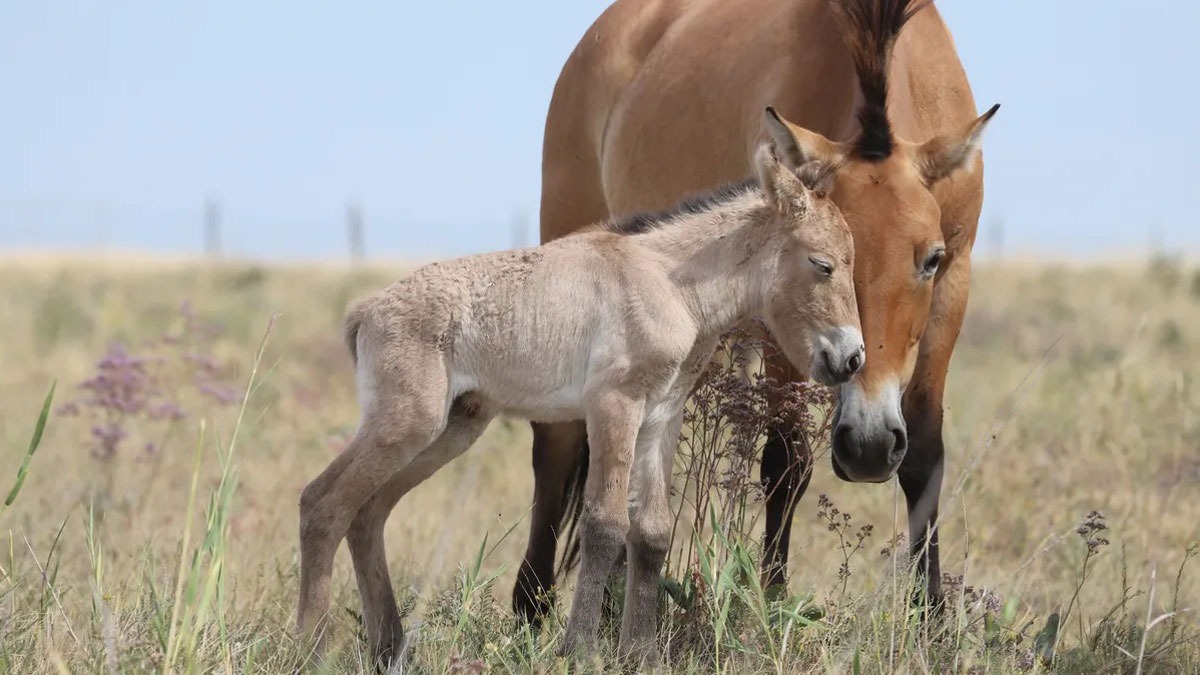
The Przewalski’s horse had vanished from the Kazakh steppes in the early 19th century. Two years after reintroducing a small group, researchers recorded the first birth of a foal in 200 years.
Comeback
Equus ferus przewalskii is regarded as the last truly wild horse. It owes its name to Nikolai Przewalski, a Russian explorer who described the species in detail in 1881. Once found in northern China, the steppes of Central Asia, Kazakhstan, and Mongolia, its populations declined rapidly from the 18th century onward due to a combination of climate change, habitat loss, and hunting.
Declared extinct in the wild in the 1960s, this lineage experienced an unexpected rebound thanks to an initial captive-breeding program, involving the last 12 individuals captured in 1947. In the following decades, the expansion of this initiative allowed the reconstitution of a minimal population, with the ultimate goal of gradually reintroducing it into the wild.
The first phase of the project took place in Mongolia in 1992, where 16 Przewalski horses were successfully released. Since then, the country is believed to have recorded nearly 400 births. Others, such as China, are also experiencing a reassuring “boom” for the conservation of this emblematic equid, physically distinguishing it from domesticated horses by its sturdier body, a bristly mane, and shorter limbs.
Ein domestiziertes Pferd trifft auf ein Wildpferd. Das Przewalski-Pferd ist die letzte wirklich wilde Pferdeart auf der Erde.pic.twitter.com/fQLxZYAGcK
— Peter Borbe (@PeterBorbe) July 18, 2026
A First Birth in Kazakhstan
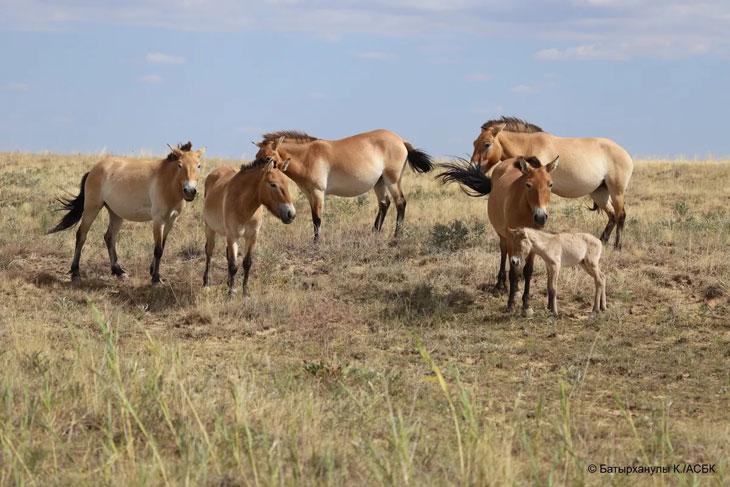
In 2024, Kazakhstan welcomed its seven first Przewalski horses in two centuries, sourced from the Prague Zoo and the Berlin Tierpark. Reintroduced into the Altyn Dala nature reserve in the country’s center, the equids gradually acclimated.
On August 22, 2026, a seven-year-old mare named Tess gave birth to a foal. According to the teams overseeing this reintroduction program, the pair appears to be thriving. They describe the mother as caring and protective, and the young one as already exploring its surroundings autonomously, seemingly fearless.
“It’s a historic moment,” rejoiced Daniyar Turgambayev from the Kazakh Ministry of Ecology and Natural Resources. “The arrival of this first foal confirms that the species has successfully regained its former natural habitat, and marks a new milestone for restoring its historical range and the Kazakh steppes. We hope that the number of kertagy will increase year after year.”
Earlier this year, a study had shown that the Chernobyl Exclusion Zone had become a true Eden for rare species, including the Przewalski horse.

Contact details
Address:
Farmers Forum,
36, Dominick Street,
Mullingar,
Co. Westmeath,
Ireland
Phone:
+353 (0)44 9310206
Or email us:
For technical issues please check out our FAQ's page or email - [email protected]
For general Queries email - [email protected]
Request to add event to our Calendar - [email protected]
Send us your mart reports - [email protected]
Suggestions and feedbacks - [email protected]
News Items / Press Release - [email protected]
To Advertise on Farmers Forum - [email protected]