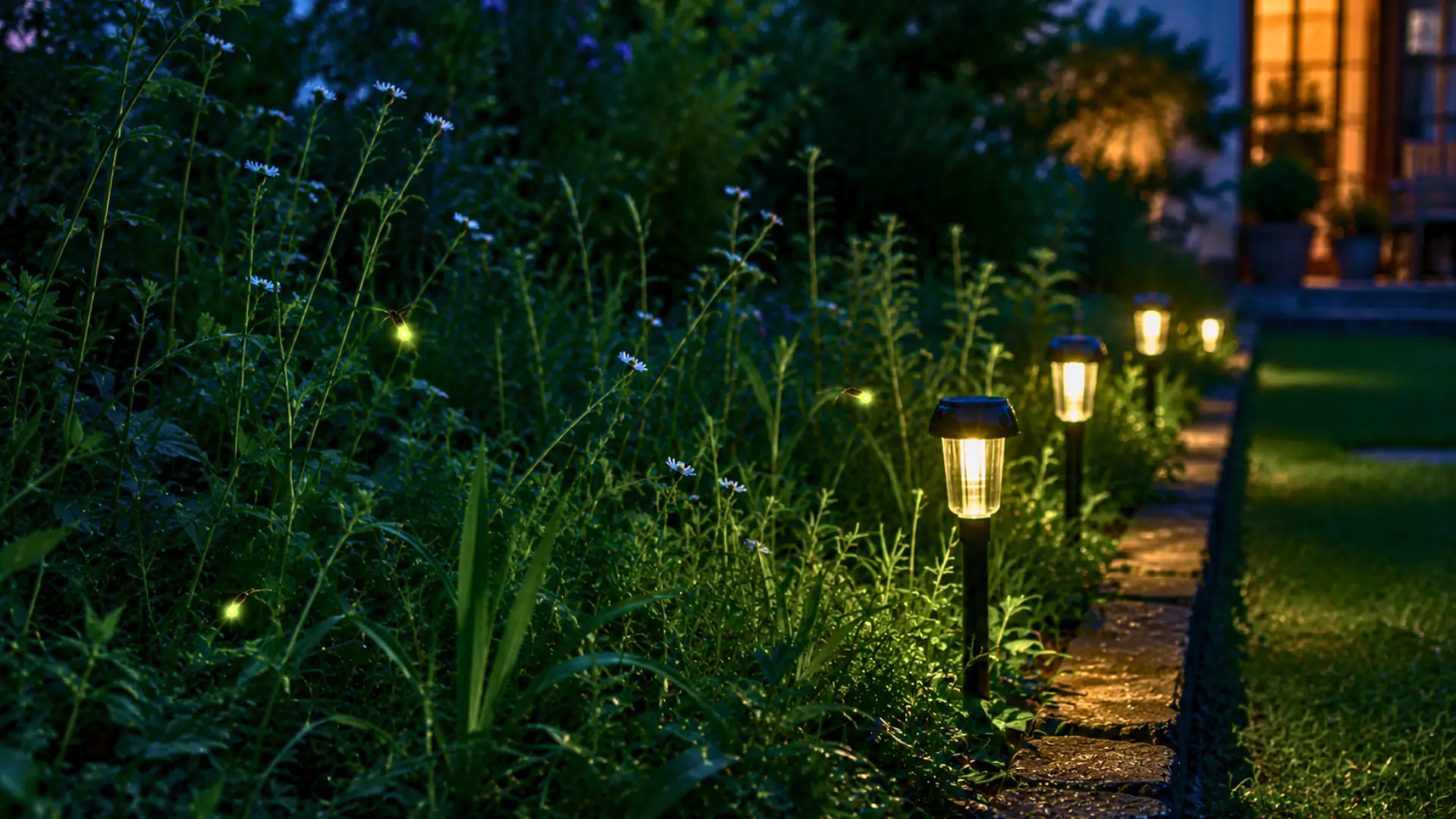
Every summer, French gardens glow with tiny solar lamps meant to conjure a magical atmosphere. Yet, at the same time, the real French fireflies vanish into nearly total silence. And the link between these two phenomena is closer than it might seem.
Solar lamps blur the fragile light signals of fireflies
As night falls, the spectacle seems tiny. A female firefly climbs slowly along tall grass and then emits a green glow that is almost unreal. This light signal has only one aim: to attract a male before the end of its very short adult life. It all unfolds over just a few nights in June.
The problem arises precisely when modern gardens begin to glow themselves. Decorative solar lamps switch on at dusk, exactly during the fireflies’ breeding window. According to several studies relayed by the CNRS and the Firefly Observatory, this light pollution drastically reduces encounters between males and females.
The mechanism is unexpectedly simple. Males are drawn to artificial light sources, especially the cool LEDs so widespread today. Meanwhile, females become almost invisible in the garbled darkness of the illuminated gardens. A single lamp can disrupt reproduction over several tens of metres.
Decorative “firefly effect” lamps are unintentionally participating in their disappearance
The irony seems straight out of an ecological novel. Hardware stores now sell solar lamps with a “realistic firefly effect.” These tiny glowing specks meant to reproduce summer magic settle into flowerbeds, along terraces, or near hedges. Exactly where real fireflies have been trying to survive.
The timing is the most troubling aspect. These devices switch on automatically as light fades, precisely when female courtship begins. Researchers also warn about white and blue LEDs, far more disruptive for nocturnal insects. The decoration thus imitates the firefly while emitting an aggressive spectrum of light that speeds up its disappearance.
Light pollution, excessive mowing and pesticides accelerate the decline of fireflies
For a long time, pesticides drew most of the attention. And the reasons are obvious. Firefly larvae mainly feed on snails and slugs. The slug pellets spread in gardens thus directly wipe out their food source. By destroying prey, modern gardens cut the entire food chain.
But specialists are now observing an accumulation of factors. The disappearance of tall grasses, habitat fragmentation and especially nocturnal light pollution create a hostile environment for these insects. A lawn cut very short, chemically treated and lit all night becomes practically uninhabitable for fireflies.
This disappearance often goes unnoticed because the firefly life cycle is surprisingly discreet. Some larvae spend nearly two years in the soil before reaching adulthood. Then everything accelerates dramatically: only a few days to find a partner, reproduce and die. A sequence of disturbed nights is enough to wipe out an entire population.
Some simple changes can still welcome fireflies into the garden
Perhaps the most surprising detail is the simplicity of the solutions. Turn off exterior lighting when the garden is not in use; it immediately changes the breeding conditions. A few nights of complete darkness in June can already improve the chances of encounters between adult insects.
The managers of the Firefly Observatory also recommend leaving wilder zones in gardens. A strip of tall grasses near a hedge or low wall often suffices. Females use these natural perches to make their light signal more visible in the darkness.
Across Europe, several cities are now starting to reduce night lighting to protect biodiversity. This movement reveals a troubling paradox: at a moment when lighting technologies become more accessible and affordable, darkness suddenly becomes a precious ecological resource. And in some gardens still spared, a few green specks continue to flicker at the heart of summer nights.

Contact details
Address:
Farmers Forum,
36, Dominick Street,
Mullingar,
Co. Westmeath,
Ireland
Phone:
+353 (0)44 9310206
Or email us:
For technical issues please check out our FAQ's page or email - [email protected]
For general Queries email - [email protected]
Request to add event to our Calendar - [email protected]
Send us your mart reports - [email protected]
Suggestions and feedbacks - [email protected]
News Items / Press Release - [email protected]
To Advertise on Farmers Forum - [email protected]