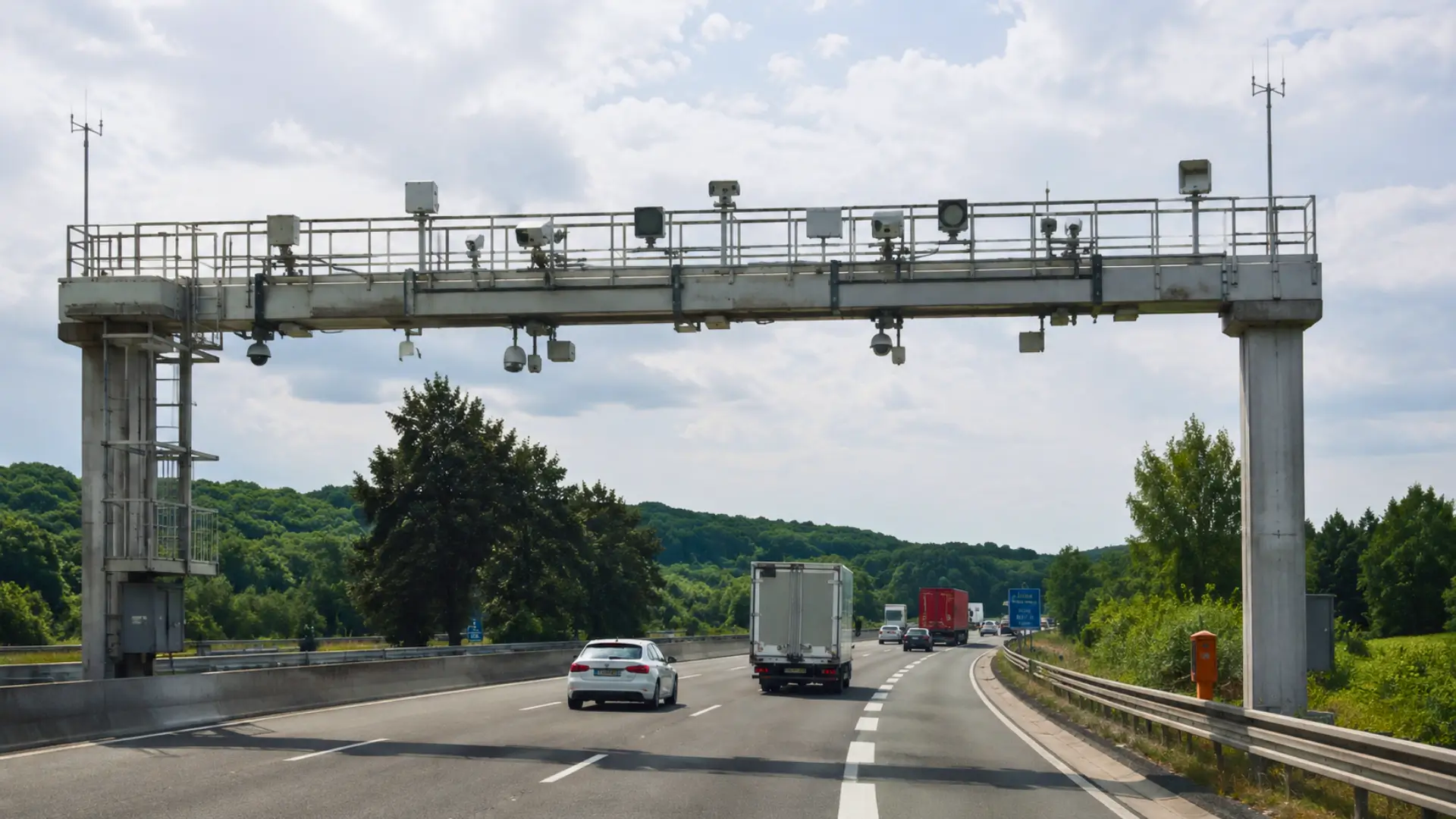
They were meant to bring billions into the public coffers. They have become one of the most troubling symbols of state waste. How did 174 ecotax gantries installed to collect the ecotax come to embody, twelve years later, a cost that continues to haunt France’s roads?
In 2013, 174 ultra-technological gantries appeared along the French roads
In the summer of 2013, motorists noticed strange structures rising above the national routes. These ecotax gantries, bristling with sensors and cameras, evoke a scene of administrative science fiction. On paper, their mission was simple: identify heavy vehicles and enable the collection of a per‑kilometre tax intended to fund the infrastructure.
Behind the scenes, the system announced itself with its scale. It would require 174 gantries, hundreds of roadside terminals on secondary axes, a dedicated IT center, and thousands of devices for trucks. Everything existed. The system was wired. The equipment was ready. Yet, this ultra‑tech setup would never collect a single euro.
This is where the affair shifts into another category. The Court of Auditors speaks of a very costly failure. Nearly €957 million are paid to the Ecomouv’ consortium after the contract’s termination. Added to this are administrative costs. The image of rusting gantries along the roads is therefore not merely a symbol. It is a frozen counter.
The Bonnet Rouge uprising transforms a technical tax into a political disaster
The ecotax did not spring from nowhere. It was born in the wake of the Grenelle de l’environnement. The idea is known to several European neighbors: make heavy goods vehicles contribute to the wear on roads and to environmental costs. But between principle and implementation, the social climate grew tense. In Brittany, the agrifood crisis already fueled the debate.
In the autumn of 2013, the Bonnet Rouge movement turned a technical tax into a political bomb. The government first suspended the scheme. Then it buried its revised version in 2014. The most astonishing thing is not only the abandonment. The contracts, later deemed nearly impossible to unwind without ruin, left the state with a costly exit.
Behind the abandonment, a colossal bill for indemnities, write-downs in equipment, and lost revenues
The scandal lies not only in what was paid. It also lies in what was never collected. According to the Court of Auditors, the revenue shortfall during the planned operating period amounts to €9.83 billion. This money was supposed to help finance transport via the Agency for Financing of Transport Infrastructures in France.
The other shock comes from the devalued value of the equipment. A portion of the hardware was indeed resold, but at derisory prices. Sometimes, 2% of its value only. In any industrial story, such a ratio sounds like a hasty liquidation. Here, it mainly tells the tale of a project designed to be modern, then finished as bulky stock.
And while the gantries remain standing, another irony emerges. Their dismantling also carries a cost, estimated at around €7 million in a recent TF1 report. Leaving them in place costs. Removing them costs as well. Rarely has a public decision given the impression of choosing the most expensive path.
While France backs away, Germany turns the ecotax into an effective lever
The contrast is even sharper given that the idea was not exotic. In Germany, the LKW‑Maut has been operating since 2005 and has gradually expanded. It, too, rests on taxing heavy goods vehicles according to the routes traveled. The system funds the network and progressively strengthens the environmental incentive.
Such a system produced concrete effects on fleets. Modulation by vehicle categories and emissions encouraged fleet renewal. The less polluting trucks quickly gained ground in the following years. Where the German tool steered behavior, the French version stopped before its first full‑scale test.
The most striking part lies elsewhere. To compensate for the abandonment of the ecotax, the state raised the diesel tax. The Court of Auditors deems this choice poorly targeted. Foreign trucks contribute little. Roads are aging. And the old gantries remind us that a policy abandoned too late can keep costing a lot.

Contact details
Address:
Farmers Forum,
36, Dominick Street,
Mullingar,
Co. Westmeath,
Ireland
Phone:
+353 (0)44 9310206
Or email us:
For technical issues please check out our FAQ's page or email - [email protected]
For general Queries email - [email protected]
Request to add event to our Calendar - [email protected]
Send us your mart reports - [email protected]
Suggestions and feedbacks - [email protected]
News Items / Press Release - [email protected]
To Advertise on Farmers Forum - [email protected]