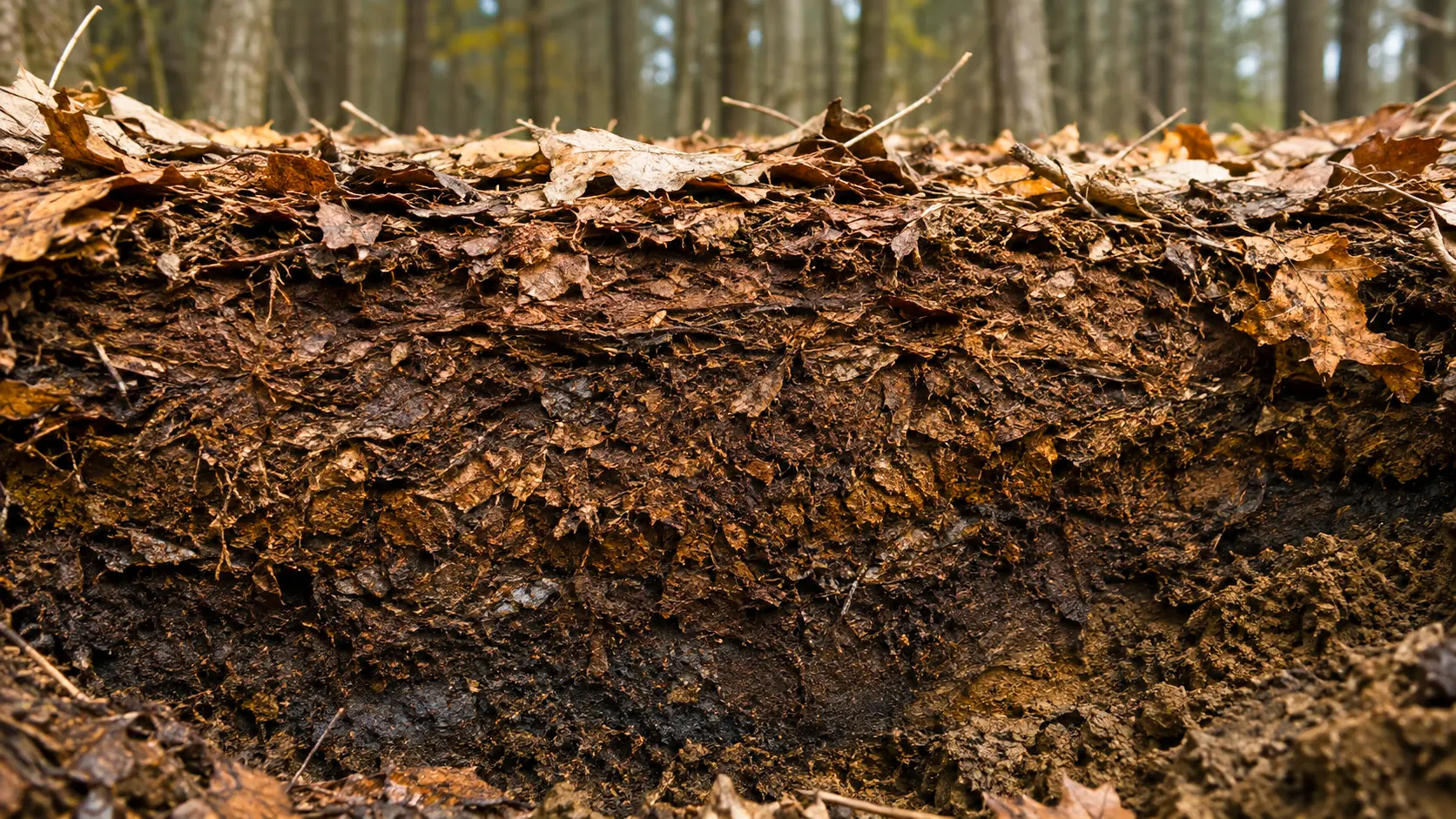
The illusion of a rapid disappearance of fallen leaves masks a major ecological phenomenon. By studying forest litter, scientists reveal an extremely slow decomposition. This unsuspected slowdown transforms the understory soil into an essential carbon reservoir for the global climate balance.
Field measurements challenge the idea of a rapid recycling of plant matter
The casual observer often believes the vegetative mat disappears in merely a few months. Insects, fungi, and micro-organisms seem to assimilate all the material fallen from the trees. Yet precise measurements show that this visible disappearance conceals a reality far more complex within the soil.
Organic matter does not immediately return to the soil in a fully degraded form. In fact, the foliage piles up, compacts, and fragments gradually. A large portion of its components remains trapped beneath the surface, prolonging the preservation of the forest litter well beyond usual estimates.
Lignin and the local climate slow the natural degradation of vegetative debris on the soil
Decomposition of debris follows a step-by-step progression across several seasons. At first, the simpler components are consumed very quickly by soil fauna. However, the structure also contains lignin, a particularly tough plant backbone that resists biological attacks for a long time.
The pace of this transformation depends heavily on surrounding environmental conditions. The average temperature, ambient humidity, and the variety of tree species influence the decomposition work. In cool and moist areas, the process extends over several years.
This persistence alters our view of forest understories. Far from being merely zones of quick recycling, these environments operate as a very slow assimilation mechanism. The fallen leaves take far longer to fully meld into the subsoil than simplified models suggested.
A longer-locked carbon storage in the soil of the understory
This slowness of assimilation has direct consequences for soil chemistry. When plants take time to rot, the carbon accumulated during their growth remains imprisoned underground. If this material degraded rapidly, this gas would be released massively into the surrounding air.
Thus, forest lands emerge as particularly efficient carbon reservoirs. Each vegetation layer that takes several seasons to transform allows for the durable sequestration of this compound. This ongoing process makes the leaf litter a discreet but effective shield against the deterioration of the atmosphere.
Climate forecasts revised in light of the vulnerability of forest soils
These quantified data compel climatologists to adjust their current calculations. The capacity of ecosystems to retain carbon dioxide could prove higher than earlier estimates. Taking into account the actual resistance of the litter allows refining climate models with greater precision.
Nevertheless, this natural balance remains particularly sensitive to thermal disruptions. The rise in global temperatures risks stimulating soil microbiological activity. Excess warming would accelerate the decomposition of the litter, causing a faster release of stored carbon dioxide.
Preserving the freshness of the understory thus becomes a priority environmental challenge. Protecting forest cover conditions the maintenance of this natural storage. This fragile mechanism beneath our feet reminds us that climate stability directly depends on the internal dynamics of soils.

Contact details
Address:
Farmers Forum,
36, Dominick Street,
Mullingar,
Co. Westmeath,
Ireland
Phone:
+353 (0)44 9310206
Or email us:
For technical issues please check out our FAQ's page or email - [email protected]
For general Queries email - [email protected]
Request to add event to our Calendar - [email protected]
Send us your mart reports - [email protected]
Suggestions and feedbacks - [email protected]
News Items / Press Release - [email protected]
To Advertise on Farmers Forum - [email protected]