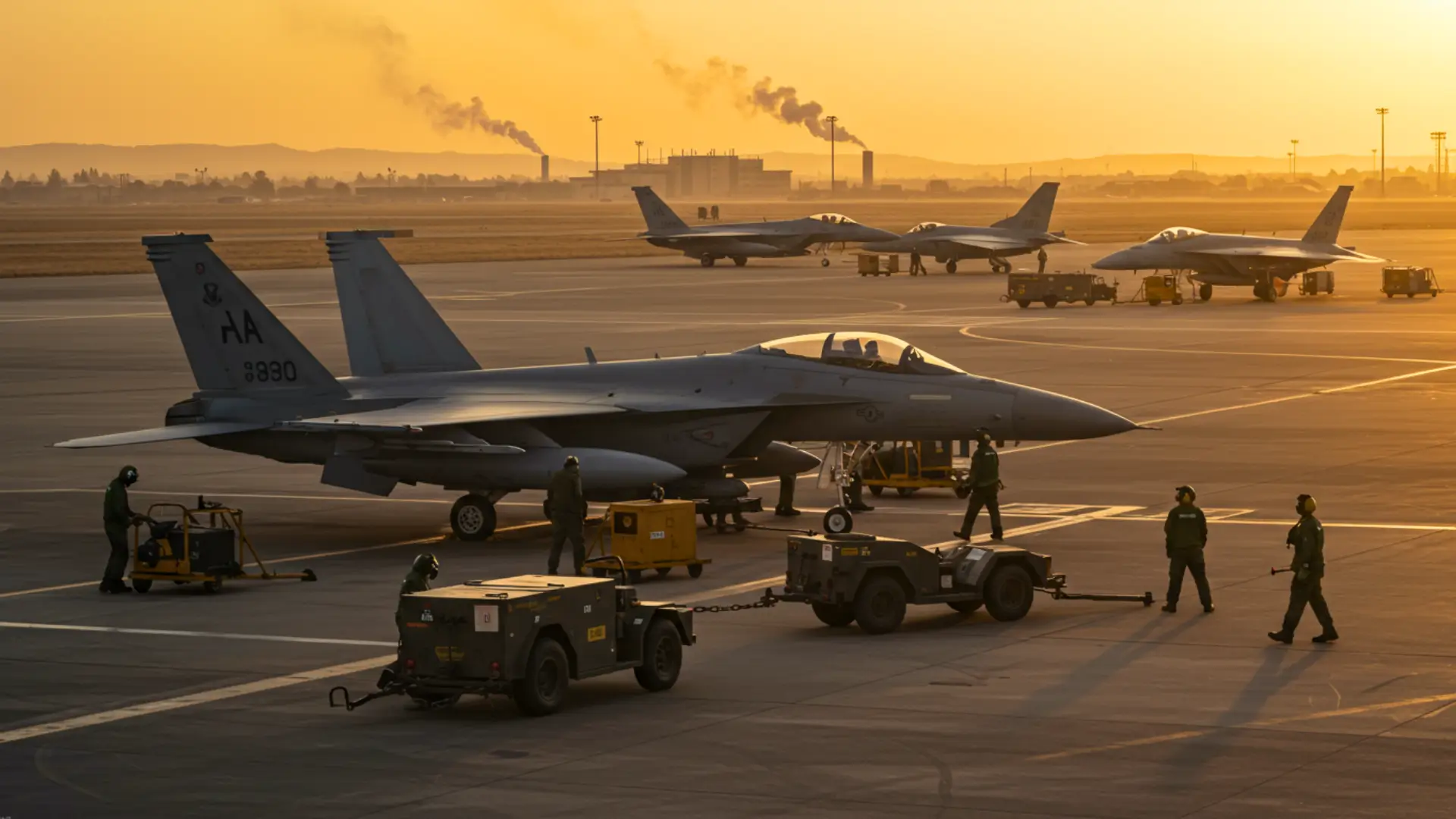
What if the machine meant to protect the planet from future crises was already helping to worsen them? Behind American military power lies a troubling paradox, where global security and climate destabilization sometimes go hand in hand.
A Global Military Power Whose Carbon Footprint Surpasses That of Many Nations
At the heart of the American military system lies a striking reality: its colossal carbon footprint. Indeed, bases span all continents. Air and naval fleets stay active around the clock. Logistical chains stretch like tentacles. Each operation therefore consumes enormous amounts of fuel.
Thus, according to studies published in the scientific journal PLOS Climate, the cumulative emissions between 2010 and 2019 reached about 636 million tonnes of CO₂. Moreover, this figure surpasses the annual emissions of many industrialized countries. It reveals an energy footprint of extraordinary scale.
However, this finding is not solely about the number of soldiers. It primarily stems from an energy-intensive global infrastructure. Accordingly, deploying fighter jets or refueling aircraft carriers requires constant fluxes. Maintaining isolated bases further reinforces this dependence on fossil fuels.
A Global Network of Bases and Operations That Relies on Massive Energy Consumption
Behind every military mission lies a highly complex organization. In practice, the United States operates hundreds of facilities abroad. Each one demands a continuous energy supply. Thus, this global web forms a permanent military logistics network.
Moreover, kerosene plays a central role. Indeed, combat and transport aircraft are among the most energy-hungry assets. Added to these are ground vehicles and ships. Consequently, the whole system creates an energy consumption beyond the norm.
Even in times of relative peace, these activities persist. Exercises and patrols do not stop. Maintenance remains constant. Thus, this mode of operation makes the army a quiet climate actor. Yet its weight remains substantial and often overlooked.
Rising Military Spending That Automatically Drives Emissions Up
A direct link appears between military spending and emissions. Indeed, analyses show that when budgets fall, fuel consumption also declines. Thus, this correlation reveals a structural relationship between defense and climate. However, the current trend runs in the opposite direction. Global military spending rose sharply in 2024.
They reach unprecedented levels. Consequently, this dynamic leads to an increase in indirect emissions. Thus, a question arises: can we reduce the carbon footprint without revising priorities? In practice, security still relies on massive energy power. Therefore, any ecological transition in this domain faces deep constraints.
An Institution That Acknowledges Climate Risk While Contributing to It
The most troubling remains the official stance of military institutions. Indeed, climate change is recognized as a major threat. Thus, sea-level rise, shortages and migrations are identified as future conflict factors. Yet, at the same time, military activities worsen these risks.
Thus, a loop is created between preparation and destabilization. Consequently, military power becomes an involuntary accelerator of climate disruption. Moreover, this paradox extends beyond the American case. Indeed, it questions the very notion of security. As environmental threats intensify, a persistent question remains: should we accumulate more power or rethink what it truly means to be secure?

Contact details
Address:
Farmers Forum,
36, Dominick Street,
Mullingar,
Co. Westmeath,
Ireland
Phone:
+353 (0)44 9310206
Or email us:
For technical issues please check out our FAQ's page or email - [email protected]
For general Queries email - [email protected]
Request to add event to our Calendar - [email protected]
Send us your mart reports - [email protected]
Suggestions and feedbacks - [email protected]
News Items / Press Release - [email protected]
To Advertise on Farmers Forum - [email protected]