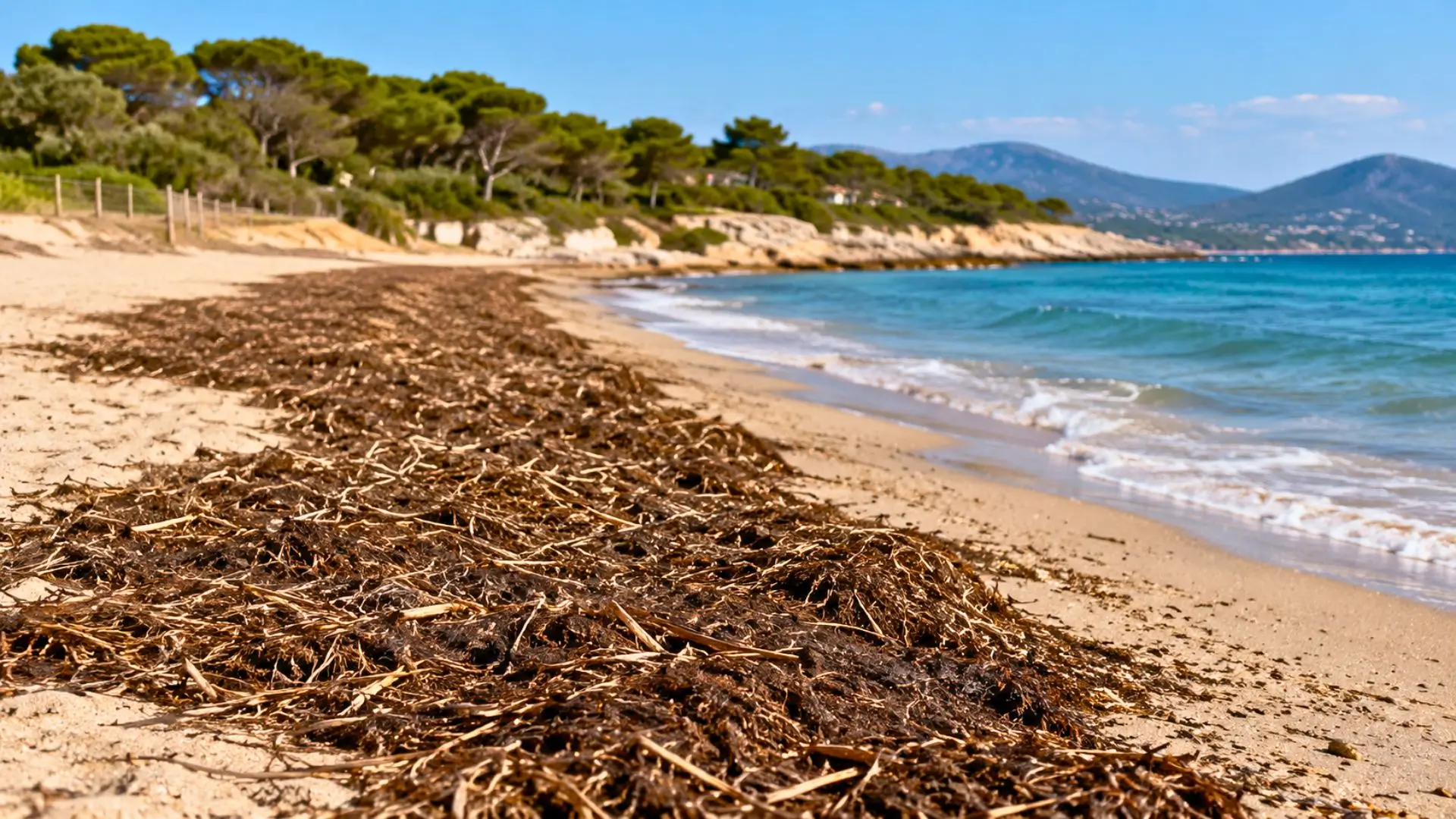
Each year, coastal municipalities along the Mediterranean remove the brown seagrass that blankets the sand to attract beachgoers. Yet this intensive cleaning destroys an essential natural barrier, triggering dramatic erosion of our coastlines that scientists are now trying to curb.
Why these brown sea grasses washed ashore by the sea constitute the best defense of the coastline
Posidonia is not a weed but a native protective marine plant. In autumn, its dead leaves wash up and form thick dark layers along the shore. These plant accumulations are regularly subjected to the passage of construction equipment, which removes them in the name of aesthetics.
This mechanical intervention seriously disrupts the coastal balance by wiping out a protective barrier. These sea grasses absorb the shock of winter waves and help stabilize sediments. Moreover, a single cubic meter of this vegetation can trap between 100 and 300 liters of sand.
These ecosystems also possess a carbon storage capacity three times higher than that of tropical forests. By eliminating these protective structures, managers directly expose the coasts to storms. The shoreline then experiences irreversible sediment loss with every season.
The mirage of paradise beaches triggers an economic and environmental crisis
The pursuit of an aesthetic ideal inspired by tropical landscapes has driven towns to circumvent a legal prohibition dating from 1988. To satisfy vacationers’ expectations, municipalities have chosen to alter the natural appearance of the shores, triggering a destructive self-perpetuating cycle.
To make up for erosion, localities spend substantial sums on artificial replenishment of beaches. However, this quarry sand proves unstable and disperses quickly offshore. The phenomenon eventually suffocates the underwater seagrass beds that originally protected the coast.
Marseille’s mille-feuille method redefines coastal management
Facing the emergency, Marseille shifts strategy and tests an innovative method through 2027. This technique involves stacking alternating layers of sediments and marine vegetation. The arrangement acts as a natural sponge against the repeated onslaught of the waves.
Early results are already encouraging, notably at the Prophet Beach. The area has regained several metres of shoreline in just a few months, securing threatened infrastructure. The success demonstrates the effectiveness of nature compared with costly artificial solutions.
The Phocaean city aims to become a model for the entire Mediterranean basin. In parallel, a charter encourages mayors to preserve these deposits until May. For now, the adoption of this sustainable coastal management remains limited among elected officials.
An educational challenge to transform beachgoers’ perceptions of the state of the beaches
The success of this ecological transition depends above all on a major cultural shift. Holidaymakers often associate these botanical deposits with a lack of site maintenance. Municipalities must therefore explain that a wild shoreline is the guarantor of long-term sand preservation.
In Var, the town of Lavandou sets an example with exclusively manual maintenance. Teams collect only anthropogenic litter without disturbing the ecosystem. This approach proves that it is possible to combine visual cleanliness with biodiversity protection.

Contact details
Address:
Farmers Forum,
36, Dominick Street,
Mullingar,
Co. Westmeath,
Ireland
Phone:
+353 (0)44 9310206
Or email us:
For technical issues please check out our FAQ's page or email - [email protected]
For general Queries email - [email protected]
Request to add event to our Calendar - [email protected]
Send us your mart reports - [email protected]
Suggestions and feedbacks - [email protected]
News Items / Press Release - [email protected]
To Advertise on Farmers Forum - [email protected]