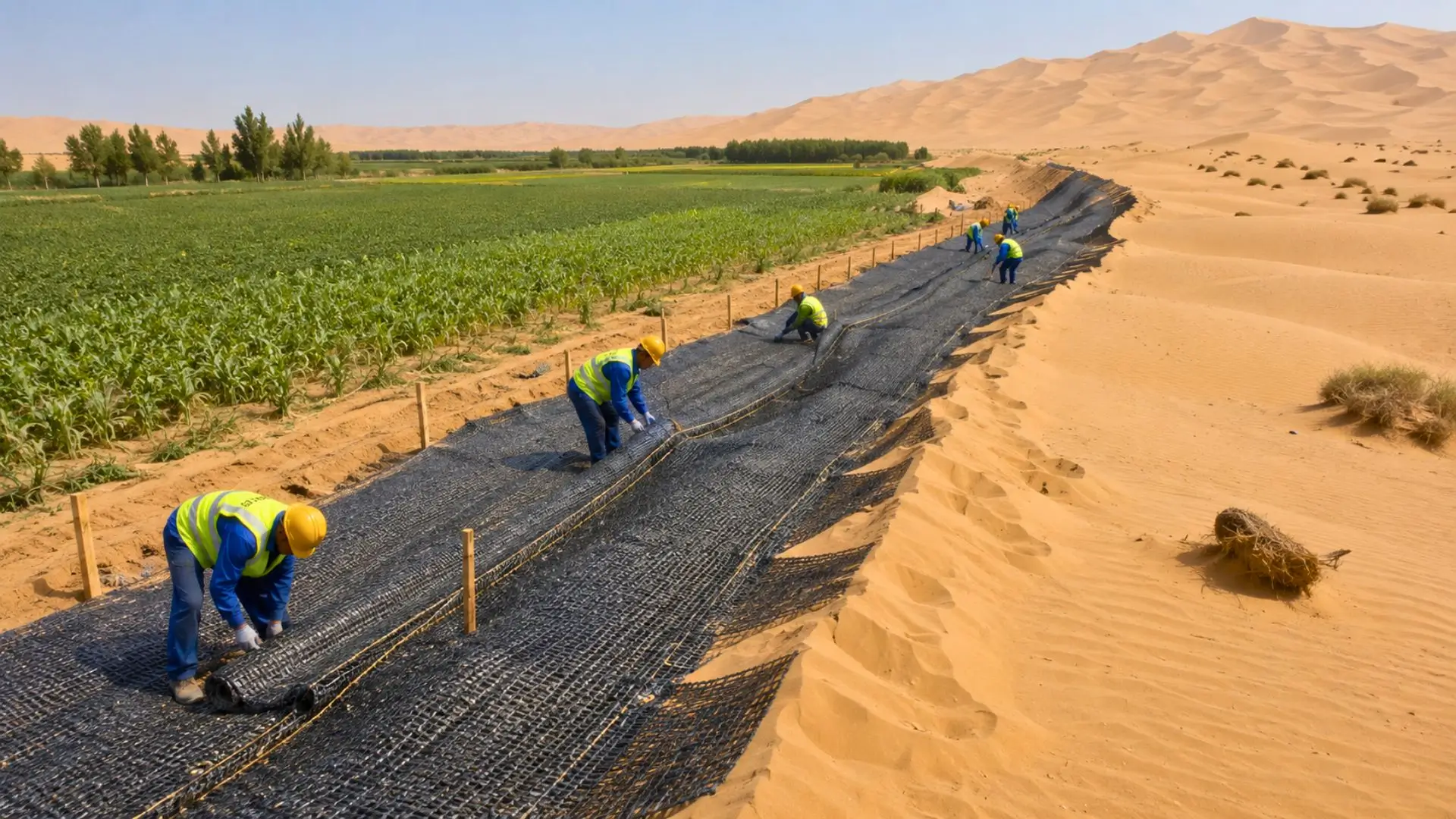
To safeguard its precious agricultural lands against erosion and drifting sands, Beijing is turning to its space program. Indeed, Chinese scientists are transforming a volcanic rock into a protective barrier. This method enables the durable stabilization of the shifting dunes in the strategically important Xinjiang region.
The Tarim Basin Faces the Direct and Growing Threat of the Mobile Dunes of the Taklamakan Desert
The Taklamakan Desert covers an area roughly equivalent to that of Germany. Moreover, its expanse is almost entirely composed of shifting sands. That is why strong winds readily shift these accumulations. Consequently, the dunes advance every day, threatening to swallow arable fields.
Yet this geographic space remains a crucial economic pillar for the country. Indeed, the region accounts for about a fifth of the world’s cotton harvest. Furthermore, modern water management enables the production of a diverse range of fruits. These vital resources therefore suffer from ongoing sand erosion.
In the face of this peril, local authorities must act swiftly to secure the crops. Farmers, in particular, fear losing their alfalfa plantations intended for livestock. Thus, protecting the oases becomes an absolute priority. This environmental challenge calls for the immediate deployment of innovative solutions.
Researchers Envision an Innovative Ecological Barrier Made from Volcanic Rock Fibers
To erect an effective rampart, the Chinese Academy of Sciences is developing an original method. Engineers are turning to the basalt fiber. This material is obtained by subjecting volcanic rock to high temperatures. In this way, they create exceptionally sturdy meshes.
Experts estimate that these mineral fibers possess the property of stabilizing arid soils. Moreover, they effectively block the progression of sand. The construction of this ecological barrier has thus begun. Workers are now busy securing the nearby roads and fields for the long term.
A Construction Material Initially Tested to Withstand the Moon’s Extreme Conditions
Before aiding agriculture, this innovation was first used to design robust space structures. That is why China tested this mineral during the Chang’e 6 mission in 2024. The flag unfurled on the Moon’s far side indeed contained a large proportion of these fibers.
Despite the vacuum of space and cosmic rays, the fabric demonstrated exceptional longevity. The flag showed no visible discoloration. Accordingly, scientists plan to use this material around 2035. They will then build an international research station in close collaboration with Russia.
Integrating Industrial Byproducts to Maximize the Overall Effectiveness of Protection Structures
On the ground, the use of volcanic rock is not the only option under study. Researchers are also examining the contribution of fly ash. These residues come directly from local thermal power plants and can be easily incorporated into the fabrication of the new protective modules.
This industrial recycling promises to double the resilience of ground barriers. Moreover, this method reduces production costs by about one third. That is why this technological alliance optimizes the processing of energy waste. It ultimately provides a durable shield for the region’s agriculture.
Thus, the country cleverly combines space innovation with industrial valorization to green its lands. This overarching strategy shows how science turns heavy constraints into real opportunities. From now on, the people of Xinjiang have modern tools to sustainably safeguard their vital harvests.

Contact details
Address:
Farmers Forum,
36, Dominick Street,
Mullingar,
Co. Westmeath,
Ireland
Phone:
+353 (0)44 9310206
Or email us:
For technical issues please check out our FAQ's page or email - [email protected]
For general Queries email - [email protected]
Request to add event to our Calendar - [email protected]
Send us your mart reports - [email protected]
Suggestions and feedbacks - [email protected]
News Items / Press Release - [email protected]
To Advertise on Farmers Forum - [email protected]