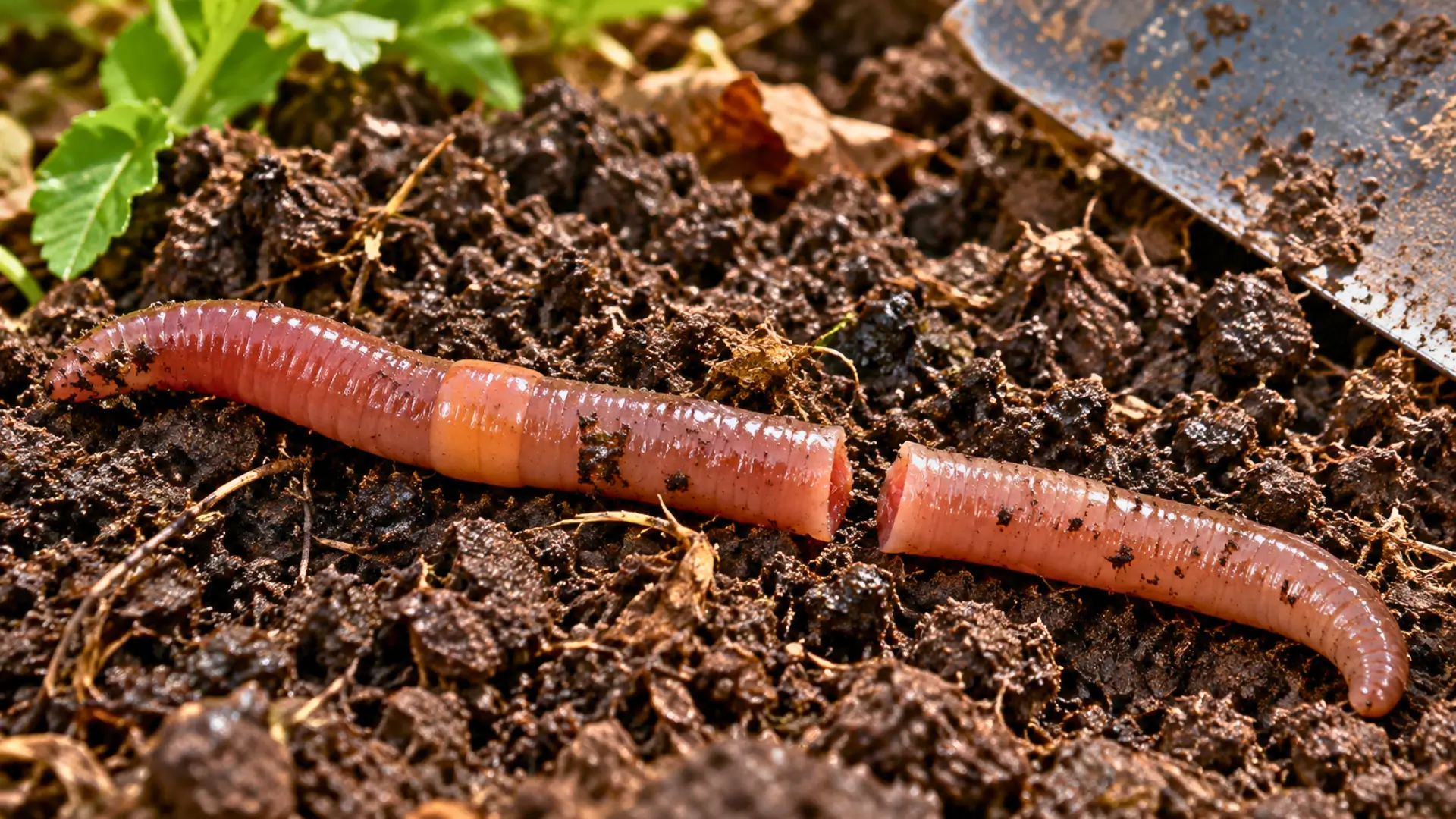
Two segments that wriggle after a spade strike: that’s all it takes to believe a worm could become two animals. Yet behind this apparent feat lies an astonishing anatomy, with five pairs of pseudo-hearts and regenerative abilities that are unevenly distributed.
Why do the two halves of an earthworm keep moving after a cut?
The scene is familiar to gardeners. A shovel sinks into the soil, accidentally bisecting a worm, and the two pieces twist and writhe. It’s hard not to imagine that each half goes on living. This illusion of survival has fed for generations a stubborn belief: a worm cut in two would yield two individuals.
But movement alone does not necessarily mean the animal will survive. The nervous system of the earthworm comprises a chain of ganglia spread along its body. After a serious injury, some segments temporarily retain muscular responses. These impressive contractions, therefore, do not prove healing or the formation of a new organism.
Under its nearly identical rings, the earthworm hides five pairs of pseudo-hearts
At first glance, an earthworm looks like a simple tube made of segments. Yet its internal organization is far from uniform. Near its anterior end lie its mouth, cerebral ganglia, and several essential organs. The clitellum, this visible band in adults, helps identify the side that bears the head.
Even more surprising, many earthworms possess five pairs of contractile vessels, often nicknamed pseudo-hearts. These structures propel blood between the major vessels of the body. Unlike the human heart, they do not form a single pumping chamber. This anatomical peculiarity, documented notably by work from the University of California, explains part of their circulatory operation.
The posterior region also carries muscles, nerves, vessels, and digestive organs. It is therefore not biologically empty. But in common species, it usually lacks all the structures necessary to reconstruct a functional head after a substantial cut. And that is precisely where the myth begins to crumble.
One half can regrow its tail, but this remarkable regeneration has its limits
When a cut occurs far enough behind the vital organs, the forward portion can sometimes heal and regenerate posterior segments. The process requires the formation of new tissues, followed by their orderly organization. However, this repair depends on the species, the location of the injury, and the conditions for survival. No outcome is guaranteed.
The North Carolina State University notes that an ordinary earthworm does not become two worms after a cut. A scientific nuance deserves attention: studies on certain species, notably Eisenia fetida, have shown limited possibilities for regeneration of the head. The claim that all posterior fragments would be systematically unable to regenerate is therefore too categorical.
This old myth also reveals why earthworms deserve protection
Scientists have long studied the remarkable reparative abilities of annelids. A synthesis published in 2021 in the journal Frontiers in Cell and Developmental Biology shows that some species rebuild both ends, while others possess far more modest capabilities. Behind the term regeneration lie mechanisms that differ greatly from one species to another.
This diversity particularly engages developmental biology. Researchers seek to understand how cells participate in the reconstruction of complex tissues, especially nervous and muscular tissues. Observing these phenomena in worms allows exploration of fundamental repair mechanisms, without promising their replication in humans.
In the garden, the consequences are more immediate. By digging their galleries and processing organic matter, earthworms contribute to the structure and fertility of soils. Hurting them unnecessarily would weaken valuable subterranean helpers already facing soil disturbances and certain intensive agricultural practices.

Contact details
Address:
Farmers Forum,
36, Dominick Street,
Mullingar,
Co. Westmeath,
Ireland
Phone:
+353 (0)44 9310206
Or email us:
For technical issues please check out our FAQ's page or email - [email protected]
For general Queries email - [email protected]
Request to add event to our Calendar - [email protected]
Send us your mart reports - [email protected]
Suggestions and feedbacks - [email protected]
News Items / Press Release - [email protected]
To Advertise on Farmers Forum - [email protected]