
September, the month when nests become visible
The nest stayed invisible all summer, hidden fifteen meters up in a linden tree. Leaves begin to fall, the gray sphere appears, and with it comes the question: who is being called, who pays, and was spring trapping really necessary? September and October concentrate most discoveries of Asian hornet nests in France, at the precise moment when the colony reaches its maximum and the pressure on beehives peaks.
The framework has changed. Law no. 2025-237 of March 14, 2025, its implementing decree published at the end of December 2025, and the national plan launched in March 2026 establish for the first time a national anti-hornet organization, with departmental plans and a dedicated budget. What has not changed is what the garden-center traps actually contain. And that is where the issue becomes uncomfortable: the most recent selectivity studies show that a non-selective trap kills between 25 and 1,300 beneficial insects for each Asian hornet captured.
The verdict in one sentence: reporting and having nests destroyed remains the only action whose effectiveness is established, spring trapping only makes sense if selective, coordinated, and pursued for several years, and the garden bottle trap causes more harm than good.
What the 2025 law says, and what actually applies in 2026
Law no. 2025-237 of March 14, 2025 aims to curb the spread of the Asian hornet and to safeguard the beekeeping sector. Its implementing decree, no. 2025-1377, did not appear until December 29, 2025—a delay of more than nine months that the senator who raised the government question deemed excessive, with the risk of losing another beekeeping season. The national plan was opened to public consultation from April 8 to 29, 2026 and received around 300 contributions.
What the system concretely puts in place:
- A nest declaration via prefectural forms, with data centralized at the National Inventory of Natural Heritage. The objective is a national map of predation pressure, department by department.
- Departmental plans that each prefecture must adopt within six months following the national plan, calibrated on four density levels from zero to high.
- A density-differentiated strategy: systematic destruction of nests in areas with low colonization, spring trapping and direct protection of apiaries in high-density zones, where eradication is no longer achievable.
- A funding of 3 million euros per year, via a grant window open on May 1, aimed at local authorities and associations: trapping equipment, electric harps, training of referents, compensation for beekeeping losses.
- Regulation of techniques: bottle and bell-type traps are banned from the official system, nest destruction must be carried out with natural pyrethrins or sulfur dioxide, and paintball destruction is prohibited.
The contentious point raised in the public consultation: 3 million euros per year against beekeeping losses estimated at tens of millions. Many beekeepers deem the budget paltry. The call for free destruction of nests under national solidarity was not retained.
Understanding the cycle before deploying a trap
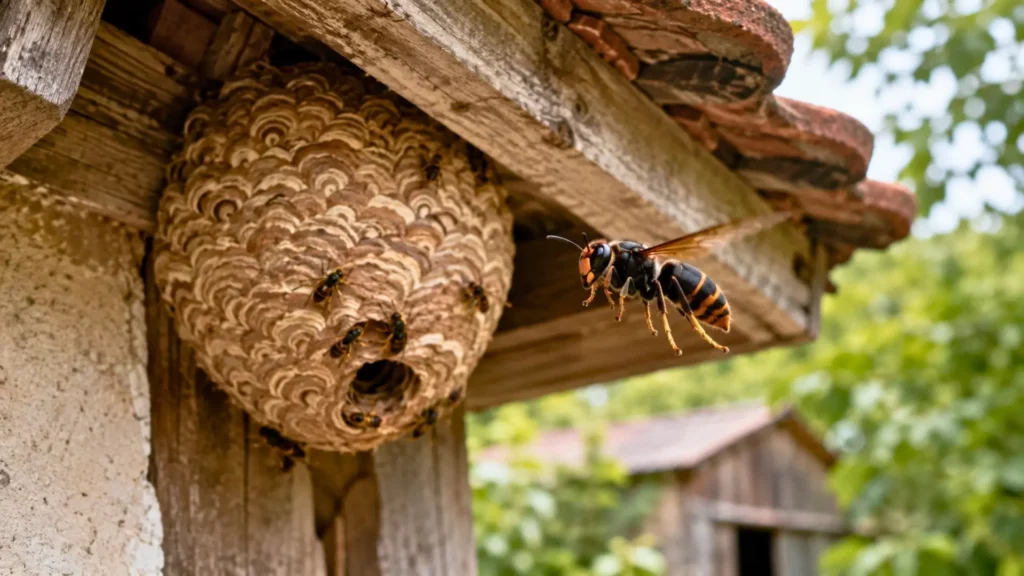
All the debate about trapping hinges on biology. A founding queen emerges from hibernation between February and April and alone builds a primary nest, the size of an orange, often under a garden shed or an overhang. The first workers emerge in late April or May. The colony then moves to a secondary nest, built from June to September and in 73% of cases above ten meters in height, which explains why no one sees it before the leaves fall.
The predation pressure on beehives peaks in September and October. A colony can reach 13,000 individuals, produce about 2,000 workers, and raise roughly 500 future founders before dying in December. The males and sexually mature females appear in October, and the dispersal of founders takes place in November.
On the predation side, the figures set a few things straight. A colony consumes more than 11 kg of insects between March and October, about 97,000 prey items. Its diet is distributed roughly as 38% domestic bees, 30% flies, and 20% wasps. The Asian hornet is therefore not an exclusive predator of bees: it heavily taps the local entomofauna, which makes non-selective trapping even more absurd since it kills the very same insects.
What traps actually capture: the numbers that bother
This is the part that packaging never mentions. Several measurement campaigns weighed and sorted the contents of traps, rather than counting hornets.
The Cévennes National Park is most direct: without a physical selection system, the Asian hornet accounts for only 1 to 4% of the insects captured. In other words, 96 to 99% of what dies in a cut bottle was not the target.
A Swiss trial series conducted in 2024 and 2025 across several cantons, with more than a thousand traps of eight different models, arrived at an even harsher average: for a single Asian hornet captured, about 1,298 non-target insects are also killed. The model-by-model details are instructive.
| Trap model | Asian hornets captured / season | Non-target insects | Notes |
|---|---|---|---|
| VespaCatch (non-selective) | 3.6 | 13,811 | The most “effective” at hornets, and by far the most destructive |
| VespaCatch Select | 0.5 | 1,090 | The selective version cuts damage by 12 and captures by 7 |
| VelutinaTrap | 2.5 | ~100 to 120 | The best measured compromise of the series |
| Ornetin | 0.5 | ~80 to 120 | Very selective, marginal capture |
| 3D Trap | 0.5 | ~80 to 120 | Same |
A French study conducted by Véto-Pharma on ten apiaries in Eure, between July 15 and November 4, arrives at the same order of magnitude: 2.8 hornets captured per apiary for the VespaCatch, 1.5 for a bottle trap, 0.7 for the Jabeprode, and 73,832 insects captured in total, across all traps, mainly diptera, then hymenoptera and lepidoptera.
What is most telling remains the field effect. In Valais, 2 hornets trapped in spring 2024 were followed by 4 nests discovered the following year; 376 hornets trapped in 2025 were followed by 18 nests. In the canton of Vaud, 466 queens trapped in 2025 did not prevent the passage of about 230 nests in 2024 to nearly 1,000 in 2025. The authors’ conclusion is blunt: no trap to date can be considered selective for the Asian hornet, nor effective at capturing significant numbers.
This does not mean nothing should be done. It means that unsystematic, non-selective individual trapping is a practice that costs biodiversity without any measurable effect on hornet populations.
Trap correctly, if you trap
Trapping makes sense in two precise cases: in a low-density zone, within a coordinated departmental plan, and in front of a hive during the predation period. In these two cases, technical rules are documented.
Physical selectivity first
A usable trap has 5 mm escape holes, letting out small insects, and an entrance hole of about 9 mm, large enough for the Asian hornet. Grated nets meet this specification; a pierced bottle does not.
The bait
The reference mix is three parts: beer, white wine, syrup. Alcohol reduces bee captures, which they cannot tolerate. No marketed attractant today is truly selective; you must choose a bait that limits damage, not one that avoids it.
Maintenance
The attractant is renewed every 8 to 10 days, and every 3 to 4 days in hot weather. The trap is not washed: dead hornets emit pheromones that attract their conspecifics. A trap left for three weeks becomes a trap for everything but hornets.
Density and timing
A trap every 350 meters, placed between 50 cm and 1.50 m high, in sun in the morning and shade in the afternoon. The usable window runs from early spring to mid-May, when the temperature approaches 15 °C; the national plan uses a trigger threshold of 12 °C for initiation. From June onward, captures mostly target the European hornet, a protected and useful species. The device only makes sense if renewed for at least four consecutive years in the same territory.
To give a sense of what a well-conducted collective action yields: the Gard Beekeeping Health Defense Group trapped 1,400 founding queens between March and June in a single campaign. It is a network result, not a garden in isolation.
Available models
Select nets traps range from 15 to 40 € per unit: a two-trap set of Vespa Velutina selective traps, selective traps manufactured in Normandy, or the VespaCatch kit with attractants, keeping in mind that you should aim for the Select version, not the standard one. Beekeepers will find professional lines at Icko Apiculture and Thomas Apiculture.
Protecting a hive: what really works
In front of beehives, direct protection yields much better results than trapping. Three devices are endorsed by the national plan.
The electric harp is the most effective: an energized wire grid placed in front of the hives that eliminates up to 200 hornets per day at the height of predation season. Expect 400 to 900 € depending on size and autonomy. It is an investment for a hive, not for a garden.
The housings for the hornets and the entrance reducers keep the hornet out of the flight board while letting bees pass. A few tens of euros per hive, reasonable effectiveness at the entrance predator, without affecting the hovering that exhausts the colony.
A point rarely stated: beyond the bees killed, it is the predation stress that does the most damage. A besieged colony stops foraging, fails to build stores, and dies the following winter without a single hornet entering the hive.
Find, report and have a nest destroyed
This is the most useful action of this dossier. A nest destroyed in September prevents up to 500 future founding queens from dispersing in November.
Signing up is done on the platform of the National Museum of Natural History, frelonasiatique.mnhn.fr, and now also via the prefectural forms provided by the decree. The data feed the national map used to calibrate the departmental control plans.
Having it destroyed is done by a specialized company. Firefighters intervene only for real danger to people. The prices observed in 2026 are:
| Situation | Observed price | Remark |
|---|---|---|
| Nest accessible, low height | 80 to 150 € | Hedge, garden shed, under a low roof |
| Nest high up, telescopic pole | 150 to 250 € | The most frequent case in September |
| Hard to access, basket lift required | 250 € and up | Tree 15 to 20 m, complex roof |
Who pays: the owner of private land, the landlord in rental situations since the building belongs to them, the municipality on public land. Home insurance generally does not cover it, unless there is a specific clause or an imminent danger situation. Some municipalities and department councils subsidize all or part of the intervention, and beekeeping unions sometimes participate: a call to the town hall before ordering is rarely time wasted.
What not to do
- Destroy a nest yourself. A disturbed colony attacks in groups over tens of meters. Serious accidents almost always occur during attempts by individuals to destroy nests.
- Burn, spray with gasoline, or shoot it. The nest does not burn properly, hornets disperse and rebuild, and the risk of fire or injury is real.
- Use a bottle trap. Prohibited in the official system, and responsible for the bulk of non-target insect captures documented above.
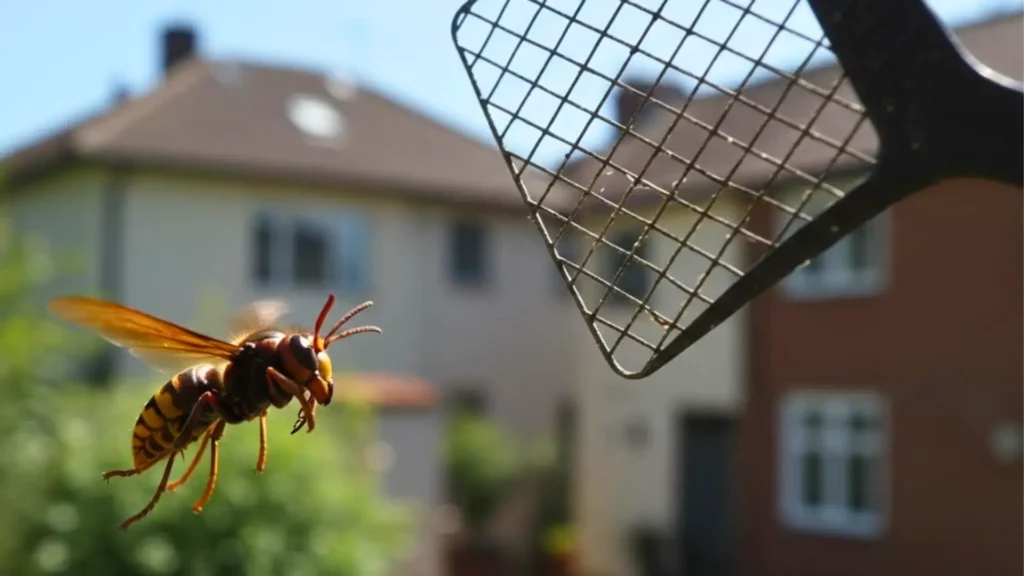
- Trap in summer and autumn in your garden. After June, most captures concern the European hornet, a useful species that should not be confused—it is larger, with a yellow abdomen striped in black and brown legs, whereas the Asian hornet has an orange face, a black thorax and yellow-tipped legs.
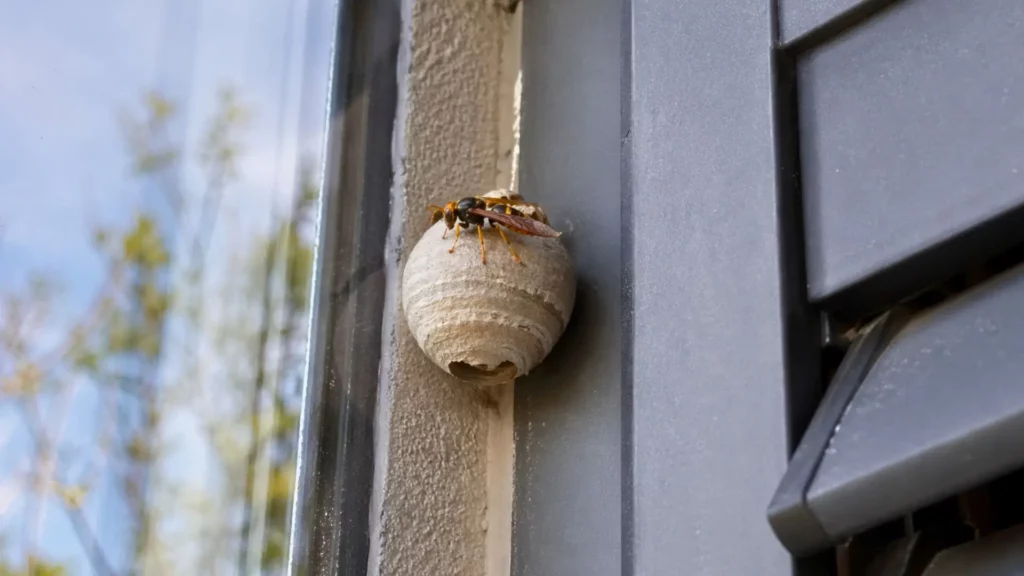
- Confuse it with a wasp nest. A wasp nest on a roof does not justify the same means or the same costs.
Where France stands region by region
| Context | Situation | Priority |
|---|---|---|
| Nouvelle-Aquitaine, Occitanie, Pays de la Loire | Longstanding colonization, high density | Direct protection of hives and destruction of nests; eradication is no longer the objective |
| Brittany, Normandy, Centre-Val de Loire | Medium to high density, growing pressure | Systematic destruction and coordinated spring trapping by the departmental plan |
| Île-de-France, Hauts-de-France | Rapid urban spread, nests frequent in built environments | Reporting, destruction, and vigilance on primary nests in spring in garden sheds |
| Grand Est, Bourgogne-Franche-Comté, Auvergne-Rhône-Alpes | Active front of colonization | Area where early destruction has the greatest effect: every nest destroyed really counts |
| Provence-Alpes-Cuite d’Azur | Colonization underway, plus oriental hornet in Marseille | Double vigilance and correct species identification before any action |
| Corse, mountainous areas | Low to zero density depending on altitude | Immediate reporting of any observation: this is where early detection pays off the most |
And now, the oriental hornet
A second actor has entered the scene. Vespa orientalis, the oriental hornet, was detected in France for the first time on September 22, 2021 in the Cabucelle district of Marseille. The species is established in Italy, Greece and Spain; the mode of introduction remains undetermined.
Its profile differs markedly from the Asian hornet: nests about three times smaller, located in ground cavities rather than up high, colonies of around a thousand individuals, and a shorter cycle. It also preys on domestic bees. A practical consequence for equipment: traps designed for the oriental hornet require 10 mm openings, compared with 9 mm for the Asian hornet. Observations should be reported to the Museum at [email protected].
Frequently asked questions
Is the Asian hornet bottle trap effective?
No, and it has been banned from the official scheme since the December 2025 decree. Without a physical selectivity system, the Asian hornet accounts for only 1 to 4% of captured insects according to the Cévennes National Park. The rest consists of useful insects, including pollinators.
Who pays for destroying an Asian hornet nest?
The landowner on private property, the landlord in rental situations, the municipality on public land. Home insurance generally does not reimburse. Some municipalities and some departments subsidize all or part of the intervention: you must call the town hall before ordering.
How much does it cost to destroy an Asian hornet nest in 2026?
Between 80 and 150 € for an accessible nest, 150 to 250 € for a high nest treated with a pole, and more than 250 € when a basket lift is required. The price mainly depends on height and accessibility, very little on nest size.
When should you trap founding Asian hornet queens?
From the start of spring to mid-May, when temperatures reach 12 to 15 °C. After June, captures mainly concern the European hornet, a useful species. Trapping only makes sense if selective, coordinated at the territory level, and renewed for at least four consecutive years.
How to report an Asian hornet nest?
On the platform of the National Museum of Natural History, frelonasiatique.mnhn.fr, and via the prefectural form of your department since the implementing decree of the 2025 law. Reports feed the national map used to calibrate the departmental control plans.
What to do if you find an Asian hornet nest in your garden?
Do not approach within five meters, do not spray anything, report the location, then call a specialized company. A disturbed colony attacks in groups over tens of meters, and most serious accidents occur during attempts by individuals to destroy nests.
Verdict
Three actions have demonstrated effects: reporting nests, having them destroyed before November, and physically protecting beehives when you own them. They cost almost nothing for an individual, and they tackle the only moment in the life cycle when the population is truly vulnerable—the dispersal of the 500 founding queens from a mature nest.
The trapping, on the other hand, has become a subject to approach with caution. Recent measures are convergent and not flattering: between 1,298 non-target insects per hornet captured in Swiss trials and 73,832 insects recorded in a single French campaign, the ecological bill of mass trapping far outweighs its yield. The national plan has incorporated this by reserving spring trapping for high-density zones, under the condition of selectivity, coordination, and duration.
The most defendable position for a private individual in September 2026 thus boils down to this sentence: raise your eyes to the trees as they shed their leaves, report what you see, and leave the syrup bottle where it is.

Contact details
Address:
Farmers Forum,
36, Dominick Street,
Mullingar,
Co. Westmeath,
Ireland
Phone:
+353 (0)44 9310206
Or email us:
For technical issues please check out our FAQ's page or email - [email protected]
For general Queries email - [email protected]
Request to add event to our Calendar - [email protected]
Send us your mart reports - [email protected]
Suggestions and feedbacks - [email protected]
News Items / Press Release - [email protected]
To Advertise on Farmers Forum - [email protected]