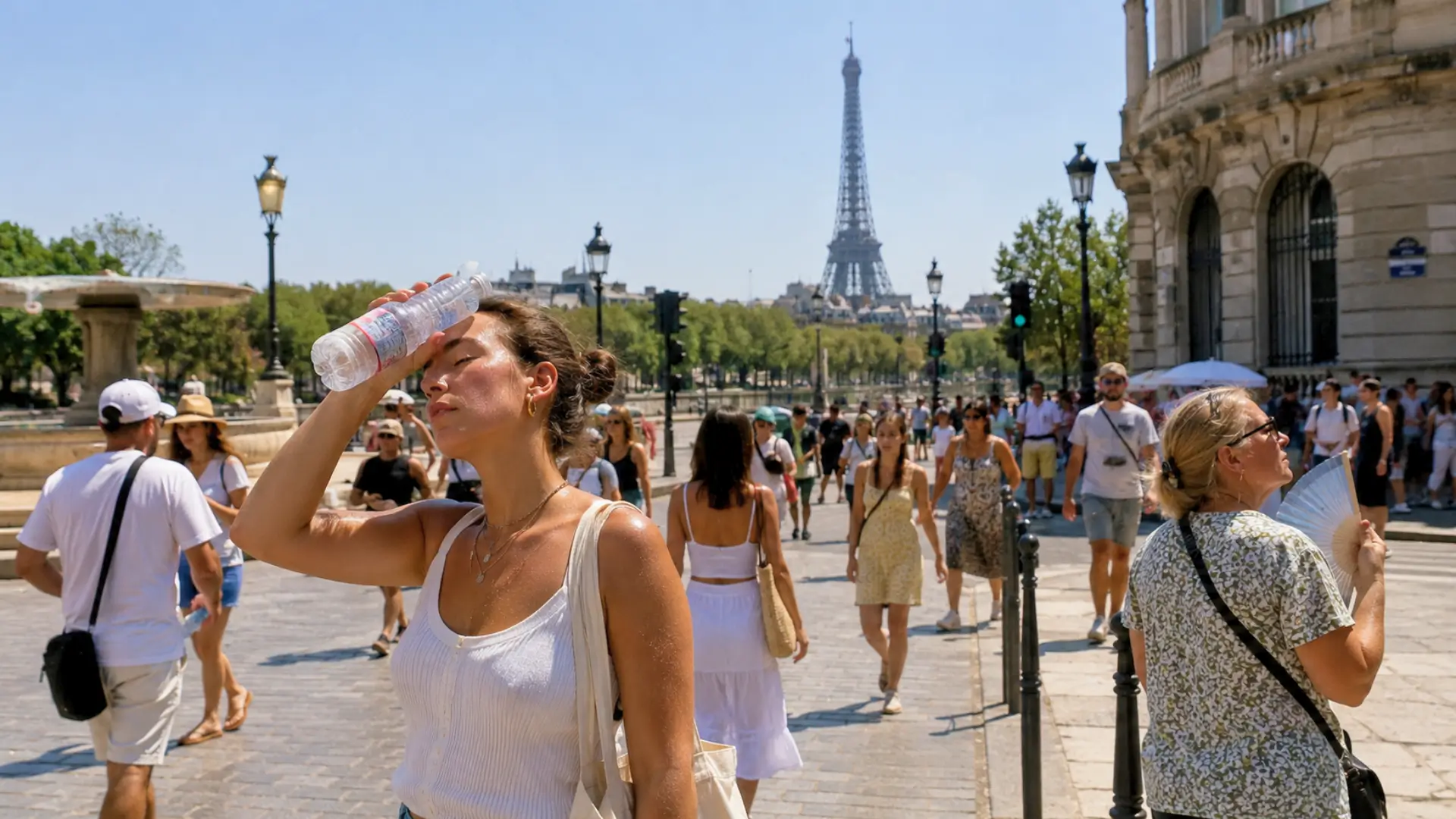
Europe is warming faster than the rest of the globe. Behind this acceleration lies a sequence of factors: drying soils, an increasingly overheated Mediterranean, retreating snow, and persistent anticyclones. How do these mechanisms progressively turn each summer into ground ripe for record heat?
Continental Geography and High Latitudes Amplify Warming
On a map, Europe appears surrounded by water. Yet its climate remains largely governed by the vast continental landmass of Eurasia. And the land heats up more quickly than the oceans: it stores heat less efficiently and has less water to evaporate to cool itself. A first, rather troubling advantage in this race toward higher temperatures.
The continent’s position further worsens the picture. Europe extends into high latitudes, where warming is amplified. Copernicus now estimates its warming at around 2.5 °C since the preindustrial era, i.e., more than double the global average. The East, the Center, and the European Arctic rank among the most affected regions.
In the south, the Mediterranean no longer always serves as a natural climate regulator. When it becomes abnormally hot, it releases energy and moisture into the atmosphere, particularly during the night. Temperatures then fall back only slowly. These more frequent tropical nights fatigue bodies, heat cities, and reduce the relief offered after scorching days.
Persistent Anticyclones Strengthen Heat Waves and Dry Out Soils
An anticyclone is sometimes portrayed as a promise of clear skies. In hot periods, it resembles more of a weather atmospheric lid. The air descends, compresses, and heats up. Clouds disappear, the sun scorches the ground, and evaporation diminishes as the land dries. All the available energy then goes into heating the air.
This mechanism can quickly spiral. A moist soil dissipates some heat by evaporating its water. A dry soil, by contrast, heats up almost like a mineral slab. Each rainless day prepares the next. Heat waves become longer and more intense, a phenomenon the IPCC attributes clearly to human-caused warming.
Melting Snow and Ice Lower the Albedo and Accelerate Warming
Europe has a particularly vulnerable neighbor: the Arctic. Ice and snow reflect a large portion of solar radiation. When they melt, darker surfaces are revealed that absorb more energy. This feedback loop, known as Arctic amplification, helps make high latitudes the region where warming is fastest.
Researchers are also examining potential effects of this transformation on the jet stream, that ribbon of fast winds guiding disturbances. Some highly wavy configurations can slow the movement of air masses and set persistent weather patterns in place. Yet the link remains complex: the Arctic does not, by itself, explain every blockage observed over Europe.
The retreat of the snow produces a similar phenomenon in the Alps, the Pyrenees, and the Scandinavian highlands. In spring, exposed ground absorbs solar radiation earlier. The mountains thus lose part of their reflective power, while glaciers and ecosystems come under mounting pressure. The landscape that once whitened Europe now contributes less to its cooling.
The Decline of Aerosols Reveals Warming That Was Previously Partially Masked
Since the 1980s, European policies have sharply reduced pollution particle emissions. The health benefits are substantial. But some aerosols also reflected sunlight and favoured cloud formation. Their decrease therefore unveiled a portion of the warming that had been hidden. A clearer sky lets more radiation reach the soils.
All these factors do not operate in isolation. They compound with the accumulation of greenhouse gases and make extreme events more likely on a continent already fragile. Copernicus confirms that Europe is the fastest-warming continental region, while the European Environment Agency warns about health, agricultural, water, and economic risks. The real unknown now concerns our pace of adaptation.

Contact details
Address:
Farmers Forum,
36, Dominick Street,
Mullingar,
Co. Westmeath,
Ireland
Phone:
+353 (0)44 9310206
Or email us:
For technical issues please check out our FAQ's page or email - [email protected]
For general Queries email - [email protected]
Request to add event to our Calendar - [email protected]
Send us your mart reports - [email protected]
Suggestions and feedbacks - [email protected]
News Items / Press Release - [email protected]
To Advertise on Farmers Forum - [email protected]