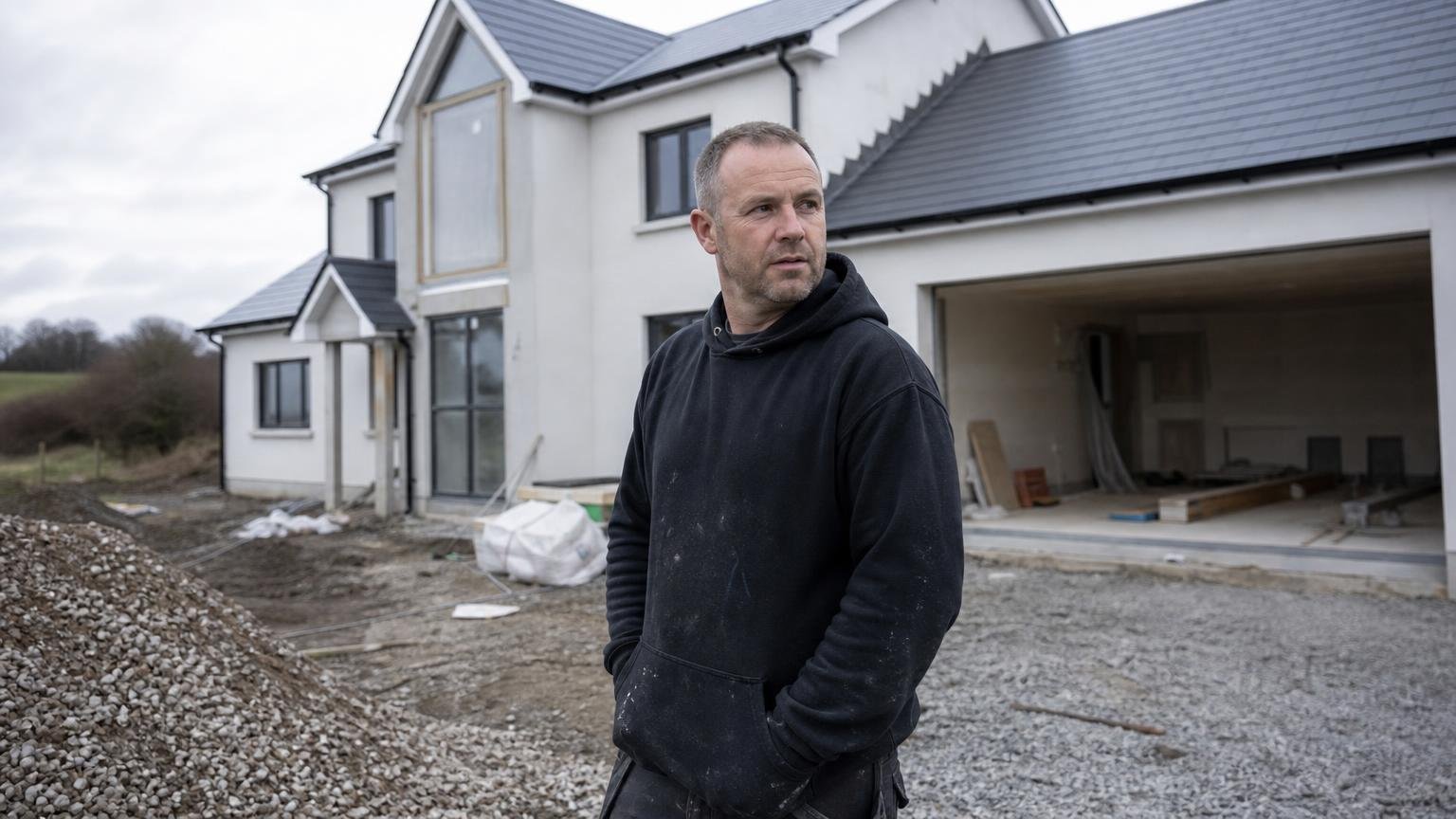
He landed before dawn, hands still nicked with work, eyes full of scaffolds and skyline. The taxi took the long road by the bog, mist lifted, and he counted fields, then gates. Sixteen years of city noise dissolved into a lane of silence and birdsong. He was back to raise something small, something stubborn: four walls that knew his name.
Neighbors waved. Word traveled, as it always does. “He’s home to build,” they said, a mix of pride and wonder. He nodded, kept moving, and touched the gatepost like a promise, like a start.
The road out and the road back
He left at twenty, with a holdall of tools and the address of a cousin in Kilburn. London gave him work and winter after winter. He hauled steel, mixed mud, watched towers climb, listened to cranes sing.
“On a good day the city felt limitless,” he said. “On a bad day it felt hollow.” The pay was steady, the routine brutal. He learned the language of fixings, of snags, of deadlines that didn’t flinch.
Then a noticeboard photo: a cottage by water, roof slumped, grass ankle-high. The picture would not leave, not fade. “I wanted something mine,” he said, “not bigger—just more honest.”
A blueprint drawn in pencil and patience
He opened a notebook and sketched corners, then light. No drama, no statement stair, just lines that breathe. He drew a bench under a window, the stove tucked safe. Bedrooms small, walls thick, the kind that hold heat and secrets.
Planning took months, not days. He learned the grammar of setbacks, the nuance of nerves. “It’s a dance with paper,” he laughed, “and paper loves to lead.” Approval finally came, thin envelope, big relief.
Tools, timber, and the weather’s opinion
He set string on pegs, checked diagonals, broke ground. Clay offered its truth, heavy and honest. Friends arrived with flasks and stories, lifted blocks, lifted mood. “Build slow,” a neighbor advised, “the land will tell you when.”
He chose timber for touch, lime for breath. No plastic drama, no glossy tricks. He chased airtight, not airless; warm, not wheezed. “I’ve seen façades that feel tired before they’re done,” he said. “I wanted quiet materials with backbone.”
A house stitched from memory
In the kitchen he planted a sill wide enough for elbows and cups. “My mother would keep bread there,” he smiled. The hallway bends, not boasts; you turn and meet light. Each choice nodded to people, to places he missed in the metallic glow of long shifts.
He carried a door he’d found in a skip, sanded it thin, found oak beneath paint. Hinges from a farm shed, handle warmed by a hundred palms. “Secondhand is first-rate when it has story,” he said. “You can hear a house breathe if you give it lungs.”
Cost, craft, and what was saved
Money behaved like weather—fair, then squalls. He tracked every euro, every receipt. Some days he traded time for savings; other days he bought time with help.
Here’s what he says made the biggest difference:
- Keep the plan simple and the envelope tight; complexity multiplies cost and delay.
- Spend on what you touch every day—handles, floors, switches—and forgive the unseen brand.
- Sequence is everything; move once, cut once, lift once—waste is often motion.
- Hire specialists for the parts that need guarantees; pride can be expensive.
- Leave room for future changes; rigor beats rigidity.
“Budget is a language,” he said. “It tells you what the house can’t be, so the rest can shine.”
Learning to live while building
He rented a small caravan, learned the rhythm of damp socks and small stoves. In the evenings he wrote lists, three items max, and slept like a stone. Weekends brought cousins, one with a level, one with a song.
“Some days were just mud and stubborn nails,” he said. “But even then I could step back and see the line of the roof against the sky.”
What weather taught him
The Atlantic kept its say. Wind tested every seal, rain searched for every foolish gap. He waited when he should, hurried when he must, learned to read a cloud like a clock.
“Climate isn’t a trend here,” he said. “It’s a boss.”
Opening the front door
The first night came quietly. A kettle sighed, a chair creaked. He watched the stove’s orange, counted the ticks of cooling metal. No skyline, no sirens—just a fox in the ditch and moon on slate.
“I didn’t build a castle,” he said. “I built a sentence I can read every day.”
In the morning he stood by the hedge, steam from a mug blurring the world’s straight edges. The house sat right, not loud, a little to the left of perfect. The kind of place you pass and think, someone cares for that corner, that light.
Work remains. A wall to stone, a path to settle. But the big thing has a pulse, and it’s never going away. Sixteen years taught him how to scar, and how to heal. Here, back on the lane where rain meets bog, he learned something else: you can spend a life building for others, or you can dare to build the thing that finally builds you.

Contact details
Address:
Farmers Forum,
36, Dominick Street,
Mullingar,
Co. Westmeath,
Ireland
Phone:
+353 (0)44 9310206
Or email us:
For technical issues please check out our FAQ's page or email - [email protected]
For general Queries email - [email protected]
Request to add event to our Calendar - [email protected]
Send us your mart reports - [email protected]
Suggestions and feedbacks - [email protected]
News Items / Press Release - [email protected]
To Advertise on Farmers Forum - [email protected]